
S-PM800 Vacuum Mixer for Coating Slurry: Void-Free Mixing for Conformal Coating, Potting and Silver Paste
Coating voids, pinholes and weak die-attach bonds usually start on the mixing bench, not at the dispenser. The S-PM800 Vacuum Mixer for Coating Slurry from Southern Machinery combines rotation and revolution mixing with a high-power vacuum pump so high-viscosity, filler-loaded materials can be homogenised and de-aerated in one repeatable operation. This guide covers what the machine is used for, which material families it is documented for, how it fits into an SMT and THT PCB assembly line, the parameters buyers must confirm before ordering, and the quality and throughput case for moving material preparation off manual stirring.
Sep 19, 2026 · Updated Sep 19, 2026 · Southern Machinery
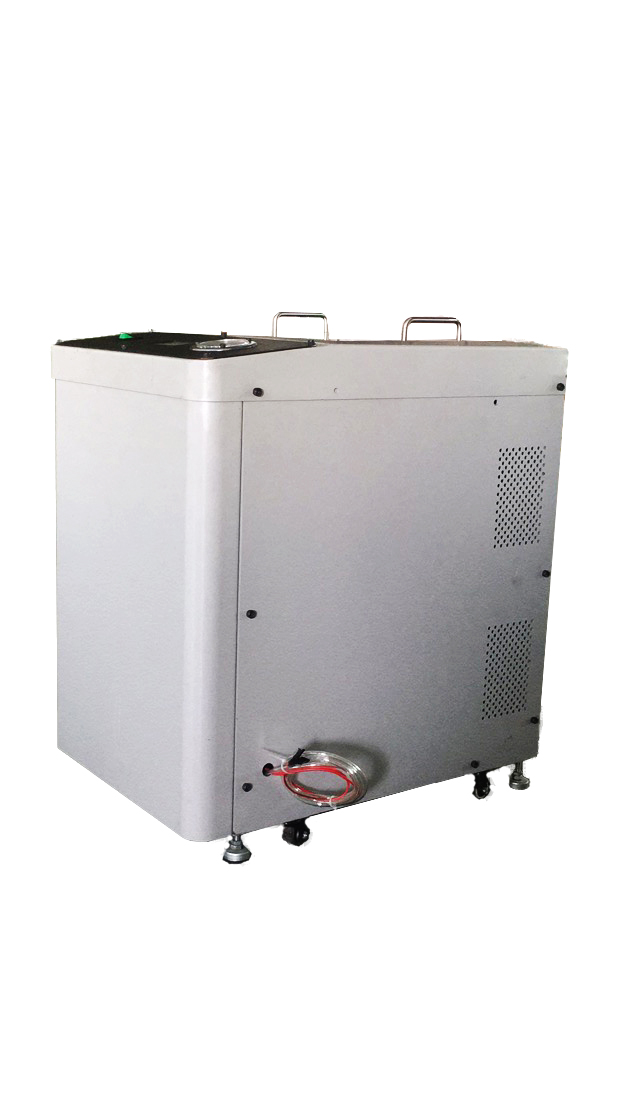
S-PM800 Vacuum Mixer for Coating Slurry: Void-Free Mixing for Conformal Coating, Potting and Silver Paste
Most coating, potting and die-attach defects on a PCBA are not created by the dispensing head. They are created earlier — in the container, before the material ever reaches the board. Air entrained during transfer, filler that settles out of suspension, and high-viscosity material that never fully homogenised all leave the mixing bench as a defect that only becomes visible later, as a void, a pinhole, a weak bond line or an inconsistent coating thickness.
The S-PM800 Vacuum Mixer for Coating Slurry from Southern Machinery addresses that upstream step. It combines rotation/revolution mixing with a high-power vacuum pump, so high-viscosity and filler-loaded materials can be homogenised and de-aerated in one bench operation instead of being stirred by hand and applied with whatever air survived the transfer.
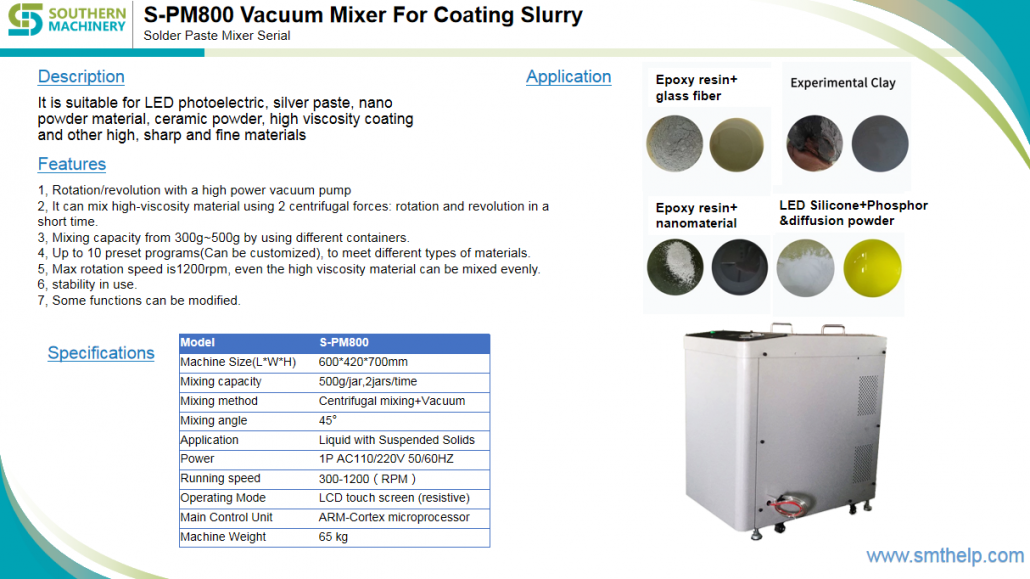
S-PM800 Vacuum Mixer for Coating Slurry — rotation and revolution mixing combined with a high-power vacuum pump for high-viscosity coating and paste materials. Photo: Southern Machinery.
What is the S-PM800 Vacuum Mixer for Coating Slurry?
The S-PM800 is a vacuum mixing unit for coating slurries and high-viscosity electronic materials. Southern Machinery publishes it as suitable for LED photoelectric materials, silver paste, nano-powder material, ceramic powder, high-viscosity coating and similar high-precision fine materials.
It is not a solder-paste-only machine and it is not a simple paddle stirrer. The published mechanism is rotation and revolution combined with a high-power vacuum pump, which is what allows a heavily filled or viscous material to be homogenised in a short mixing cycle rather than a long, heat-generating one.
Rotation and revolution: two centrifugal forces, one container
Southern Machinery's published feature list states that the S-PM800 mixes high-viscosity material using 2 centrifugal forces — rotation and revolution — in a short time. A single-axis stirrer can only shear the material it can reach; the rotation/revolution motion in the S-PM800 is what the manufacturer credits for reaching the full volume of the container rather than the region around the paddle.
What the vacuum pump adds
The vacuum pump is the part of the specification that matters most to coating and potting engineers. Vacuum-assisted mixing is the standard process answer to entrained air: reduce the pressure above the material, and the gas that would otherwise end up as a void in the cured coating or encapsulant has a path out before dispensing. For silver paste, thermal paste, epoxy and filled coatings, that is a direct line to void reduction on the finished assembly.
Published specifications in brief
Everything in the following list comes from Southern Machinery's own product documentation for the S-PM800:
- Mixing drive: rotation/revolution with a high-power vacuum pump
- Mixing capacity: 300 g to 500 g, depending on the container used
- Preset programs: up to 10, customisable, to suit different material types
- Maximum rotation speed: 1200 rpm
- Customisation: some functions can be modified
- Stated material families: LED photoelectric materials, silver paste, nano-powder material, ceramic powder, high-viscosity coating and similar fine materials
What Southern Machinery does not publish
Southern Machinery does not publish overall machine dimensions, machine weight, supply voltage, power rating, achievable vacuum level, or a specified mixing cycle time for the S-PM800. Those figures are not repeated here in any form, and every one of them should be taken from a current datasheet or a written configuration confirmation before you place an order. The section Key selection parameters to confirm before you buy below is written around exactly those gaps.
What is this machine used for?
Q: What is the S-PM800 used for?
A: It is used to mix, homogenise and vacuum de-aerate coating slurries and other high-viscosity electronic materials before they are dispensed, printed, potted or applied to a PCB or PCBA. It replaces manual stirring on the material-preparation bench.
Q: Which materials is it documented for?
A: Southern Machinery publishes it for LED photoelectric materials, silver paste, nano-powder material, ceramic powder and high-viscosity coating. The product page's material tags additionally list solder paste, electronic paste, epoxy resin, ink, silver paste and thermal paste. Because filler loading and viscosity vary so widely between these materials, confirm your specific material with Southern Machinery before ordering.
Q: Is it a solder paste mixer?
A: Solder paste is one of the listed material families, and Southern Machinery also offers dedicated solder paste preparation equipment — the S-PM680 touch-screen solder paste mixer, the S-SPM01 solder paste mixer and the S-SPW01 solder paste warmer. The S-PM800's distinguishing role is high-viscosity and coating-slurry work, where the vacuum pump and the rotation/revolution motion matter most.
Q: Does it go in-line on a conveyor?
A: It is preparation equipment, not a conveyor-mounted module. It sits in the material-preparation and process-support area and its output feeds the processes that consume mixed material. Take the exact workflow, bench footprint and material-transfer arrangement from Southern Machinery during configuration.
Q: Who normally buys it?
A: EMS and ODM factories, LED and optoelectronics manufacturers, power supply and automotive electronics producers, and any operation that coats, pots or encapsulates assemblies and has decided that manual mixing is no longer an acceptable process variable.
Typical applications
- LED and optoelectronics: LED photoelectric materials, phosphor and encapsulant systems, luminous-character and lighting production where coating consistency is visible in the final product
- Silver paste and die-attach work: conductive adhesives and sinter pastes where entrained air becomes a bond-line defect
- Thermal interface materials: thermal paste and gap-filler slurries that must be homogeneous before dispensing
- Potting and encapsulation: epoxy resin systems where voids become long-term reliability risks in automotive, industrial and outdoor assemblies
- High-viscosity coatings: protective and conformal coating slurries, including filled and ceramic-loaded systems
- Nano-powder and ceramic-powder materials: fine-particle systems where agglomerates do not break down under a simple stir
- Ink and electronic paste: conductive and functional inks where settling out of suspension is a changeover failure mode
How the S-PM800 fits a complete PCB assembly line
Southern Machinery supplies SMT, THT, Wave Soldering, board handling and inspection equipment as line-level solutions, and process-support machines such as the S-PM800 are how the material side of that line stays under control. A useful way to place it:
- Material preparation (S-PM800 here). Coatings, slurries, silver paste, thermal paste and resin systems are mixed and vacuum de-aerated as a controlled, repeatable bench operation. This is the step that determines whether the material arriving at the next process is homogeneous and air-free.
- Application. Mixed material flows to dispensing, conformal coating, potting or brush/print stations — and, for the solder-paste families, to stencil printing ahead of the SMT line where the Pick and Place machines, SPI, Reflow Oven and AOI stations do their work.
- Assembly and joining. For through-hole content, the mixed and prepared material families support the same boards that pass through THT auto insertion and Wave Soldering.
- Verification. Post-application inspection — AOI, X-ray for void analysis on potting and BGA work, AOI after Wave Soldering — is where a de-aeration problem would previously have been discovered. Fixing it at step 1 is the point.
- Traceability. Where a factory runs an MES, the mixing record (program used, material batch, operator) is the process-support data that sits alongside the line data. Confirm what data capture your intended configuration supports during specification.
Southern Machinery is based in Shenzhen and has served 237+ customers worldwide since 2011, so the S-PM800 is normally specified as one element of a broader SMT/THT equipment package rather than as an isolated purchase.
Key selection parameters to confirm before you buy
The published specification for the S-PM800 covers the mixing concept, the capacity range, the preset programs and the maximum speed. Everything below must be confirmed in writing for your own material and facility, because Southern Machinery does not publish fixed values for it:
- Material system: your exact coating, silver paste, thermal paste, epoxy or paste chemistry, including filler type and loading
- Viscosity: the working viscosity range the configuration must handle — high-viscosity capability is claimed, but confirm your value
- Container format: jar/syringe/container type and size, so the mixing action suits your container and your 300 g–500 g batch size
- Vacuum requirement: the vacuum level your material needs to release entrained gas, and confirmation of what the pump in your configuration achieves
- Rotational speed: your required speed versus the published 1200 rpm maximum
- Programs: how many material recipes you need to store and switch between, against the published capacity of up to 10 customisable presets
- Cycle time: the mixing time your production tact requires — no cycle time is published, so request it against your material
- Footprint and mass: machine dimensions and weight are not published; request a dimensional drawing and weigh the bench-space impact
- Utilities: supply voltage, frequency and power draw for your site — request the electrical specification for your configuration
- Wetted parts: material-contact surface compatibility and cleanability between material changeovers
- Consumables: containers and any material-contact parts you will need in routine operation
- Documentation: any certification or declaration your customer or region requires — request it rather than assuming it
- Safety: operator protection, interlock behaviour and the training that Southern Machinery provides with the unit
- Customisation: which functions your process needs modified, since Southern Machinery states some functions can be modified
ROI, quality and throughput
Quality. The S-PM800's value is measured in defects that never happen. Voids in potting and encapsulation, pinholes in conformal coating, inconsistent coating thickness and weak die-attach bond lines are all failure modes that trace back to entrained air, agglomerates or inconsistent hand mixing. A vacuum mixing step removes the operator-to-operator variation that makes those defects hard to reproduce, investigate and eliminate. X-ray void analysis on potted or BGA assemblies is where the improvement usually becomes measurable first.
Throughput. Mixing is a batch operation, and the throughput question is not how fast one batch mixes — it is whether material is ready when the line needs it. The line's own output is measured elsewhere, in CPH at the placement machines, and in boards per hour through Wave Soldering; a material-preparation bottleneck shows up as starvation at those stations rather than as a slow machine. Because the S-PM800 is driven by stored programs rather than by operator technique, a batch can be prepared to the same recipe every time and staged ahead of demand. The published preset capacity of up to 10 customisable programs is what makes multi-material, high-mix production practical without retraining operators on each recipe.
Cost. The commercial case rests on three lines: scrap and rework avoided when coating and potting defects fall, labour removed from a manual bench task that consumes skilled operator time, and material loss reduced when containers are handled consistently instead of being over-stirred or partially wasted. Quantify these against your own defect data and bench labour rather than accepting any generic saving estimate.
Support. Southern Machinery backs equipment with spare parts supply, repair services, retrofit and upgrade kits, and operator training — relevant here because a mixing recipe is only reproducible if the people running the bench have been trained on it.
FAQ
What is the S-PM800 Vacuum Mixer for Coating Slurry? It is a vacuum mixing machine from Southern Machinery for coating slurries and high-viscosity electronic materials. It uses rotation and revolution together with a high-power vacuum pump to homogenise and de-aerate material in one bench operation.
What is the mixing capacity of the S-PM800? Southern Machinery publishes a mixing capacity of 300 g to 500 g, using different containers. Batch size therefore depends on the container you choose.
What is the maximum rotation speed? The published maximum rotation speed is 1200 rpm. Southern Machinery states that at this level even high-viscosity material can be mixed evenly.
How many programs can it store? Up to 10 preset programs, which Southern Machinery states can be customised to meet different types of materials.
Does every material need vacuum mixing? No. Vacuum is the process lever for materials that entrain air — filled coatings, potting resins, silver paste and thermal paste. Whether you need it, and at what vacuum level, depends on your material chemistry; confirm it rather than assuming.
Can the machine be customised? Southern Machinery states that some functions can be modified and that preset programs are customisable. Describe your process requirement during configuration.
Where can I see the machine and its documentation? Machine images and photo albums are published at ph.smthelp.com, and product catalogues, manuals and PDF datasheets are available at file.autoinsertion.com.
Get a configuration recommendation from Southern Machinery
Shenzhen Southern Machinery Sales And Service Co., Ltd has supplied SMT and THT PCB assembly automation equipment to 237+ customers worldwide since 2011. Beyond the S-PM800, the company builds and supports SMT lines, THT auto insertion, Wave Soldering, board handling, cleaning and coating, and inspection equipment — so a mixing requirement can be specified as part of the whole process rather than in isolation.
Southern Machinery also supplies the consumables and spares that keep that equipment running, including SMT Nozzle and Feeder spare parts, machine repair and overhaul services, retrofit and upgrade kits, and operator training.
Send your material system, working viscosity, container format and required batch size to jasonwu@smthelp.com or +86 13602562576, and Southern Machinery will confirm the S-PM800 configuration that matches your process, including the vacuum performance, utilities and dimensional data for your site.
- Browse product catalogues, manuals and PDFs: https://file.autoinsertion.com
- View machine images and albums: https://ph.smthelp.com
- Company website: https://www.smthelp.com
- LinkedIn: https://cn.linkedin.com/in/smtsupplier
Specifications quoted in this article are those published by Southern Machinery for the S-PM800 Vacuum Mixer for Coating Slurry. Values not published by the manufacturer — including dimensions, weight, electrical supply, vacuum level, cycle time and certifications — are deliberately not stated and must be confirmed in writing for your configuration.
Comments