
S-PM680 Touch Screen Solder Paste Mixer: Automated Paste Preparation for SMT and EMS Production
Solder paste is the most process-sensitive material on an SMT line, yet it is often mixed by hand with a spatula. The S-PM680 Touch Screen Solder Paste Mixer from Southern Machinery turns paste preparation into a controlled process step, with digital speed and time settings, selectable positive, negative and alternating rotation modes, intelligent diagnostics and interlocked safety. This guide covers what the machine does, the bridging and voiding defects that inconsistent manual mixing causes, where it fits in a complete SMT and THT line, how it compares with the S-SPM01, S-PM800 and S-SPW01, and the parameters buyers should confirm before specifying one.
Sep 18, 2026 · Updated Sep 18, 2026 · Southern Machinery
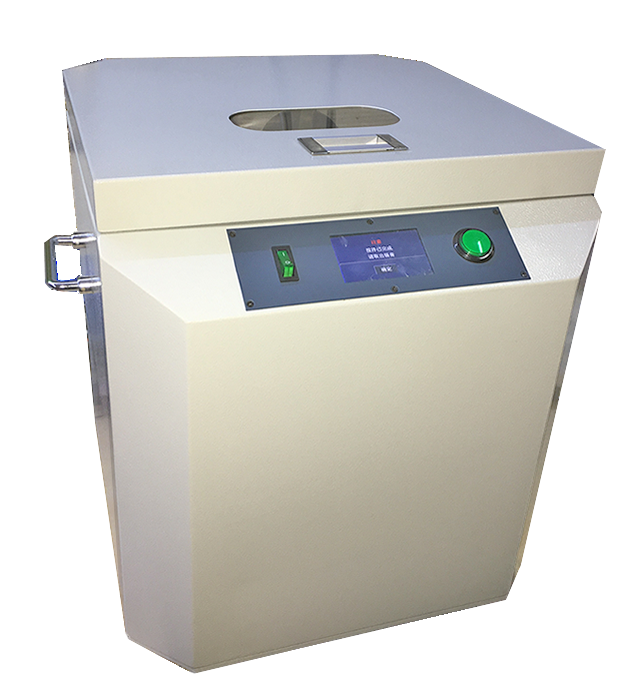
S-PM680 Touch Screen Solder Paste Mixer: Automated Paste Preparation for SMT and EMS Production
Solder paste is the most process-sensitive material on an SMT line, and it is frequently the least controlled. Paste arrives frozen or refrigerated, is thawed on a bench, is stirred by hand with a spatula, and is then loaded into a stencil printer — and every one of those informal steps eventually shows up as bridging, voiding or uneven print volume.
The S-PM680 Touch Screen Solder Paste Mixer from Southern Machinery is a compact peripheral machine that turns paste preparation into a defined, repeatable process step: digital speed and time control, selectable rotation modes, intelligent diagnostics, and interlocked safety that a manual bench cannot provide.
This guide covers what the S-PM680 does, the process problem it solves, where it sits inside a complete PCB assembly line, how it compares with the other mixers in the Southern Machinery family, and which parameters an EMS, ODM or OEM engineering team should confirm before specifying one.
What Is the S-PM680 Solder Paste Mixer Used For?
Q: What is the S-PM680 used for? It automates solder paste preparation. Instead of an operator stirring a jar by hand, the machine mixes the material to a set speed and time using selectable rotation modes, so viscosity and consistency are repeatable from jar to jar and shift to shift.
Q: Which materials can it process? Southern Machinery specifies the S-PM680 for SMT solder paste, paste, glue, slurry and other viscous materials. The wider solder paste mixer family is also tagged for electronic paste, epoxy resin, silver paste, thermal paste and ink. Always confirm compatibility with your specific material, viscosity and container format before ordering.
Q: How is it operated? Through a touchscreen interface with a Chinese / English bilingual switch. Running speed and time are set digitally and the running status is displayed in real time.
Q: How is it different from stirring paste by hand? Manual stirring varies with operator technique, jar temperature and how much time the operator has. The S-PM680 applies a fixed program, runs intelligent diagnostics, and shuts down and warns automatically when the cycle completes or when conditions are abnormal.
Q: Do I still need a paste warmer? Yes — mixing and temperature recovery are different process steps. Solder paste must reach a usable working temperature before it is mixed and printed, which is why Southern Machinery also offers dedicated warm-up equipment in the same product category. See the family comparison below.
Why Solder Paste Mixing Deserves a Machine, Not a Spatula
Southern Machinery's own product documentation states the failure mode plainly: inconsistent manual mixing introduces micro-bubbles and uneven viscosity, which then produce solder bridging and reflow voids in high-precision SMT lines.
Three mechanisms drive that outcome:
- Entrained air. A spatula folds air into the paste. Air sitting in a stencil aperture gives an incomplete deposit; air that survives reflow becomes voiding inside the joint.
- Viscosity drift. Refrigerated paste is stiffer in the centre of the container than at the wall. Printing from a partially recovered jar produces inconsistent deposit volume across the board.
- Operator variability. Two shifts, two techniques, two outcomes. This is the root of the classic "the line was running fine yesterday" defect investigation.
A mixer converts all three from habit into parameters.
Rotation, revolution and container geometry
Mixers in this class use one or both of two motions, and the distinction matters when you match a machine to your paste container:
- Rotation spins the container about its own axis. It homogenises the paste and helps release entrained air.
- Revolution carries the container around a central axis, adding a centrifugal component that is useful for higher-viscosity materials.
In the Southern Machinery range this is documented at model level. The S-PM800 vacuum mixer combines "rotation / revolution with a high-power vacuum pump" to mix high-viscosity material using two centrifugal forces in a short time. The S-SPM01 uses a 45-degree angled rotational axis. When you evaluate any mixer, ask which motion it uses and how that maps to your container geometry — that is a more useful question than a headline speed figure.
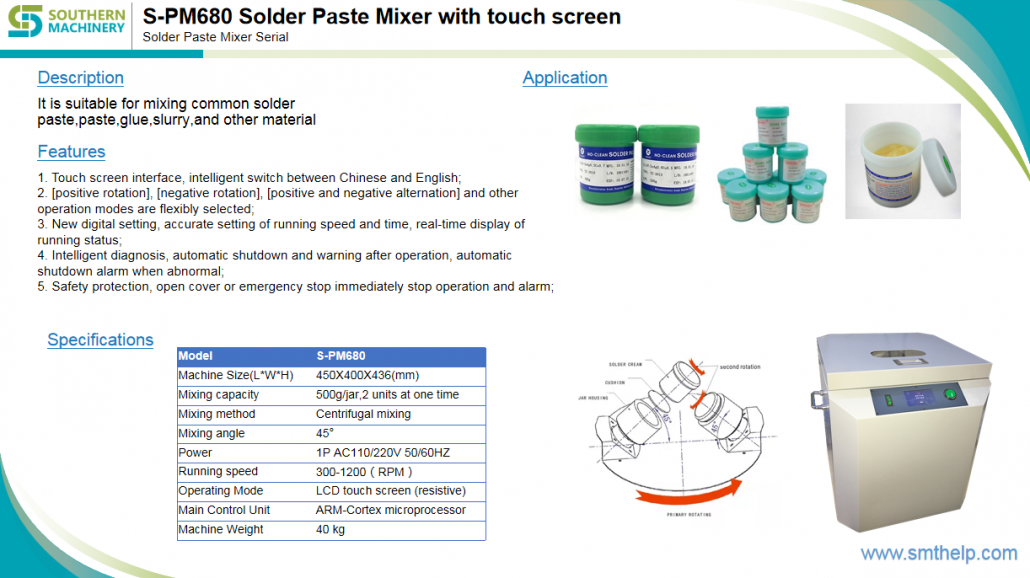
An inline product photo of the S-PM680 with its touchscreen control panel:
S-PM680: Verified Specifications
The following is taken directly from Southern Machinery's published product data for the S-PM680. Nothing below is estimated.
- Model: S-PM680
- Control interface: Touchscreen interface with English / Chinese bilingual switch
- Rotation modes: Positive rotation, negative rotation, and positive-and-negative alternating rotation
- Operation control: Digital speed and time setting with real-time running status display
- Safety and alarm system: Cover-open protection, emergency stop interlock, automatic shutdown alarm
- Application range: SMT solder paste, paste, glue, slurry and viscous materials
Documented operator-facing features:
- Touchscreen interface with intelligent switching between Chinese and English
- Flexibly selectable operation modes: positive rotation, negative rotation, and alternating rotation
- New digital setting for accurate running speed and time, with real-time display of running status
- Intelligent diagnosis — automatic shutdown and warning after the cycle completes, and automatic shutdown with alarm under abnormal conditions
- Safety protection — opening the cover or pressing emergency stop immediately stops operation and raises an alarm
Southern Machinery does not publish a maximum speed, batch capacity or cycle-time figure for the S-PM680, and this article does not invent one. If you need those numbers for a capacity study, request them against your specific paste SKU and container format.
Typical Application Scenarios
Solder paste preparation is a yield lever in almost every electronics assembly environment, but it matters most where print quality has nowhere to hide:
- EMS and contract manufacturing with a high mix of customers. Every switchover brings a new paste SKU, a new jar and a new operator. A programmed mix cycle removes one variable from a changeover that already has too many.
- Automotive electronics. Fine-pitch and high-reliability assemblies are intolerant of voiding. Consistent, deaerated paste gives the printing and reflow processes a stable starting point.
- Medical electronics. Documented, repeatable process steps support traceability and audit expectations far better than "operator stirred until it looked right."
- Industrial control and power electronics. Mixed-technology boards combining SMT and THT benefit from stable paste behaviour before Wave Soldering is even in play.
- LED lighting, LED display and power supply manufacturing. High-volume, repetitive production exposes any inconsistency in paste preparation within hours.
- Appliance and general electronics. Wherever several operators prepare paste per shift, machine mixing standardises the result.
How the S-PM680 Fits Into a Complete PCB Assembly Line
Paste preparation is upstream of everything else, which is exactly why it is worth automating. In a typical Southern Machinery SMT and THT configuration:
- Paste and material storage — refrigerated or controlled storage for paste and SMT reels.
- Temperature recovery — paste warm-up so the material reaches a usable working temperature.
- Mixing — the S-PM680 prepares the paste on a fixed program before printing.
- Stencil printing — paste is printed onto the PCB through a stencil.
- SPI — 3D solder paste inspection verifies deposit volume and position. Note that better mixing upstream shows up here as a tighter deposit distribution.
- Pick and Place — SMT components are placed.
- Reflow Oven — the paste reflows into the joints.
- AOI — post-reflow inspection catches placement and joint defects.
- THT and Wave Soldering — through-hole components are inserted and soldered.
- Cleaning and depaneling — flux removal, coating where required, and PCB separation.
Because the S-PM680 is an offline peripheral machine, it needs no SMEMA interface and no line rebalancing. It sits beside the printer or in the material preparation area. That makes it one of the simplest line-level upgrades available: it improves an existing process without touching the conveyor layout.
Choosing Within the Solder Paste Mixer Family
Southern Machinery lists four products in this category, and they are not interchangeable. Each documented below.
S-PM680 Touch Screen Solder Paste Mixer — touchscreen control with bilingual interface, positive / negative / alternating rotation modes, digital speed and time setting, cover-open protection, emergency stop interlock and automatic shutdown alarms. The most operator-configurable of the group, and the subject of this guide.
S-SPM01 Solder Paste Mixer — documented for mixing in sealed containers along a 45-degree angled rotational axis, with two 500 g cans processed simultaneously (up to 1 kg total), dual safety interlock devices on a dedicated control circuit, an anti-sedimentation design, and direct mixing capability without prior room-temperature thawing.
S-PM800 Vacuum Mixer for Coating Slurry — documented for rotation / revolution with a high-power vacuum pump, mixing high-viscosity material via two centrifugal forces in a short time, a mixing capacity from 300 g to 500 g depending on container, up to 10 preset programs (customizable), and a maximum rotation speed of 1200 rpm. Documented for LED photoelectric materials, silver paste, nano powder material, ceramic powder and high-viscosity coatings.
S-SPW01 Solder Paste Warmer — the temperature-recovery step that runs before mixing. Documented with four independent placement tanks handling 500 g containers simultaneously (customizable), independent LED timers per tank with First-In, First-Out logic and alarm, automatic tank sinking with timed popup release, and auto-popup on power failure plus an emergency stop button.
If your requirement is standard 500 g SMT solder paste for a high-mix line, the S-PM680 and the S-SPW01 warm-up step are the natural pair. If your material is a high-viscosity coating slurry, the S-PM800 is the relevant machine. Confirm the mapping with Southern Machinery using your actual material data sheet.
Key Selection Parameters to Confirm Before You Buy
Because mixer selection depends on your material and container, treat the following as a checklist of categories to confirm rather than values to assume:
- Container format and size — jar, can or cartridge; confirm the size and geometry the machine accepts against your paste packaging.
- Material type and viscosity — standard solder paste, silver paste, thermal paste, epoxy, ink or a high-viscosity coating slurry. Viscosity drives the choice between a standard mixer and a vacuum mixer.
- Required motion — rotation only, or rotation plus revolution.
- Vacuum or non-vacuum mixing — relevant when entrained air is critical, as with high-viscosity or void-sensitive materials.
- Batch quantity per shift — how many containers one operator must prepare, and whether the machine must run several simultaneously.
- Control interface and operator language — touchscreen with bilingual switching if your floor operates in more than one language.
- Safety and interlock requirements — cover-open protection and emergency stop interlock to satisfy your EHS review.
- Temperature workflow — whether your process requires sealed-container mixing, and whether a warm-up stage is needed before mixing.
- Facility requirements — power supply, air pressure and footprint for the specific model (the S-SPW01 warmer, for example, is documented at 1P 220 V or 110 V, 50/60 Hz, 5 kg/cm² air pressure, and roughly L500 × W300 × H230 mm).
- Spare parts and service — Southern Machinery supports its equipment with spare parts supply, sub-assembly and retrofit kits, repair services, training and overhaul, which matters for uptime planning on a two-shift line.
- Data and smart-factory requirements — if your roadmap requires equipment data capture, state that requirement explicitly and ask which interface the exact model offers; do not assume it.
The ROI, Quality and Throughput Case
Automating paste preparation is attractive because the investment is small relative to the process risk it removes. The business case rests on four points:
- Defect cost moves first. Bridging and voiding are rework and scrap events. If inconsistent mixing is contributing to them — and the documented failure mode says it is — a mixer attacks the defect at its origin rather than at inspection.
- Operator time returns to the line. Manual stirring consumes skilled operator minutes every shift and every paste change. Those minutes are gone from an activity that adds no value to the board.
- Consistency replaces judgement. A fixed program produces the same result at 06:00 and at 22:00. That is what makes a print process statistically stable enough to improve.
- Material discipline improves. When mixing becomes a defined step, storing, warming and tracking paste becomes a defined workflow, which supports FIFO control and reduces paste waste from expired or mishandled containers.
We deliberately do not publish a savings percentage or a payback period here. Those figures depend on your defect rates, labour rates and production mix, and any number quoted without your data would be a guess.
FAQ: Solder Paste Mixing in SMT Assembly
What is the S-PM680 Touch Screen Solder Paste Mixer? It is a solder paste preparation machine from Southern Machinery that automates mixing with a touchscreen interface, digital speed and time settings, and selectable positive, negative or alternating rotation modes.
Which rotation modes does the S-PM680 support? Positive rotation, negative rotation, and positive-and-negative alternating rotation — all selectable depending on the material being prepared.
What safety features does the S-PM680 include? Cover-open protection, an emergency stop interlock, and an automatic shutdown alarm. Opening the cover or pressing emergency stop immediately halts operation and raises an alarm, and the machine performs intelligent diagnosis with automatic shutdown and warning when the cycle ends or conditions are abnormal.
Does the S-PM680 replace a solder paste warmer? No. Mixing and temperature recovery are separate process steps. Solder paste must reach a working temperature before printing, so Southern Machinery also offers the S-SPW01 Solder Paste Warmer, documented with four independent tanks, per-tank timers and First-In, First-Out control.
Can the S-PM680 mix materials other than solder paste? Yes — Southern Machinery specifies it for SMT solder paste, paste, glue, slurry and other viscous materials. For very high-viscosity coating slurries and void-sensitive materials, the S-PM800 vacuum mixer is the family option, documented with rotation / revolution under vacuum, 300 g–500 g capacity depending on container, up to 10 preset programs and a maximum rotation speed of 1200 rpm.
Can Southern Machinery supply the rest of the SMT and THT line? Yes. Southern Machinery supplies SMT and THT PCB assembly automation equipment as individual machines or as complete line solutions covering insertion, Pick and Place, stencil printing, SPI, Reflow Oven, AOI, Wave Soldering, Selective Soldering, board handling, cleaning, coating, depaneling and storage. Founded in 2011 in Shenzhen, China, the company serves more than 237 customers worldwide.
Next Step: Get a Configuration Recommendation
If inconsistent paste preparation is costing you yield, the fastest way to close the question is a short technical conversation about your material and container format. Southern Machinery can recommend the right mixer — or the right mixer plus warm-up combination — for your line rather than selling you a generic unit.
- Talk to the engineering team: Jason Wu, jasonwu@smthelp.com, +86 13602562576
- Browse product catalogues and documentation: file.autoinsertion.com
- See machines and photos: ph.smthelp.com
- Watch the solder paste mixer running: SMT solder paste mixer machine for Smart EMS factory PCB assembly on the Southern Machinery YouTube channel
- Company website: www.smthelp.com
Tell us your paste SKU, container size, number of containers prepared per shift, and whether you currently mix by hand — that is enough to start a configuration recommendation.
Comments