
S-MVF01 Belt Bulk Feeder Selection and Integration Guide by Southern Machinery
The S-MVF01 Belt Bulk Feeder helps EMS, ODM and industrial electronics teams bring suitable loose odd-form components to a consistent SMT pick position without tape or tray packaging. Its belt-and-vibration feeding concept supports repeatable presentation while returning non-selected material for another pass. This guide explains application fit, critical component and mounter checks, line integration and the catalog values that require final engineering confirmation. Southern Machinery combines feeder evaluation with practical SMT, THT, soldering, board handling, training and spare-parts support for complete PCB assembly projects.
Aug 3, 2026 · Updated Aug 3, 2026 · Southern Machinery
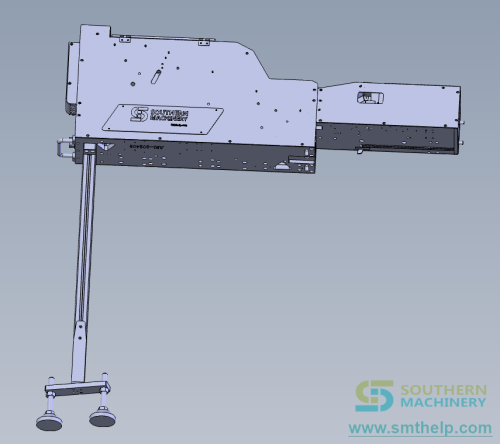
S-MVF01 Belt Bulk Feeder: Selection and Integration Guide by Southern Machinery
For electronics manufacturers handling suitable loose odd-form components, packaging is often only part of the challenge. The part must arrive at the placement point in a stable, repeatable way and match the available mounter interface. The S-MVF01 Belt Bulk Feeder is designed to create that path without requiring tape or tray packaging.
What is this machine used for?
The S-MVF01 is used to bring appropriate bulk components to a consistent SMT mounter pick position. Its source material describes a motor-driven belt combined with direct vibration: loose components enter the feeder, parts with distinguishable physical characteristics are selected on the belt, non-selected material returns for another pass, and fiber-optic induction supports positioning at the pick point.
It is an application-specific feeder, not a universal replacement for every bowl, tube, tape or tray solution. Final suitability depends on the actual component geometry, pins, orientation and the target mounter interface.
Where the S-MVF01 can fit
The source identifies connectors, buzzers, network ports, terminals and square capacitors as example suitable bulk components. It can be relevant when an EMS, ODM, automotive-electronics, medical-electronics or industrial-control team needs a more flexible bulk-feeding route than dedicated packaging allows.
The first-principles question is simple: can the feeder present the actual part in a repeatable orientation for the target mounter? The material specifies three important boundaries:
- Parts need distinguishable physical characteristics for selection.
- Components with easily deformed pins are not recommended.
- Parts with a length-to-height ratio below 1:1.2 are not recommended.
Those boundaries should be treated as a screening step, not as a substitute for a sample review.
Catalog data for initial feasibility
The following values are catalog data from the selected S-MVF01 source document. They are useful for early layout and utility planning, but remain subject to final technical confirmation for the component and mounter application.
- Envelope: 850 x 140 x 260 mm.
- Component size range: 3 x 3 x 3 to 20 x 20 x 20 mm.
- Feed method: single-channel belt plus direct vibration.
- Typical feeding: 1.5-2 seconds, depending on the validated component and setup.
- Feeding accuracy: +/-1 mm catalog value.
- Utilities: 220 V / 50 Hz and 0.4-0.6 MPa air; confirm the local configuration.
How to connect it to a PCB assembly line
A reliable line integration starts with the point of use, rather than the feeder in isolation. The source describes a positioning key and clamping block as standard, with alternative fixing structures matched during engineering review. Its PLC-controlled operation can include optional I/O connection.
A typical project sequence is:
- Define the component and its required orientation at the pick location.
- Confirm the placement machine brand, exact model, feeder rail or interface space and current feeder reference.
- Review the S-MVF01 footprint, utilities and physical interface beside the placement process.
- Validate belt selection, return flow, direct-vibration timing and fiber-optic positioning using the actual component.
- Confirm final tooling, controls and line handoff before production release.
This approach helps manufacturing and purchasing teams separate a technically valid feeder concept from an assumed plug-and-play installation.
Key selection parameters to send for review
Southern Machinery requests the information that determines whether a bulk-feeding concept is viable:
- Part number, clear description and photos of the actual part.
- Overall dimensions, including PW, PL, H and LH as requested in the component template.
- Pin geometry, marking and orientation requirements.
- Target mounter brand and exact model.
- Feeder rail or mounting-interface photos and any existing feeder reference.
- Required cycle time, production volume and available installation space.
Quality, capacity and ROI considerations
The practical value of a feeder comes from repeatable component presentation and a configuration that matches the line, not from an unverified headline performance claim. For a validated application, the S-MVF01 return-and-reselect flow can reduce the need to manually re-handle non-selected loose material at the feeder. The belt plus direct-vibration concept is intended to support a stable pick position.
Actual throughput, labor impact, yield impact and payback depend on component behavior, required cycle time, mounter integration and final control logic. They should be evaluated against a sample run or approved engineering configuration.
Why Southern Machinery
Founded in Shenzhen in 2011, Southern Machinery serves 237+ global customers with SMT and THT PCB assembly automation equipment. Beyond a single feeder, we support complete solutions across SMT, THT, wave soldering, board handling and inspection, with high-efficiency and cost-effective project planning, global service, spare-parts support and professional training.
For a bulk-feeding project, that broader capability matters: the feeder, mounter interface and downstream assembly process need to be reviewed as one operating system.
FAQ
Can the S-MVF01 feed any loose component?
No. The source states that components need distinguishable physical characteristics and identifies restrictions around easily deformed pins and a length-to-height ratio below 1:1.2. Send samples and drawings for engineering confirmation.
Does the feeder eliminate tape or tray packaging?
It is designed to present suitable loose components without tape or tray packaging. Whether that is appropriate depends on the part geometry, orientation requirement and placement process.
What is the stated component size range?
The catalog source lists 3 x 3 x 3 to 20 x 20 x 20 mm. This is an initial feasibility value, not an approval of a specific part.
What placement equipment information is needed?
Provide the mounter brand and exact model, available feeder rail or interface information, mounting-area photos and any current feeder reference.
How fast is the S-MVF01?
The source lists a typical feeding value of 1.5-2 seconds. Actual performance depends on the validated component, setup and mounter integration.
Request an S-MVF01 application review
Send your component list, actual part photos, dimensions, pin and orientation notes, target mounter model, interface photos and cycle requirement. Southern Machinery can review the S-MVF01 fit, confirm the closest configuration or recommend a more suitable feeding method as part of a complete PCB assembly automation solution.
Comments