
S-MLD350 Mini PCB Loader: Compact Board Feeding for Space-Constrained SMT Lines
The S-MLD350 Mini PCB Loader is a compact, magazine-less board feeding machine from Southern Machinery for SMT and FPC production lines. It takes bare PCBs from an operator, transports them one by one on an ESD flat belt, and hands off to downstream equipment over a SMEMA-compatible interface. With a 600 x 650 x 1400 mm footprint, a 50 x 50 to 445 x 350 mm board envelope and a 100 VA maximum power draw, it is built for factories where a full magazine loader cannot be justified on floor space or volume. This guide covers what it does, when a mini loader beats a magazine loader, how to integrate it into a complete PCB assembly line, and which parameters to confirm before requesting a quotation.
Sep 24, 2026 · Updated Sep 24, 2026 · Southern Machinery
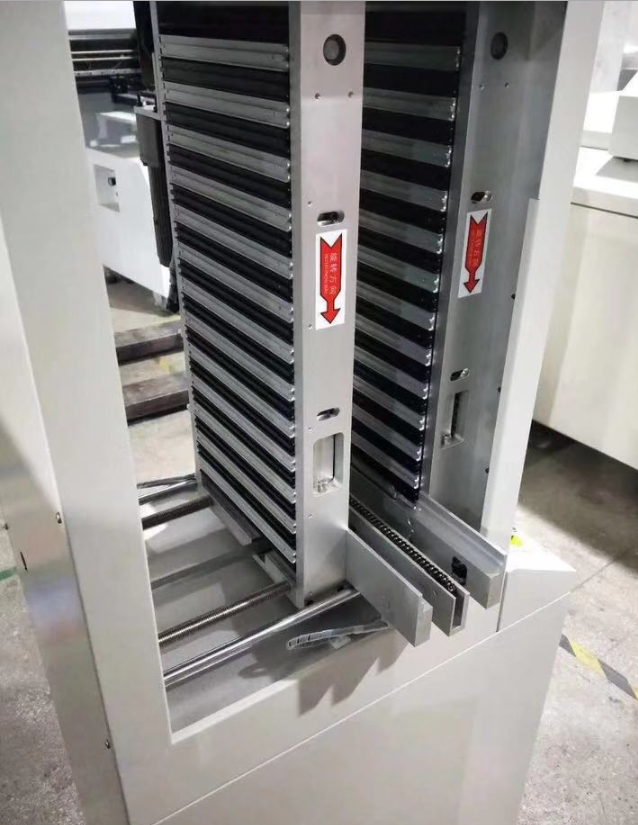
S-MLD350 Mini PCB Loader: Compact Board Feeding for Space-Constrained SMT Lines
Watch the machine in action: S-MLD350 Mini Loader — Smart Loader with Asynchronous Transmission Function

The S-MLD350 Mini PCB Loader is a compact, magazine-less board feeding machine from Southern Machinery that takes bare PCBs from an operator and transports them one at a time onto an inline SMT or FPC production line. It is the machine you specify at the start of the line when the board envelope is small-to-medium, the floor space is tight, and the volume does not justify the footprint of a full magazine loader station.
This article explains what the S-MLD350 does, when a mini loader is the better engineering choice than a magazine loader, how to integrate it into a complete PCB assembly line, and — critically — which parameters to confirm before you request a quotation.
What Is This Machine Used For?
Q: What does the S-MLD350 Mini PCB Loader actually do? It is an inline board feeding machine. An operator places bare PCBs on the loading side; the machine transports them individually along an ESD flat belt and presents each board to the next machine in the line at the standard transport height.
Q: What problem does it solve? It removes manual hand-feeding of bare boards into the first process station of the line. In factories running small and medium boards, hand-feeding is a hidden bottleneck: the line is only as fast as the person placing boards, and board-to-board variation in placement causes jams, scratches and false starts at the printer or mounter infeed.
Q: Does it use a magazine? No. Southern Machinery's own product page states this explicitly: "No magazine, so it will need operators to feed PCB to the track." That is the defining trade-off of this machine — it is semi-automatic, not fully automatic. The operator still handles the boards; the machine handles the transport, alignment and handshake with the line.
Q: How does it connect to the rest of the line? It is SMEMA compatible, uses a standard ESD flat belt, and presents boards at a transport height of 900 mm ± 20 mm, which is the common inline conveyor reference height. No custom interface engineering is required to place it in front of a printer, mounter, or inspection conveyor.
Q: Is it a "smart" loader? Southern Machinery's own demo title describes it as a "Smart loader with asynchronous transmission function." In practice, this means the loader can transfer boards on its own timing cycle rather than in strict lockstep with every downstream machine — which matters when the first downstream process (printing, placement) has a longer cycle than the load step.
Mini Loader vs. Magazine Loader: Choosing at the Line Start
Both machines sit at the head of a line, but they solve different problems.
| Consideration | Mini Loader (S-MLD350) | Magazine Loader (e.g. SLD / SLD-400B family) |
|---|---|---|
| Board presentation | Operator feeds loose bare boards to the track | Operator loads a magazine; machine indexes boards out automatically |
| Automation level | Semi-automatic loading | Fully automatic loading |
| Footprint | Small, compact chassis — designed to save line space | Larger, because the magazine elevator and rack handling must be accommodated |
| Best fit | Space-limited lines, small/medium boards, loose-board supply, FPC lines, NPI and low-to-mid volume | High-volume lines with boards already supplied in magazines, 24/7 unattended flow |
| Staffing | One operator presents boards | One operator loads/unloads magazines at intervals |
| Line interface | SMEMA compatible | SMEMA compatible |
Rule of thumb: if your boards arrive in magazines and you want the line start to run without an operator standing there, choose a magazine loader. If your boards arrive loose or in small batches, your floor space is tight, or the line is a pilot/FPC/compact line, the magazine-less mini loader is the more proportionate investment.
Typical Applications
Based on how Southern Machinery positions the S-MLD350 — "suitable for SMT, FPC production line, providing semi-automatic loading, a small volume designed to save space" — the machine fits these scenarios:
- Line start for small and medium PCB formats. The documented board envelope is 50 × 50 mm up to 445 × 350 mm, which covers a large share of consumer, power supply, LED driver and industrial control boards.
- FPC and flexible circuit production lines, where boards arrive loose and light, and where a heavy magazine elevator is unnecessary.
- Compact and space-constrained SMT cells, where the loader has to fit between existing equipment rather than define the line layout.
- Pilot lines, NPI and low-to-mid volume builds where operators are present anyway and the priority is a stable, repeatable board feed rather than unattended flow.
- Feeding a semi-automatic printer into a partial inline flow — a documented way to give a semi-automatic stencil printer a proper inline infeed instead of manual board placement.
- Supplying boards downstream into depaneling, cleaning or inspection equipment that expects a SMEMA-compatible infeed.
How to Integrate the S-MLD350 Into a Complete PCB Assembly Line
The loader is one module in a chain.
Typical SMT line configuration
- S-MLD350 Mini PCB Loader — bare boards enter the line
- Stencil printer / SPI — solder paste deposition and inspection
- Pick and Place / SMT placement — surface mount components
- Reflow Oven — solder reflow
- AOI — automated optical inspection
- Board handling — buffer conveyor, NG/OK unloader, magazine unloader
Typical THT and mixed-technology line configuration
The same loader can feed a through-hole or mixed-technology chain:
- S-MLD350 Mini PCB Loader
- Radial / Axial / Odd-Form Insertion — THT component insertion
- Wave Soldering — through-hole solder joint formation
- Lead cutter / PCBA cleaning
- Wave unloader or magazine unloader — line exit
Because the S-MLD350 uses the SMEMA interface and the standard 900 mm transport height, it can be placed in front of equipment from other vendors as well. Southern Machinery supplies the full chain — insertion machines, wave soldering, reflow ovens, board handling, inspection, cleaning and depaneling — so the loader can be specified as part of a matched line rather than as a standalone component.
Key Selection Parameters to Confirm
Before requesting a quotation, confirm these items. The values shown are the documented parameters for the S-MLD350 from Southern Machinery; anything outside them requires engineering confirmation for your specific configuration.
| Parameter | Documented Value / What to Confirm |
|---|---|
| Model | S-MLD350 |
| Machine dimensions (L × W × H) | 600 × 650 × 1400 mm |
| PCB size range | 50 × 50 mm up to 445 × 350 mm |
| Machine weight | 100 kg |
| Max PCB capacity | 50 pcs (cyclic) |
| Transport height | 900 mm ± 20 mm |
| Transfer direction | L to R, or specify R to L |
| Conveyor speed | 6 seconds |
| Belt type | ESD flat belt |
| Max PCB weight | ≤ 2 kg |
| Power supply | 110 VAC or 220 VAC / 50 Hz / 1 Ph |
| Power consumption | 100 VA max. |
| Line interface | SMEMA compatible |
| Board supply method | Loose boards, operator-fed (no magazine) |
Also Confirm With Your Supplier
- The board thickness range and edge clearance your panel actually uses
- Whether your downstream machine expects SMEMA pass-through or parallel handshake
- The rail width setting required for your board mix (the S-MLD350 has leadscrew width adjustment)
- Required ESD grounding and floor-space clearance around the machine
- Spare parts availability, training and service coverage in your region
Southern Machinery's product page also notes a related model, the S-MLD250 (machine dimensions 500 × 475 × 1400 mm; PCB size 50 × 50 – 330 × 250 mm; 90 kg; 50 pcs cyclic), for smaller board envelopes — and a matching S-MUL350 Mini PCB Unloader (700 × 650 × 1400 mm; PCB 50 × 50 – 445 × 350 mm; 110 kg) for the line exit.
ROI, Quality and Throughput Considerations
Throughput. Southern Machinery states the S-MLD350 is capable of loading up to 350 PCBs per hour. Treat manufacturer-stated figures as a planning starting point and validate against your own board size, handoff timing and downstream cycle.
Quality. Two documented mechanical behaviors directly affect board quality. First, the closed fuselage structure with a double circulation tank chain keeps transportation smooth. Second, the machine adjusts the PCB automatically when the board is tilted — a small feature with an outsized effect, because a cocked board at the printer infeed is a leading cause of misprint and rework. The ESD flat belt also avoids triboelectric charge on bare boards travelling into a paste-printing or placement process.
Labor. The S-MLD350 is semi-automatic, so it does not eliminate the operator at the line start — it removes the need for that operator to hand-place every board precisely at the infeed and to stand at the machine for the whole shift. For low-to-mid volume lines, that is the realistic labor model, and it is why the machine can stay compact and cost-effective compared with a full magazine loader.
Capital efficiency. The value of a mini loader is measured in floor space as much as in cycle time: a 600 × 650 mm chassis frees line length for machines that add process value. When you plan a new line or a re-layout, calculate the cost per square metre of production floor before choosing between a mini loader and a magazine loader.
FAQ
What is a mini PCB loader?
A mini PCB loader is a compact inline board feeding machine that presents bare PCBs to the first process station of an SMT or FPC line. Unlike a magazine loader, it does not need the boards to arrive in a magazine — an operator places boards on the loading side and the machine transports, aligns and hands them off.
Does the S-MLD350 require a magazine?
No. The manufacturer's product page states the machine has no magazine and requires an operator to feed PCBs to the track. It is a semi-automatic loader.
What PCB sizes does the S-MLD350 handle?
The documented board envelope is 50 × 50 mm up to 445 × 350 mm, with a maximum board weight of 2 kg. Confirm your specific panel size with Southern Machinery before ordering.
Is the S-MLD350 SMEMA compatible?
Yes. The S-MLD350 is documented as SMEMA compatible, with a transport height of 900 mm ± 20 mm and an ESD flat belt conveyor, so it can hand off to downstream machines over a standard inline interface.
What does "asynchronous transmission" mean on this loader?
Southern Machinery describes the S-MLD350 as a smart loader with asynchronous transmission — meaning the loader transfers boards on its own timing rather than in strict lockstep with every downstream station. This helps decouple the load step from a slower first process step.
How much floor space does the S-MLD350 need?
The machine itself measures 600 × 650 × 1400 mm (L × W × H) and weighs 100 kg. Allow additional clearance for operator access at the loading side and for service access.
Next Step: Get a Configuration Recommendation
Board feeding is a line-layout decision, not a catalogue purchase. Send Southern Machinery your PCB size range, panel thickness, target output, existing downstream machines and available floor space, and the engineering team will recommend whether a mini loader, a magazine loader, or a different board handling configuration fits your line.
- Contact: Jason Wu — jasonwu@smthelp.com | +86 13602562576
- Browse the equipment catalogue and PDFs: file.autoinsertion.com
- See the machines and real machine photos: ph.smthelp.com
- Company and product pages: www.smthelp.com
Southern Machinery Sales And Service Co., Ltd was established in March 2011 in Shenzhen, Guangdong, China. The company designs and manufactures SMT/THT assembly automation equipment — auto insertion machines, wave soldering, reflow ovens, board handling, inspection, cleaning and depaneling — and supports PCB assembly manufacturers worldwide with spare parts, training, retrofit and service.
Specifications quoted in this article are taken from Southern Machinery's published product documentation and are provided for evaluation purposes. Final configuration, capacity and interface details are subject to technical confirmation for your specific application.
Comments