
S-JVF02 Stick Feeder Spare Parts by Southern Machinery
Stick feeder spare parts as a stocking plan: the S-JVF02's 14 numbered items, the five wear parts to shelf, and a documented 1-day spare parts lead time.
Oct 8, 2026 · Updated Oct 8, 2026 · Southern Machinery
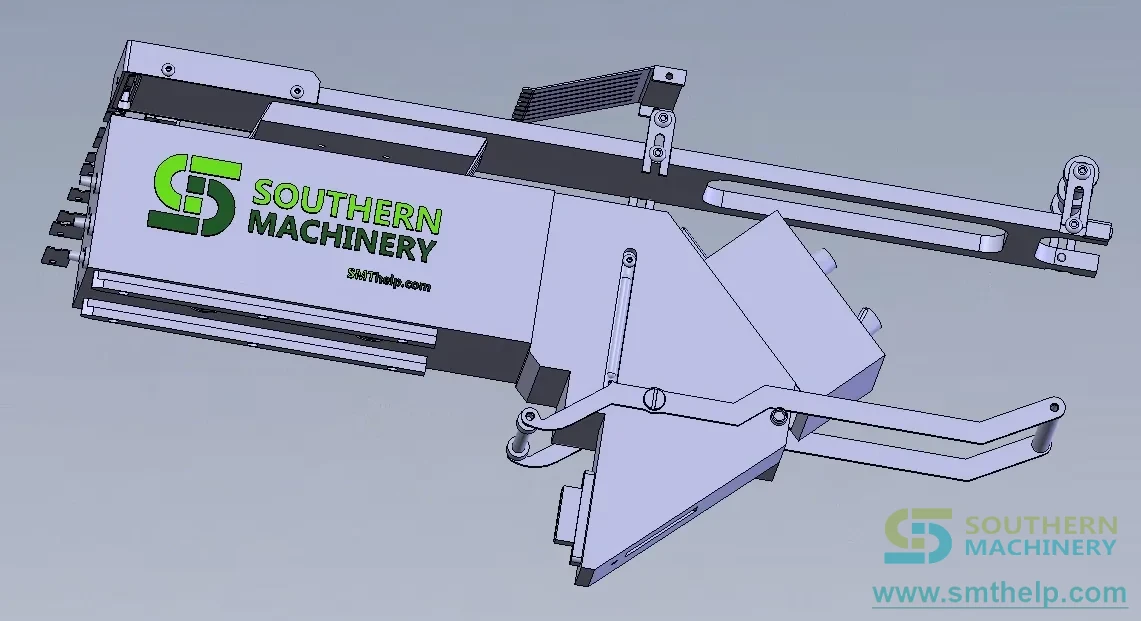
Quick answer. The S-JVF02 is a four-channel vibration stick feeder for the JUKI RS-1 feeder bank. It carries 66 mm component sticks, presents parts from 3 × 3 mm up to 30 × 10 mm to the placement nozzle, and runs on 24 V DC at 15 W through the bank connector. Its product manual publishes a 14-item stick feeder spare parts list numbered S-JVF02-052801 to S-JVF02-052814, and Southern Machinery documents a 1-day spare parts lead-time. Most factories keep five items on the shelf — leaf spring, locating ring, locating piece, control unit, connector — at one kit per feeder bank.
What spare parts does a vibration stick feeder actually use?
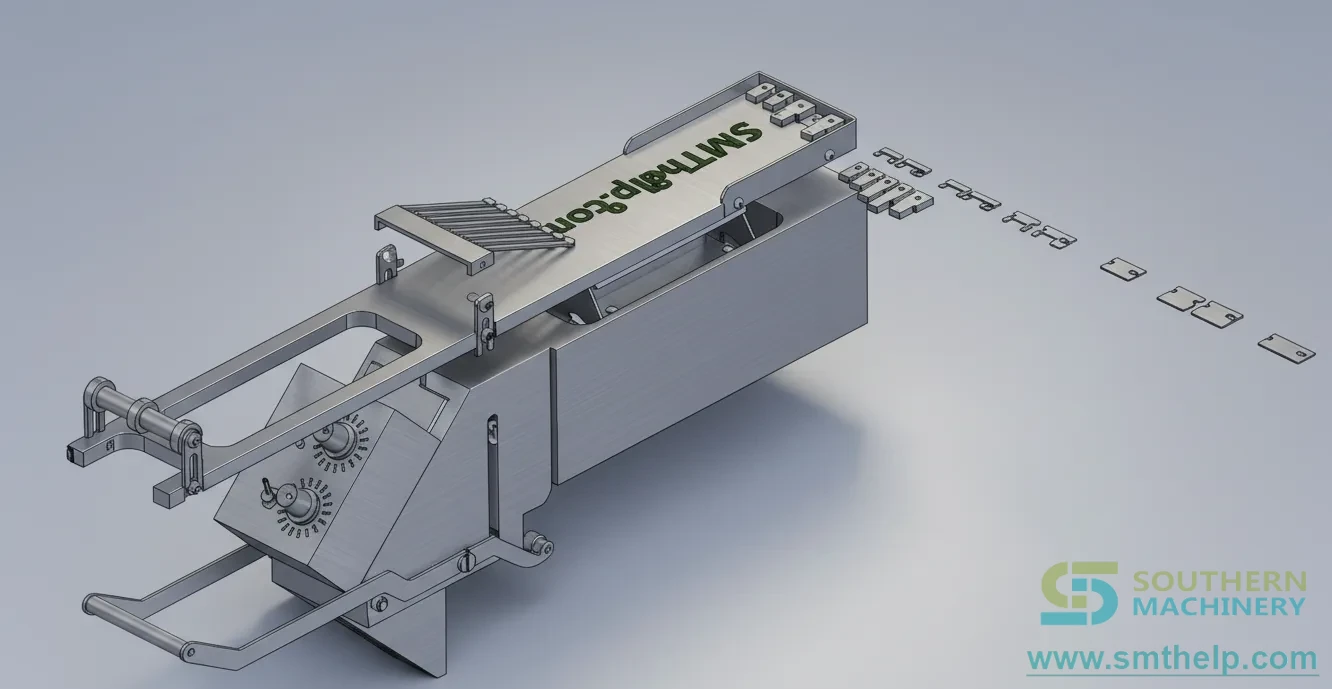
A stick feeder has no tape path, no reel motor and no pneumatic circuit: the tube is fixtured at three points, a vibrator moves parts down the lane, and two dials set the flow. That simplicity is why its spare-parts list is short enough to stock on purpose — the manual's parts chapter lists fourteen numbered items, S-JVF02-052801 (main body) to S-JVF02-052814 (connector), so a lane fault is diagnosed against a drawing instead of described to a supplier.
The five items the manual names for the shelf
- Leaf spring (S-JVF02-052802) — holds the middle of the tube in pressure, so the stick cannot walk loose.
- Locating ring (S-JVF02-052808) — fixes the rear end of the tube above the support frame.
- Locating piece (S-JVF02-052813) — fixes the front end, where the top face is cut open at the picking area.
- Control unit (S-JVF02-052805) — frequency dial, power dial, pilot lamp and switch on one module.
- Connector (S-JVF02-052814) — carries power and communication, and mates with the bank at every mounting.
The manual also names the top plate, spring, handlebar, support frame, front cover, vibrator, locating pin and guide rail, without a separate number for every one. Order those against the manual line and confirm the number with Southern Machinery.
Which parts wear first — and why fixturing wears before the body?
Three points of contact define the tube
The manual's set-up procedure fixes the stick at three points: the rear end by the locating ring, the middle under the leaf spring and in pressure, the front end by the locating piece with the top face cut away at the picking area. Two of those three points are also what you adjust when a new component geometry arrives.
Wear follows pressure and motion
The wear items are the parts taking load: the leaf spring that presses the tube, the ring and piece that define it, the connector that mates thousands of times, and the control unit your operators touch at every changeover. The body, guide rails and support frame are structure — they keep the four lanes parallel and sticks aligned to the nozzle path, and they are rarely what a lane fault names.
What does a documented 1-day spare parts lead time actually change?
The feeder sits in an RS-1 bank, and the mounter is normally the most expensive machine on the line: when a feeder stops feeding, production stops at the placement cycle. That is why the service model is built around a documented 1-day spare parts lead-time — a lane fault becomes a shelf swap instead of a schedule change.
The document publishes no price, no stock quantity and no penalty clause, and claims no quantified uptime guarantee. It publishes the list, the part numbers and the lead-time; the quantity decision stays with you.
How do you turn the 14-item part list into a stocking plan?
The document's own guidance is one of each wear item per feeder bank: one leaf spring, one locating ring, one locating piece, one control unit and one connector.
Stocking is a living decision, not a purchase order. Add a component family to the lanes and spring pressures and wear patterns change with it, so review the shelf whenever the part mix changes — fourteen lines, five of them stock items, and a documented lead-time for the rest. Parts outside the 3 × 3 mm to 30 × 10 mm window on 66 mm sticks change the feeder geometry, and the fixturing you stock with it; the documented 5-day customized design service covers unusual stick widths, delicate bodies and awkward presentation angles.
How does the S-JVF02 fit into a complete PCB assembly line?
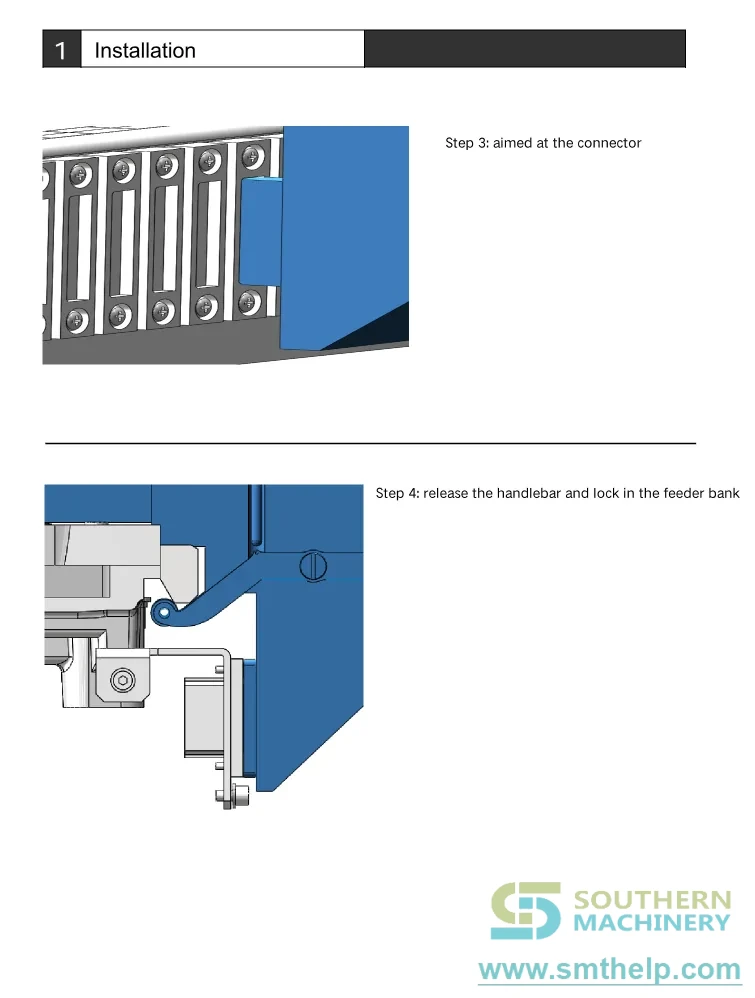
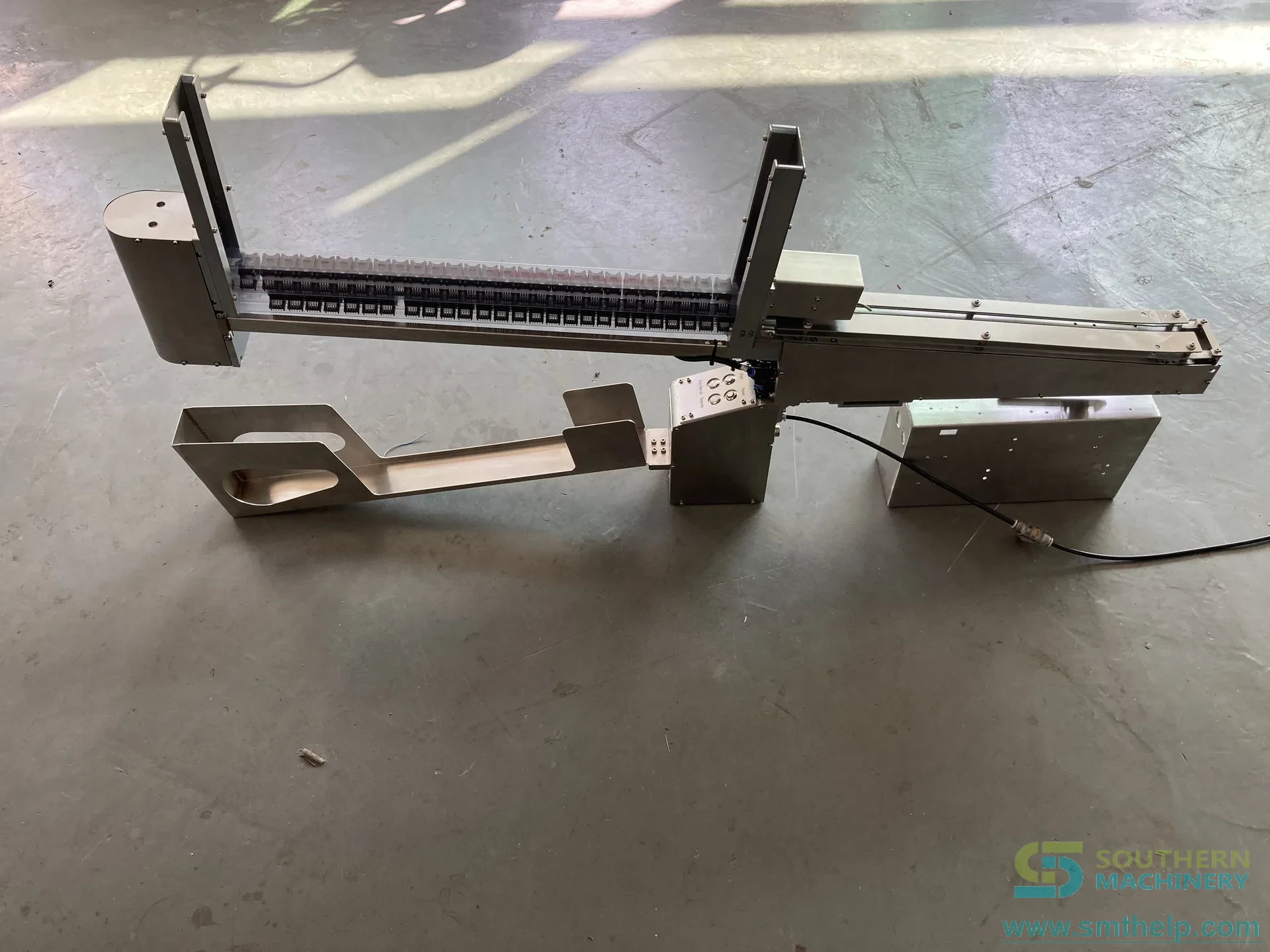
Stick and tube packaging is what tape feeding cannot take: long-leaded parts, fragile bodies and small odd-form components. The feeder does not replace the printer, the mounter or the reflow oven; it removes the hand-picking bench beside the mounter. Four independent channels carry four part numbers, or four sticks of one high-runner, and mounting is four tool-less moves on the bank: put up the handlebar, aim at the alignment hole, aim at the connector, release to lock.
Southern Machinery supplies the stages that surround a placement cell — the SMT machine and THT machine ranges, the board handling system that moves panels between them, and the PCB assembly line view. Documents for this feeder, including the stick feeder 3D model, are hosted on the Southern Machinery file library.
What are the S-JVF02 parameters and service commitments to confirm?
- Channels: four independent stick lanes per feeder
- Component window: 3 × 3 mm up to 30 × 10 mm, on 66 mm sticks
- Power: 24 V DC at 15 W through the standard RS-1 bank connector; no compressor and no external supply
- Envelope: 365 × 66 × 125 mm, 6.5 kg
- Mounting and set-up: four tool-less mounting moves, then five set-up steps — locating ring, leaf spring, locating piece, power on, tune frequency and power
- Spare parts: 14-item published list, S-JVF02-052801 to S-JVF02-052814
- Service: documented 1-day spare parts lead-time, 5-day customized design service, free installation and training, 7 × 24 worldwide support
- Not in the source document: price, complete-feeder delivery time, certification list and throughput in components per hour — contact Southern Machinery to confirm
Is it cheaper to keep the feeder running, or to replace it?
Keeping a stick feeder costs a few consumable parts, a tuning check and shelf space; replacing it costs a new feeder, a commissioning cycle and the changeover training with them. The document's argument for keeping is structural — modular fixturing, a control unit that swaps as one module, a tube path you can see: wear parts buried in a sealed assembly get replaced, wear parts on a published list get maintained. No MTBF or reliability promise is made; the documented boundary is five stock items, one published list, a 1-day lead-time, and a 5-day design service outside the standard window.
Spare-parts stocking ROI: the formula and one worked example
Annual labour addressed = (stick-pack components per board × boards per day
                          × seconds per hand placement ÷ 3600)
                          × share the feeder takes over
                          × loaded wage per operator hour
                          × working days per year

Simple payback (years)  = feeder price ÷ annual labour addressed
Worked example — illustrative only, depends on configuration, subject to final technical confirmation. Assume 40 stick-packaged components per board, 120 boards per day, 6 seconds of hand pick-and-place time per component, the feeder taking over 80% of those picks, a loaded wage of $18 per hour and 252 working days. The document publishes no prices and no time studies, so every input is a declared assumption:
- Operator-hours addressed: 40 × 120 × 6 × 0.8 ÷ 3600 ≈ 6.4 hours per day
- Components auto-fed: 40 × 120 × 0.8 × 21 working days ≈ 80,640 per month
- Annual labour addressed: 6.4 × $18 × 252 ≈ $29,030 per year
- Simple payback: feeder price ÷ $29,030 per year — substitute your own quoted price, because none is published
The method under-claims on purpose: it ignores the wrong-part and reversed-polarity escapes a manual bench lets through, the bank slot a four-lane feeder frees, and the cost of training each new operator by hand. Treat the result as a floor, and check the assumptions against your own stopwatch.
Frequently asked questions
What components can the S-JVF02 actually feed?
Stick- or tube-packaged parts from 3 × 3 mm up to 30 × 10 mm on 66 mm sticks: resistors, diodes, small capacitors, connectors and many odd-form parts. Send a sample stick for confirmation.
What spare parts should one feeder bank stock?
The manual publishes a 14-item list (S-JVF02-052801 to S-JVF02-052814). Keep the wear items on the shelf: leaf spring (052802), locating ring (052808), locating piece (052813), control unit (052805) and connector (052814) — the document's guidance is one of each per bank.
When a component jams, is it a spare part or a tuning problem?
Usually tuning: frequency too low and the column stalls before the pick area, power too high and parts bounce out of attitude. The manual's procedure — fix the tube at three points, then dial frequency and power until components run smooth and speedy — removes the structural causes. Re-verify the logged dial positions after any leaf spring or locating ring change.
Does the feeder fit any mounter other than the JUKI RS-1?
It is engineered for the RS-1 feeder bank, using the standard alignment hole and connector. The same vibration-stick principle is customized for other platforms in Southern Machinery's feeder family; tell us the machine and the interface variant is quoted.
Get the spare-parts kit quoted with the feeders
Send a photo of your component sticks, the sizes, your board volumes and your machine list to info@smthelp.com or WhatsApp +86 13602562576. Southern Machinery has shipped SMT and THT equipment to EMS factories on six continents since 2011, and what comes back is a lane configuration, a shelf inventory built from the fourteen published part numbers, and a price. Request a quote or read the frequently asked questions first, and ask which of the fourteen numbers belong on your shelf.
Comments