
S-H407 High-End PCB Conveyor by Southern Machinery: Sizing and Line-Integration Guide for SMT and THT Assembly
A practical selection and line-integration guide to the S-H407 high-end PCB conveyor for SMEMA-linked SMT and THT assembly lines from Southern Machinery.
Sep 12, 2026 · Updated Sep 12, 2026 · Southern Machinery
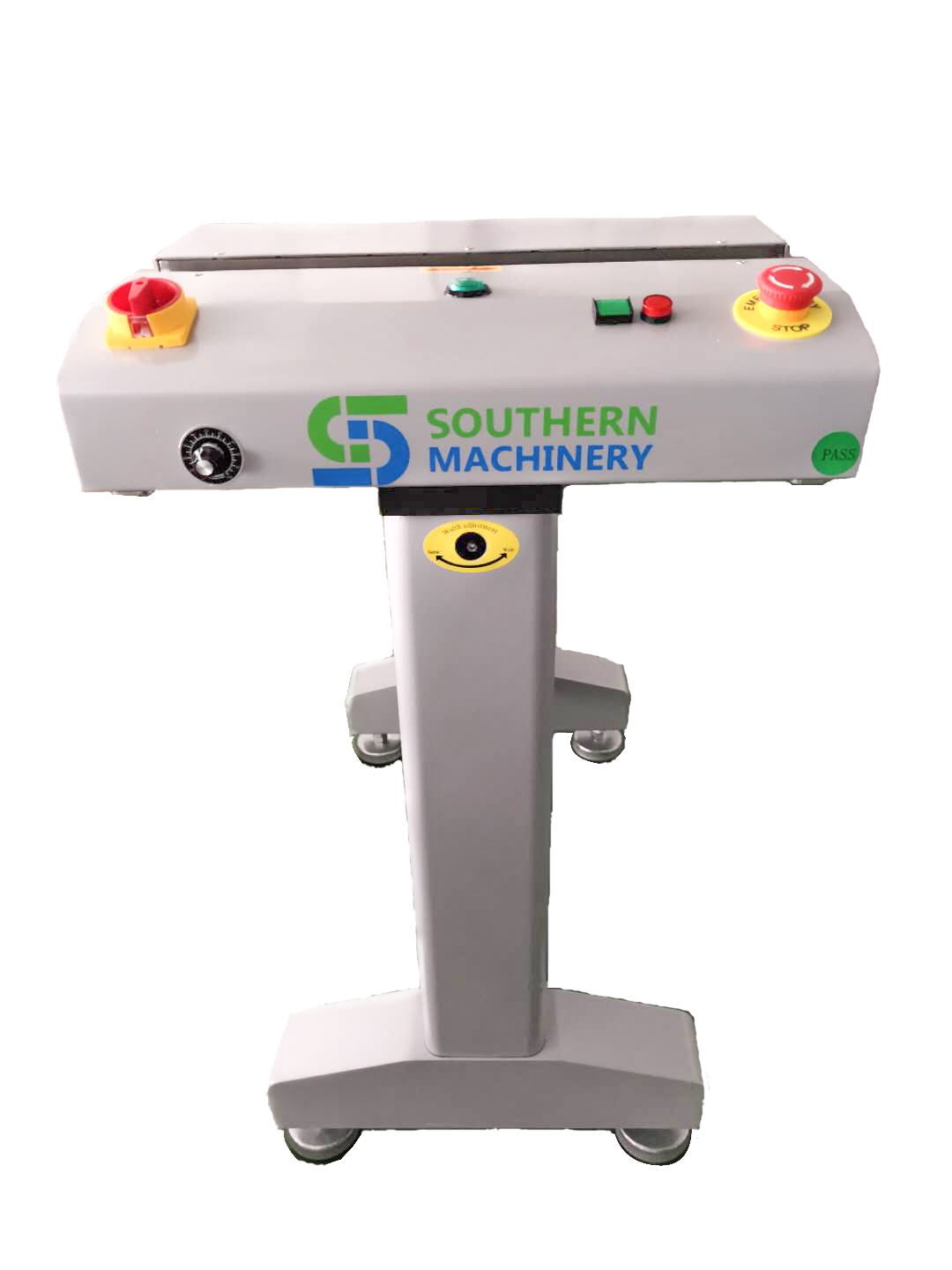
S-H407 High-End PCB Conveyor by Southern Machinery: The Linking Module That Keeps SMT and THT Lines Moving
Most capital budget in a PCB assembly line goes to the printers, the Pick and Place machines, the Reflow Oven and the Wave Soldering system. The conveyor between them is usually treated as an accessory. Then the line stops for four minutes because a board double-fed, a rail height was 15 mm out, or a belt was generating static next to an AOI station. This guide explains what the S-H407 high-end PCB conveyor is used for, where it belongs in a mixed SMT and THT line, and which parameters a buyer should confirm before ordering.
Southern Machinery is a Shenzhen-based supplier of SMT and THT PCB assembly automation equipment, established in 2011 and serving more than 237 global customers. The company supplies single machines and complete line solutions covering SMT, THT auto insertion, Wave Soldering, board handling, cleaning and inspection — which is why the conveyor family matters as much as the process machines to the company's line-integration work.
What is the S-H407 high-end conveyor used for?
The S-H407 is an edge-belt PCB transfer conveyor used to move boards between process machines that are not mechanically coupled. It is the SMEMA-linked section that sits between two machines and closes the gap:
- Between a Pick and Place machine or Reflow Oven and the next AOI or inspection station.
- Between a THT auto insertion cell and a Wave Soldering machine.
- Between Wave Soldering and post-solder inspection.
- Between a PCBA cleaning machine and a depaneling machine.
- At the entry or exit of an ESD-controlled cell, where sensitive assemblies must remain on an antistatic belt.
In simple terms: whenever two machines have separate frames, separate control systems and their own rail height, something has to bridge them while keeping the board under control, on the correct pitch, at a matched speed, and without generating static. That is the job of the S-H407.
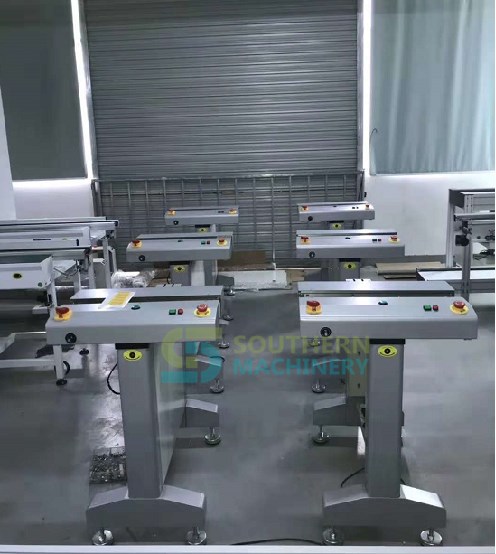
Why the linking conveyor matters more than its price suggests
A conveyor is a low-cost item next to an insertion machine or a reflow oven. Its effect on output is disproportionate, because almost every micro-stop in a line is a handoff problem:
- Speed mismatch. If a downstream machine runs slower, boards accumulate. If it runs faster, it starves. The conveyor speed range and the ability to match the slowest station in the cell determine how the cell actually runs.
- Rail height mismatch. If the conveyor does not match the neighbouring machines, boards drop, jam or arrive skewed. A standardized transport height is what makes line-leveling possible.
- Static damage. Dry, fast-moving belts generate charge. On ESD-sensitive assemblies, an antistatic belt protects boards that were just built correctly.
- Double-boarding and jams. The SMEMA handshake is what prevents a downstream machine from accepting a board before it is ready.
- Manual board carrying. Every manual transfer is a handling-damage and labour risk, and manual carrying is the first thing that fails when a line moves to two or three shifts.
None of that is exotic engineering. It is why board handling belongs in the purchasing plan, not in the afterthought column.
Verified specifications — S-H407 high-end PCB conveyor
The following parameters are published on the official Southern Machinery product page for the S-H407. Buyers should confirm the final configuration (length, lighting, sensors, options) against their own line layout at quotation stage.
| Parameter | Specification |
|---|---|
| Model | S-H407 |
| Machine dimensions | 500 (L) × 745 (W) × 900 (H) mm |
| Effective PCB size | 50 × 50 mm minimum to 445 × 407 mm maximum |
| PCB transport direction | L→R or R→L |
| Conveyor speed | 0.5–12 m/min (or as requirement) |
| Motor / power supply | AC 110 V or 220 V, 50/60 Hz |
| Power consumption | Max 110 VA |
| Belt type | Antistatic (ESD-safe) oblate belt |
| Frame material | Stainless steel and metal |
| Transport height | 900 ± 20 mm |
| SMEMA communication | Yes |
| Lighting | Not included as standard (available as requirement) |
| Approximate weight | 75 kg |
Two notes on reading this table. First, the 445 × 407 mm envelope is a large-board capability for a single conveyor section — it covers the majority of appliance, power supply, LED driver and automotive board sizes. Second, the published conveyor speed is a range, expressed as "or as requirement"; the correct figure for a specific line is the one that matches the slowest machine in the cell, not the maximum published value.
Typical application scenarios
EMS and ODM high-mix production
High-mix lines change board size frequently. A conveyor with a stable transport height, an adjustable width envelope and SMEMA communication reduces the re-engineering that follows every changeover. The S-H407's edge-belt design supports boards of different lengths without tooling.
Automotive electronics
Automotive assemblies commonly carry ESD-sensitive devices and are built under static-controlled conditions. The antistatic oblate belt and stainless-steel frame suit lines where board damage from handling is a warranty concern rather than a yield concern.
Medical electronics
Medical PCBA production values traceability and repeatability. A conveyor that transfers without manual intervention removes one variable from the process record, and the stainless-steel frame is easier to keep clean in controlled environments.
Industrial control and power supply
These products often use large, heavy boards with high component mass. Transporting them on an edge-belt conveyor rather than by hand protects solder joints formed earlier in the process — particularly relevant after Wave Soldering.
LED lighting and drivers
LED driver boards are frequently long, narrow and built in volume. A conveyor sized for a 445 × 407 mm envelope handles driver formats comfortably while the same section can be re-set for smaller boards.
Communication and computing assemblies
Where SMT and THT are combined on one board, boards cross between an SMT cell and a THT or Wave Soldering cell. That crossing is precisely where a dedicated transfer conveyor belongs.
How the S-H407 integrates into a complete PCB assembly line
Board handling is a sequence of linked handoffs. A representative SMT + THT line using Southern Machinery equipment runs:
- Magazine loading — an SLD-series magazine loader presents bare boards to the line.
- Solder paste printing — a stencil printer, with SPI where print quality needs to be measured.
- SMT placement — Pick and Place machines place surface-mount devices.
- Reflow — a Reflow Oven forms the SMT joints.
- AOI — automated optical inspection checks placement and joints.
- Transfer — the S-H407 moves boards to the THT side of the line.
- THT auto insertion — radial, axial or odd-form insertion machines populate through-hole parts.
- Wave Soldering — the THT joints are formed.
- Post-solder inspection — AOI or AVI verifies the through-hole side.
- PCBA cleaning — flux residues are removed.
- Depaneling — V-cut, routing or multi-cutter separation.
- NG/OK unloading — boards are sorted into good and rework streams.
The S-H407 is the module that appears wherever steps 1–12 sit on separate frames. In practice, a single line may use several: one between Reflow and AOI, one between Wave Soldering and cleaning, and one between cleaning and depaneling. This is why conveyor selection is really a line-layout exercise, not a machine-purchase exercise.
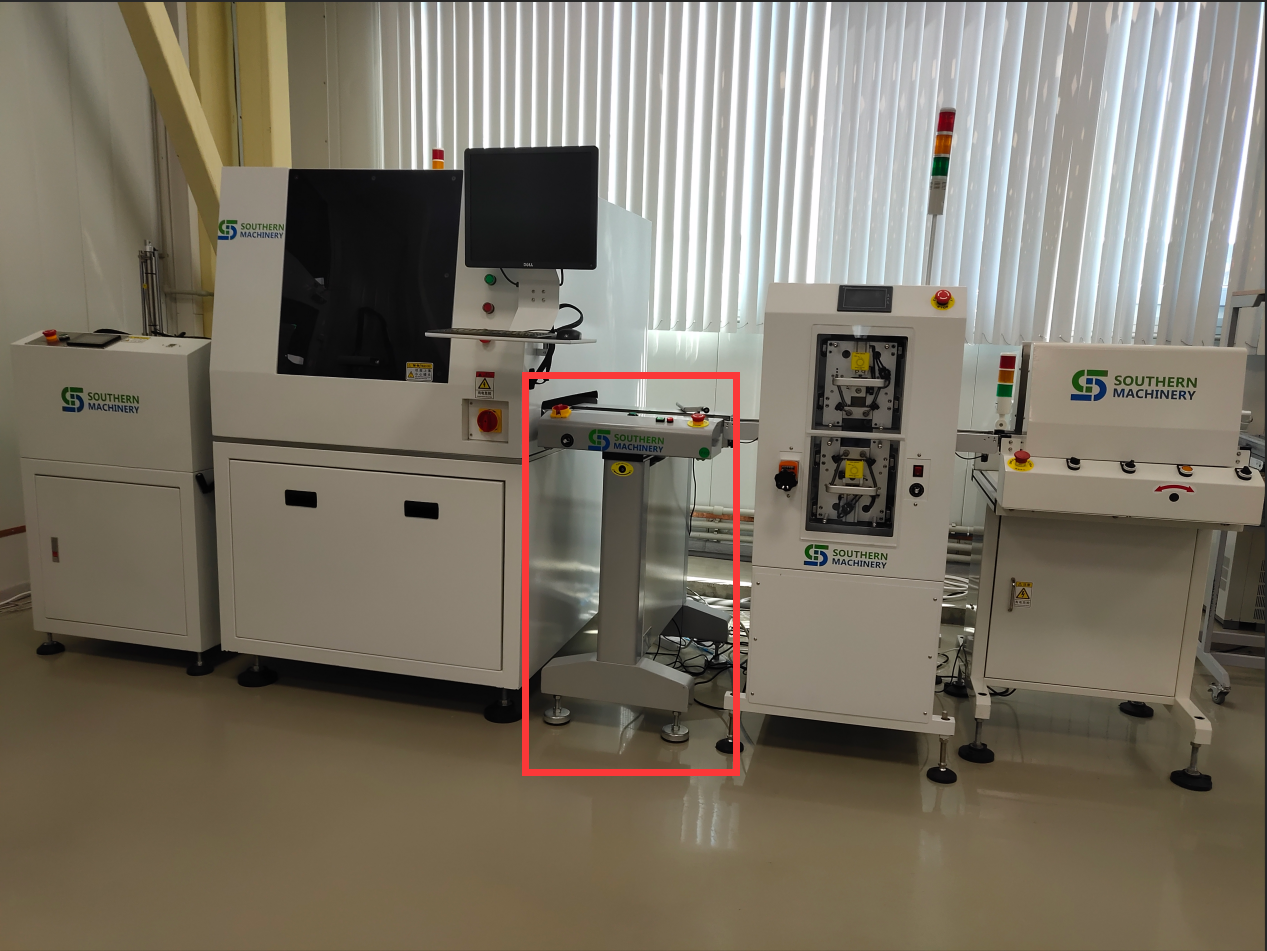
Conveyor type selection: what belongs where
| Conveyor role | Typical use | What it adds |
|---|---|---|
| Standard inline conveyor | Straight transfer between adjacent machines with a fixed product | Lowest cost; manual or optional motorized width setting |
| High-end conveyor (S-H407 class) | Straight transfer on ESD-sensitive or high-reliability lines | Antistatic belt, stainless-steel frame, SMEMA handshake |
| Buffer conveyor | Absorbing short stops and balancing line takt | Accumulation capacity |
| Inspection conveyor | Presenting boards to operators or AOI for review | Ergonomic access and lighting |
| NG/OK unloader conveyor | Separating good and rework boards after inspection | Sorting logic |
| Shuttle / translational conveyor | Moving boards sideways or between parallel lines | Two-axis board movement |
| 90° turn conveyor | Changing board direction within the line | Direction change without manual handling |
The S-H407 is the straight-transfer, high-end option in that list. If the requirement is accumulation, sorting or a direction change, a different module from the same board-handling family is the correct choice — a point worth confirming with the supplier before ordering.

Key selection parameters: a buyer's checklist
Before ordering a conveyor section — S-H407 or any equivalent — confirm all of the following. Each item is a category to verify with the supplier; specific values depend on the line.
- Maximum PCB envelope. The largest board the line will ever run, including panel frames. The S-H407 covers 50 × 50 mm to 445 × 407 mm.
- PCB thickness range and board weight. Conveyors are designed around edge support; heavy or thin boards may need additional support.
- Transport height. Confirm the 900 ± 20 mm figure against every neighbouring machine before the layout is frozen.
- Conveyor speed window. The range is published, but the operating point should be the slowest machine in the cell.
- Direction of travel. L→R or R→L is a configuration decision to declare at order stage.
- Belt type and ESD requirement. Antistatic oblate belt as standard; confirm if a high-temperature belt is needed near a Reflow Oven or Wave Soldering machine.
- SMEMA compatibility. Confirm the handshake type against upstream and downstream equipment, including third-party machines.
- Floor power supply. The machine accepts AC 110 V or 220 V, 50/60 Hz, drawing no more than 110 VA. Confirm which supply your line provides.
- Section length and count. Gaps between machines determine how many sections are needed and whether custom lengths are required.
- Options. Lighting, stoppers, board centering, additional board-presence sensors and vacuum or edge-hold support are configuration items.
- Cleanroom and wash-down constraints. Frame material and cleaning method should match the environment.
- Spare parts and service. Belt, sensor and motor availability, plus the supplier's service response time, determine the real cost of an unplanned stop.
ROI, quality and throughput: where the value actually sits
A conveyor is not normally justified by its own specification sheet. It is justified by what the line does around it.
- Labour. Manual board transfers between machines are a common assignment for operators on older lines. Replacing them with a linked transfer section frees that labour and removes a shift-to-shift variability source.
- Quality. Handling damage, edge chipping, skewed boards and static discharge are all transfer-stage defects. An antistatic belt, stable transport height and automatic handshake remove the mechanisms rather than the symptoms.
- Throughput. The gain does not come from conveyor speed. It comes from eliminating micro-stops, preventing double-boarding, and letting each machine in the cell run at its designed rate without starving or accumulating.
- Changeover. A conveyor that adjusts to the new board envelope quickly turns a line change into a setup task rather than an engineering project.
- Line reconfiguration. Modular transfer sections make it practical to re-arrange a line when volumes or products change — a real consideration for EMS and ODM factories that re-plan production areas more than once a year.
For a fair comparison, build a simple ledger: number of manual transfers per shift, documented handling defects per month, and minutes of micro-stop time per week. Conveyor ROI is usually decided by those three numbers, not by the purchase price.
Maintenance and uptime
The S-H407 is a mechanically simple module, which is a service advantage. A practical maintenance routine covers:
- Clean the belt surface on a fixed schedule, using an ESD-safe cleaner.
- Check belt tension and tracking monthly.
- Inspect the stainless-steel frame and rails for contamination or burrs.
- Verify board-presence sensor alignment and keep sensors free of dust.
- Test SMEMA communication after any line reconfiguration.
- Keep a spare belt and spare sensors on site — these are the parts that stop a line if they fail.
FAQ
What is the S-H407 high-end conveyor used for? It is an edge-belt PCB transfer conveyor used to move boards between process machines that are not mechanically coupled — for example between a Reflow Oven and AOI, between THT insertion and Wave Soldering, or between cleaning and depaneling. It keeps the board on an antistatic belt, at a matched speed and transport height, with SMEMA handshake to the neighbouring machines.
What board sizes does the S-H407 handle? The published effective PCB size is 50 × 50 mm minimum to 445 × 407 mm maximum, with transport direction selectable as L→R or R→L.
What is the difference between a high-end conveyor and a standard PCB conveyor? A high-end conveyor is specified for ESD-sensitive or high-reliability lines: antistatic belt, stainless-steel and metal frame, and SMEMA communication. A standard inline conveyor covers straight transfer where those requirements are lower. The S-H407 sits in the high-end group.
Can the S-H407 connect machines from different brands? SMEMA is an industry-standard board-transfer handshake, so the conveyor can link equipment from different manufacturers. The handshake type and rail height of each neighbouring machine should be confirmed before ordering.
Can I use it after Wave Soldering? Yes — transferring boards away from Wave Soldering without manual handling is a common application. Where the conveyor sits close to a hot process, confirm whether a high-temperature belt is required instead of the standard antistatic belt.
What should I confirm before requesting a quotation? The PCB envelope and thickness, board weight, transport height of neighbouring machines, required speed window, direction of travel, belt type, SMEMA handshake, available floor power (AC 110 V or 220 V), section length and count, any lighting or sensor options, and spare-parts availability.
Is a custom length available? Section length, lighting and additional sensor positions are configuration items. Southern Machinery should be asked to confirm the available lengths against the actual line layout.
Get configuration advice from Southern Machinery
A conveyor is specified by the line, not by the catalogue. Southern Machinery has been supplying SMT and THT PCB assembly automation equipment from Shenzhen since 2011 and supports more than 237 global customers with single machines and complete line solutions across SMT, THT auto insertion, Wave Soldering, board handling, cleaning and inspection.
- Configuration advice and quotation: contact the Southern Machinery team with your board envelope, line layout sketch and neighbouring machine heights.
- Product catalogues and PDF datasheets: browse the file portal at file.autoinsertion.com.
- Machine photos and albums: see real equipment images at ph.smthelp.com.
- Website: www.smthelp.com
- Email: jasonwu@smthelp.com
Share your board size, target volume and current line layout, and the team can propose the transfer, buffer and unloading modules that close the gaps in your line.
Comments