
S-EF30000 Semi-Automatic Pick and Place Machine: 8-Head LED Placement from Southern Machinery
Southern Machinery's S-EF30000 is a semi-automatic 8-head pick and place machine built for LED lighting boards. It publishes 25,000-30,000 CPH real speed, +/-0.1 mm accuracy, and a 310 x 1200 mm board envelope that places 1.2 m LED tube boards in a single pass, with a vision alignment camera on every head and motor-driven feeders instead of air feeders. This guide explains where semi-automatic placement fits in an SMT line, which LED products the platform suits, how it integrates with printing, reflow and inspection, the selection parameters buyers should confirm, and the cost-of-ownership case for motorized feeding.
Sep 19, 2026 · Updated Sep 19, 2026 · Southern Machinery
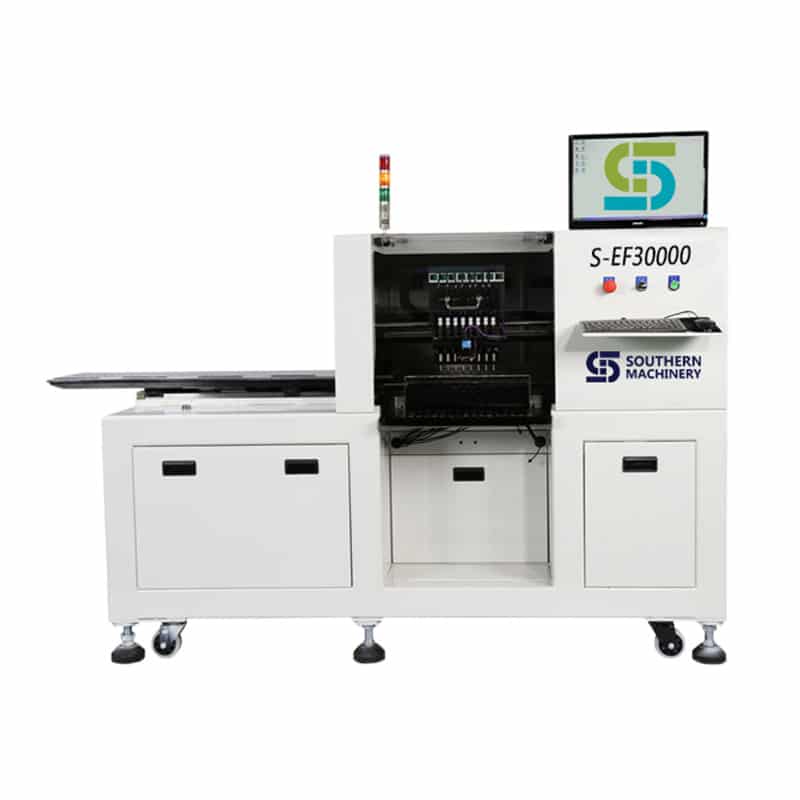
S-EF30000 Semi-Automatic Pick and Place Machine: 8-Head LED Placement from Southern Machinery
LED lighting assembly sits in an awkward middle ground for many factories. Volumes are too high for a manual bench to stay competitive, but the product mix — tube boards, bulb boards, flexible strips, odd-shaped modules — often does not justify a fully inline SMT line with an automatic loader, printer and conveyor chain sized around one board family.
The S-EF30000 semi-automatic pick and place machine from Southern Machinery is built for exactly that middle ground. It is an eight-head placement platform configured for LED lighting products, published at a real speed of 25,000–30,000 CPH with ±0.1 mm accuracy and a board envelope of up to 310 × 1200 mm — long enough to place a 1.2 m LED tube board in a single pass.
Southern Machinery has been building SMT and THT PCB assembly automation equipment in Shenzhen since 2011 and serves 237+ customers worldwide, from single machines for LED lighting and power supply factories to complete PCB assembly lines.
What is the S-EF30000 semi-automatic pick and place machine used for?
The S-EF30000 is used to place SMD components onto LED lighting PCBs at production speed, with an operator loading and unloading boards rather than a fully automatic conveyor interface. It is a placement platform, not a complete line: paste printing, reflow, and inspection remain separate process steps around it.
In practical terms, it does four jobs:
- Places LED components and passives — resistors, capacitors, standard LEDs and irregularly shaped LEDs, in sizes from 0603 up to 7474.
- Handles long LED boards — a maximum board size of 310 × 1200 mm (L × W), with Southern Machinery publishing a PCB length of 1220 mm / 4 ft and assembly of LED PCBs up to 1.2 meters long in a single pass.
- Holds placement accuracy on LED assemblies — each of the eight pick-up heads carries its own vision alignment camera, and a high-resolution digital camera handles fiducial recognition and programming.
- Keeps feeder reliability under continuous production — the machine uses motor-driven feeders rather than air-driven feeders, which Southern Machinery positions for around-the-clock LED production.
S-EF30000 specifications published by Southern Machinery
These are the values Southern Machinery publishes on the S-EF30000 product page. They are the numbers to quote internally when you build a business case, and the numbers to re-confirm in your purchase specification.
- Mounting heads: 8 nozzle heads, each with a vision alignment camera
- Real speed: 25,000–30,000 CPH
- Maximum placement speed: 0.1 s/chip
- Placement accuracy: ±0.1 mm
- PCB size: maximum 310 × 1200 mm (L × W)
- PCB length: 1220 mm / 4 ft
- Component range: 0603 to 7474, including resistors, capacitors, standard LEDs and irregularly shaped LEDs
- Feeder type: motor-driven feeders with intelligent feeding pitch adjustment
- Fiducial recognition: high-resolution digital camera, with programming from the same camera system
- Software: Southern Machinery self-developed placement software, described as simplified operation and programming
- Hardware platform (as published): KURODA ball screws (Japan), PANASONIC servo motors and drivers (Japan), SHINANO stepper motors and drivers (Japan), vacuum system from Taiwan, KITA pressure detecting system (Taiwan), IGUS cables (Germany), IPC-based operation
A note on the two speed figures: 0.1 s/chip is the peak single-head placement rate, while 25,000–30,000 CPH is the real throughput Southern Machinery publishes for the machine as a whole. Peak rates are useful for comparing platforms on paper; real CPH is the number that matters when you are quoting cycle time to a customer. Always model throughput against your own board — LED count, component mix, board length and feeder positions all move the real number.
Typical application scenarios
LED lamp and bulb board assembly
Bulb boards and lamp PCBs usually carry a moderate LED count plus passives, on a small board. That is a comfortable workload for a semi-automatic platform: the operator loads a batch, the machine places the full board, and the board moves on to reflow.
Flexible LED strips and linear lighting
Flexible PCB strips are the case that pushes many buyers away from standard inline SMT lines, because the material does not behave like a rigid panel. The S-EF30000 is published as suitable for flexible PCB strips as well as rigid LED boards.
Circular bulb boards and irregularly shaped boards
Circular and irregular LED boards are awkward to convey automatically. On a semi-automatic machine the board is simply presented and located, which removes the tooling and conveyor engineering that a fully inline approach would require.
Long LED tube boards up to 1.2 m
Tube and linear fixtures often exceed the board length of a standard inline platform. The S-EF30000 is published at a 1220 mm / 4 ft PCB length and assembles LED PCBs up to 1.2 meters long in a single pass — no panel splitting, no second pass, no re-registration.
LED display modules and LED lighting EMS overflow capacity
Factories assembling LED displays (the product page tags the platform for LED display and LED lamp work) and EMS plants that need additional LED PCBA placement capacity without commissioning a full line can use a semi-automatic platform as flexible, low-commitment capacity.
Semi-automatic vs fully inline: how to choose
This is the decision that determines whether the S-EF30000 is the right machine for you. The honest answer depends on volume, mix and floor space, not on which machine has the higher CPH figure.
Choose semi-automatic when:
- Board sizes and shapes change often, and conveyor tooling would be rebuilt constantly.
- Annual volume sits between manual assembly and full-line automation.
- You want the placement step automated first, without committing to a complete SMT line.
- Floor space or capital budget rules out a full inline configuration in this phase.
- Board families are long, flexible or irregular — exactly the profiles that fight rigid conveyance.
Choose a fully inline SMT line when:
- Volumes are high and the board family is stable, so conveyor and tooling investment amortizes.
- You need the printer, placement, reflow and inspection steps running as one untended flow.
- Labour availability, not capital, is the binding constraint on output.
Many LED lighting manufacturers run both: an inline line for the high-volume staple board, and semi-automatic platforms for everything else. Southern Machinery supplies both configurations and can advise which split fits your mix.
How the S-EF30000 fits into a complete PCB assembly line
The S-EF30000 automates one step — placement. Around it, a typical LED lighting assembly flow looks like this:
- Solder paste printing — stencil printing onto the LED board, on a manual, semi-automatic or automatic printer depending on volume.
- S-EF30000 placement — LEDs and passives placed with vision alignment on all eight heads, board loaded and unloaded by the operator.
- Reflow soldering — lead-free reflow to form the SMT joints.
- Inspection — SPI after printing, AOI after reflow, depending on the quality gate you need.
- THT and wave soldering — where the LED assembly also carries through-hole parts, the THT side of the line runs separately: insertion, wave soldering, lead trimming and cleaning.
- Depaneling and board handling — separators, loaders, unloaders and conveyors to move product between steps.
Southern Machinery supplies the equipment at each of those steps — SMT placement, THT insertion machines, wave and selective soldering, board handling, inspection and depaneling — which is the practical reason to involve the vendor at line-planning stage rather than buying the placement machine in isolation. Interfaces you should confirm in writing for your configuration: how the board is presented to the machine, whether any conveyor or SMEMA-style interface is required for your layout, and how boards will move to reflow.
Motorized feeders: the cost-of-ownership argument
The S-EF30000 uses motor-driven feeders rather than air-driven feeders. Southern Machinery publishes six advantages, and they are worth reading as a maintenance and uptime argument rather than a speed argument:
- Higher feeding stability, which effectively prevents pick-up failure
- Longer feeder life, described as hard to break down
- Motor-driven operation, which saves air source
- Higher feeding accuracy and consistency
- Higher feeding speed
- Intelligent adjustment of the feeding pitch
For LED production running continuously, the meaningful items here are feeder life and pick-up failure. A feeder that mis-picks costs you a board, an operator intervention and a re-inspection; a feeder that wears out costs you spare parts and unscheduled downtime. Removing compressed air from the feeder system also removes a whole class of maintenance and utility problems from the placement cell.
Key selection parameters to confirm with your vendor
Use this as a purchase-spec checklist. Southern Machinery does not publish every value below for every configuration, so confirm each one in your quotation rather than assuming a default.
- Maximum and minimum PCB size, including the long-board limit relevant to your tube or linear products
- Component range and nozzle set — whether your smallest passives, your largest LEDs and any irregular LED packages are all covered
- Feeder count and feeder positions available for your component mix
- Vision system configuration — per-head alignment cameras plus fiducial recognition, and how programming is done
- Placement accuracy and repeatability as specified for your configuration
- Electrical supply, air requirement and floor space for your facility
- Board loading method and line interface — semi-automatic presentation, or any conveyor interface your layout requires
- Software, programming workflow and data handling, including whether MES or traceability integration is needed
- Spare parts availability, feeder and nozzle supply, training and service response
- Warranty terms and what is included in commissioning
Quality, throughput and ROI perspective
Three things drive the return on a placement platform: placement quality, real throughput, and the cost of keeping it running.
Quality. The published ±0.1 mm accuracy and per-head vision alignment address the failure mode that hurts LED assemblers most — a misplaced or skewed LED that passes electrically but fails visually or thermally. Fewer misplacements means less touch-up, less rework and less scrap on an LED PCBA where the LEDs are often the most expensive components.
Throughput. At a published 25,000–30,000 CPH real speed across eight heads, the S-EF30000 moves LED placement out of the manual-labour column without requiring a full inline line. Build your ROI on your own cycle time: components per board, boards per shift, and the operator time the machine removes versus your current process.
Cost of ownership. Motor-driven feeders, a published hardware platform using named international component brands, and self-developed placement software all reduce the day-to-day cost of running the machine — fewer air-related faults, fewer feeder breakdowns, and programming that an operator can learn rather than a specialist.
What Southern Machinery does not publish
Southern Machinery does not publish a payback period, a savings percentage, a price, a delivery lead time, a warranty duration or a certification list for the S-EF30000, and this article does not invent them. Those values depend on your configuration, your board and your quotation. Ask for them in writing, and treat any figure you see elsewhere without a source as unverified.
FAQ
What is the S-EF30000 semi-automatic pick and place machine used for?
It places SMD components — LEDs, resistors and capacitors from 0603 to 7474 — onto LED lighting PCBs, including flexible LED strips, circular bulb boards, irregularly shaped boards and LED tube boards up to 1.2 meters long. An operator loads and unloads boards, so it automates the placement step without requiring a fully inline SMT line.
How many heads and what speed does the S-EF30000 have?
Eight nozzle heads, each with its own vision alignment camera. Southern Machinery publishes a real speed of 25,000–30,000 CPH and a maximum placement speed of 0.1 s/chip.
What accuracy and board size is published for the S-EF30000?
Placement accuracy is published at ±0.1 mm, with a maximum PCB size of 310 × 1200 mm (L × W) and a published PCB length of 1220 mm / 4 ft.
Does the S-EF30000 use air feeders?
No — it uses motor-driven feeders, which Southern Machinery specifies for higher feeding stability, longer feeder life, lower air consumption, higher feeding accuracy and speed, and intelligent feeding pitch adjustment.
What is the difference between semi-automatic and fully automatic pick and place?
A semi-automatic machine is loaded and unloaded by an operator and automates placement only; a fully automatic inline machine is fed by conveyor and runs as part of a connected flow with printing, reflow and inspection. Semi-automatic is usually the better fit for high-mix, long, flexible or irregular LED boards; fully automatic suits high volume on a stable board family.
Which components and products can the S-EF30000 handle?
Components from 0603 to 7474, including resistors, capacitors, standard LEDs and irregularly shaped LEDs. Southern Machinery publishes it as suitable for all LED lighting products, including flexible PCB strips, circular LED light bulb boards and irregularly shaped boards.
Get a configuration proposal for your LED assembly line
If you are assembling LED lighting boards and deciding between manual placement, a semi-automatic platform and a fully inline SMT line, Southern Machinery can work through the configuration with you — board sizes, component mix, feeder and nozzle requirements, and how the machine connects to your printing, reflow and inspection steps.
- Talk to Southern Machinery for machine selection and configuration advice on the S-EF30000 and the wider SMT/THT line: jasonwu@smthelp.com | +86 13602562576
- Browse the equipment catalog and technical documents, including product PDFs and manuals, at file.autoinsertion.com
- See real machine photos and product albums at ph.smthelp.com
- Explore the full equipment range, from SMT placement and THT auto insertion to wave soldering, board handling, inspection and depaneling, at smthelp.com

Southern Machinery Sales and Service Co., Ltd — Shenzhen, China. Building SMT and THT PCB assembly automation equipment since 2011, serving more than 237 customers worldwide.
Comments