
Online Routing Depaneling vs. V-Cut vs. Manual Snap-Off: S-D3500S PCB Separator Guide by Southern Machinery
Manual snap-off causes cracked traces, lifted pads, and rework on stamp-hole boards. Southern Machinery's S-D3500S online routing PCB separator replaces it with servo-driven, 60,000 RPM routing, vacuum handling, and auto
Sep 4, 2026 · Updated Sep 4, 2026 · Southern Machinery
Online Routing Depaneling vs. V-Cut vs. Manual Snap-Off: S-D3500S PCB Separator Guide by Southern Machinery
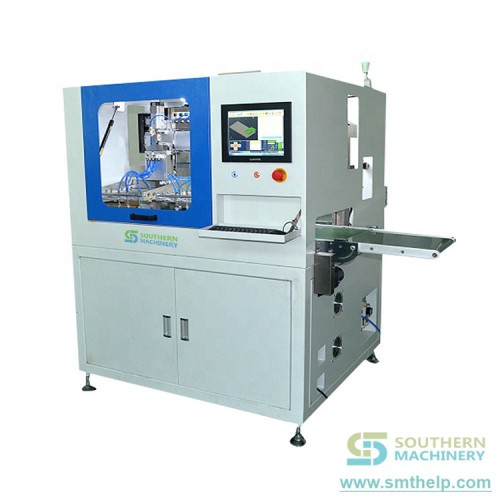
Manual snap-off is the most common cause of cracked PCB traces, lifted pads, and rework on stamp-hole boards. Southern Machinery's S-D3500S online routing PCB separator replaces that manual step with a servo-driven 60,000 RPM routing spindle, vacuum board handling, and automatic tool change—fully inline with your existing SMT and THT assembly line. This guide explains when an online routing separator is the right depaneling choice, how the S-D3500S fits into a complete PCBA line, and which parameters to verify before you buy.
What is this machine used for?
The S-D3500S is an online (inline) routing depaneling machine designed for PCBs produced in panels and separated after soldering. Instead of breaking boards by hand or pressing them over a V-cut blade, the machine routes each board along a programmed cutting path with a high-speed spindle.
Typical applications for the S-D3500S include:
- Stamp-hole / tab-route panel separation — the classic "rat-bite" or tab-routed panel format used when a board shape cannot be V-scored.
- V-groove and mixed-format boards that require clean, low-stress edges.
- Curved or non-linear outlines — linear, circular, U-curve, arc, and L-curve cutting paths are supported, something a straight V-cut blade cannot produce.
- Boards that must not be stressed — routing eliminates the mechanical shock of snap-off, protecting ceramic capacitors, connectors, and fine-pitch THT joints already soldered on the board.
Official Southern Machinery specifications for the S-D3500S (with belt) list a working area of X 300 mm × Y 350 mm × Z 0–50 mm, PCB thickness of 0.5–2 mm (or thicker), cutting precision of ±0.01 mm, and repeatability of ±0.02 mm. The air-cooled spindle runs at 60,000 RPM and accepts router bits of 0.8–2.0 mm diameter. Confirm these figures with Southern Machinery when you scope your specific board set.
Typical application scenarios
Online routing depaneling proves its value wherever panels come out of reflow or wave soldering in high volume with stamp-hole or tab-route breakaways:
- Power supply and LED driver lines — long, narrow boards and aluminum or FR4 panels with irregular outlines.
- Automotive and industrial control modules — boards with many THT connectors and electrolytic capacitors where snap-off shock creates hidden solder-joint cracks.
- EMS / ODM high-mix factories — one machine programmed for many panel designs; program capacity exceeds 400 cutting points per program with on-screen dynamic simulation.
- Boards with components close to the panel edge — routing with ±0.01 mm cutting precision keeps the bit away from component bodies that manual breaking would damage.
How the S-D3500S connects to a complete PCB assembly line
The "online" in the model name means the machine is designed for automatic loading and unloading, not manual feeding:
- Front-end link — the S-D3500S communicates with upstream equipment such as an SMT magazine loader or an unloader after reflow oven / wave soldering, so PCBA panels arrive by belt conveyor (feeding track width 60–360 mm).
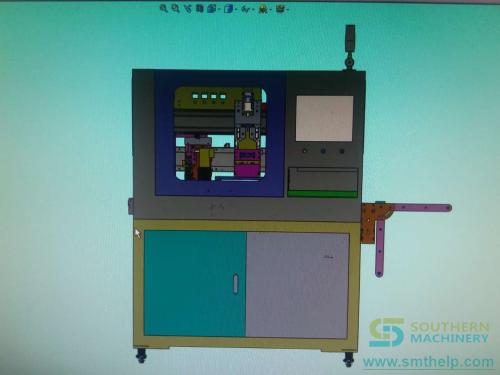
- Vacuum pick and position — a vacuum manipulator grips each panel (up to 350 mm × 350 mm) onto a dedicated fixture, eliminating placement error before cutting.
- Mark-point correction — the machine automatically corrects panel position against fiducial marks, compensating for upstream placement tolerance.
- Routing and tool management — the spindle follows the programmed path; automatic tool changing handles different bit diameters, cutter wear is monitored (0–3 knife sections programmable), and a break-detection function protects the board and spindle.
- Downstream hand-off — separated boards unload automatically to the next station; the built-in cleaner collects dust on the underside of the cut.
This is the standard position for a depaneling router in a full Southern Machinery line: SMT placement and reflow oven for the SMD side, THT auto insertion plus wave soldering for the through-hole side, then routing separation and board handling into test.
Online routing, offline routing, or V-cut: how to choose
There is no single "best" separator—the right choice depends on panel format and production flow:
- V-cut (score line) is the cheapest per board and very fast, but works only for straight lines and leaves a scored edge. If your board is rectangular and already V-scored, a V-cut separator (such as Southern Machinery's S-D505 or S-D509 series) is usually sufficient.
- Offline routing suits lower volumes or boards that arrive in batches and can be loaded by an operator. Southern Machinery's S-D4500 is an offline routing separator for this case.
- Online routing, such as the S-D3500S, pays off when panels are tab-routed or stamp-hole, have curved outlines, or run in high volume where an operator cannot keep up with manual loading and snapping. Because the S-D3500S loads and unloads automatically through the belt interface, it removes the human from the depaneling step entirely.
Ask Southern Machinery for a process recommendation based on your panel drawing—the decision among V-cut, offline routing, and online routing is normally settled by board outline, breakaway type, volume, and existing conveyor flow.
Key specifications and selection checklist for the S-D3500S
Only verifiable parameters from the official S-D3500S product page are listed here; confirm each against your own boards during quotation:
| Parameter | Official value (S-D3500S with belt) |
|---|---|
| Working area | X 300 mm, Y 350 mm, Z 0–50 mm |
| PCB thickness | 0.5–2 mm (or thicker) |
| Cutting precision / repeatability | ±0.01 mm / ±0.02 mm |
| Spindle | 60,000 RPM, air-cooled |
| Router bit diameter | 0.8–2.0 mm, automatic tool change |
| Cutting ability | Linear, circular, U-curve, arc, L-curve |
| Feeding track | Belt, width 60–360 mm; split-plate output belt 420 mm |
| Vacuum manipulator | Grips PCBs up to 350 mm × 350 mm |
| Machine data | L1750 × W1100 × H1850 mm (with belt), approx. 1000 kg, 5.5 kW, 220 V / 50 Hz |
| Extras | Mark-point auto correction, break detection, cutter-life control, built-in dust cleaner (2.2 kW), security door with sensor, ≤78 dB |
Questions a buyer should confirm before ordering:
- Your largest and smallest panel dimensions, board thickness, and breakaway type (stamp-hole, tab-route, V-groove, or mixed).
- Whether the routing outline contains curves or cutouts that require the full XY path capability.
- Conveyor height and direction of the upstream and downstream machines you will connect to.
- Fixture design—the S-D3500S uses a dedicated fixture per board type; plan for fixture cost and changeover time in the ROI.
- Voltage, air pressure (0.5 MPa or above is specified), and floor space with the belt option.
- Production volume per shift, to confirm whether online automatic loading is justified versus an offline router.
ROI, quality, and throughput perspective
The financial case for the S-D3500S rests on three measurable effects:
- Yield, not speed — manual snap-off of stamp-hole panels damages traces and pads at a rate often accepted as "normal." Routing with ±0.01 mm cutting precision and mark-point correction eliminates cracked-edge rejects, reducing rework cost and warranty risk on automotive and industrial boards.
- Labor removal — automatic loading, cutting, and unloading replaces operators whose job was snapping and sorting panels. Southern Machinery models ROI case by case, but the labor comparison is a direct headcount reduction at the depaneling step.
- Consistency across shifts — a program-controlled process holds the same cut quality at 2 a.m. as at 9 a.m. This matters for factories reporting quality KPIs to automotive or medical customers.
For throughput planning, treat the routing separator as part of the line's conveyor system: match the machine's belt interface and cycle time to your wave soldering or reflow oven output rather than sizing it in isolation.
FAQ
What is an online routing PCB separator?
An online (inline) routing PCB separator is a depaneling machine that loads PCBA panels automatically from a conveyor, cuts them apart along programmed paths with a high-speed routing spindle, and unloads the separated boards automatically—no manual snapping.
When should I choose the S-D3500S instead of a V-cut separator?
Choose routing when boards are joined by stamp holes or tabs instead of V-scores, when outlines are curved or non-linear, or when snap-off shock damages components. V-cut machines handle only straight score lines and are the lower-cost option for simple rectangular panels.
Can the S-D3500S connect to my existing SMT or THT line?
Yes. The S-D3500S is designed for online automatic loading and unloading via belt conveyor (60–360 mm track width) and communicates with front-end equipment such as an SMT magazine loader, so it can be placed after reflow oven or wave soldering. Confirm conveyor height and handshake with Southern Machinery during layout planning.
What PCB sizes can the S-D3500S handle?
The official specification lists a working area of X 300 mm × Y 350 mm, vacuum gripper capability up to 350 mm × 350 mm, and PCB thickness of 0.5–2 mm or thicker. Verify against your largest and smallest panels before ordering.
Does routing damage components near the panel edge?
Routing is a low-stress cutting method compared with manual snap-off. The S-D3500S uses a dedicated fixture, mark-point auto correction, and ±0.01 mm cutting precision, allowing the bit to follow tight outlines without mechanical shock to solder joints.
How do I get a configuration and ROI recommendation?
Contact Southern Machinery with your panel drawing, board thickness, and production volume. The team can recommend among V-cut, offline routing, and online routing, and provide a machine configuration and ROI model for your line.
About Southern Machinery
Southern Machinery, founded in 2011 in Shenzhen, China, is an SMT and THT PCB assembly automation equipment supplier serving 237+ global customers in EMS, ODM, automotive electronics, medical electronics, and industrial control. Beyond the S-D3500S, Southern Machinery provides complete SMT, THT, wave soldering, board handling, inspection, and full-line solutions, plus spare parts, training, and after-sales service.
Contact Southern Machinery for a configuration and ROI recommendation for your depaneling step. Browse the product catalog and PDFs at file.autoinsertion.com, view machine photos at ph.smthelp.com, or email jasonwu@smthelp.com.
Comments