
S-AX520 Double-Sided DIP AOI by Southern Machinery
Double-sided DIP AOI for wave-solder final inspection: the S-AX520 inspects top and bottom in one pass with 5MP/20MP cameras, DIP solder-joint algorithms, barcode line change, double-sided result binding, SPC early warning and SMEMA/Ethernet integration. This guide gives a five-point checklist for DIP final inspection, a specification table taken from the datasheet, line placement advice and an example ROI formula, so EMS and THT teams can reduce inspection stations, keep quality stable and integrate AOI into a complete PCB assembly line with Southern Machinery.
Nov 1, 2026 · Updated Nov 1, 2026 · Southern Machinery
S-AX520 Double-Sided DIP AOI by Southern Machinery
What is the S-AX520 used for? The S-AX520 series is a double-sided automatic optical inspection (AOI) machine for final inspection of PCBA after wave soldering, inspecting the top and bottom of the board at the same time. According to the source datasheet, one machine does the detection work of two machines, simplifies the process and saves plant space.
Why does the last inspection step still leak defects?
Most teams assume the soldering process decides quality. In practice, the quality you ship is decided by what you can see after the wave. Missing pins, tin holes and shifted components pass quietly when a board is checked one side at a time, by eye, under shift fatigue.
If that sounds familiar, you are probably running two inspection stations (or one station and one tired operator) for a job that should be a single pass. Every extra handling step is another chance to mix up which result belongs to which side of which board.
What should a DIP final-inspection checklist cover?
Use this five-point framework before choosing any machine:
- Coverage: can top and bottom be inspected in one pass?
- Defect list: does the system target DIP solder-joint defects, not only SMD ones?
- Board behaviour: can it cope with flexible or deformed boards?
- Data: can results be traced per board, per side?
- Line fit: does it connect to the conveyor and MES you already run?
The source datasheet lists detection examples such as good, wrong direction, deviation, missing part, tin hole, no foot, and missing needle. Use that list as your starting defect library and confirm the scope for your own products with Southern Machinery.
How does the S-AX520 apply that framework?
Coverage in one pass
Above and below detection happens at the same time. Dual cameras position synchronously but capture images asynchronously with interlocking, to avoid interference between the upper and lower light sources.
DIP-specific algorithms
The datasheet describes a special solder-joint algorithm for both hand-inserted and machine-inserted DIP parts. Component-level pad positioning handles flexible boards, where deformation causes false and missed calls. FOV overall positioning on non-flexible boards ignores interference from screen printing and printed lines. A CPU stitching algorithm targets bending, deformation and missing-pin defects.
Traceability and line control
- Scan the barcode for automatic line change: width and program are called without manual participation, with MES instruction support.
- Double-sided barcode binding: with one barcode on one side only, results from both sides are bound dynamically.
- SPC early warning: real-time monitoring and feedback to prevent batch defects from flowing out.
- Whole-board output: the full-panel image is exported, including component and non-component areas, for later traceability.
- Centralized management: remote recovery, offline programming and debugging updates.
What are the key S-AX520 specifications?
| Item | S-AX520 / S-AX520XL (per source) |
|---|---|
| Camera | 5MP / 20MP industrial camera |
| Resolution | 5MP: 24 μm, 15 μm; 12MP: 15 μm |
| FOV | 6049mm (5MP, 24μm); 6045mm (12MP, 15μm) |
| Light source | 4-colour ring programmable LED (RGBW) |
| X/Y motion | AC servo (XL: AC servo dual-drive) |
| Track | Belt standard, wheel optional; self-correcting width |
| Communication | Ethernet, SMEMA |
| Power / air | Single-phase 220V, 50/60Hz, 5A; 0.4-0.6 MPa |
| Track height | 900±20mm standard, 740±20mm optional |
| Weight | 900kg |
| Size | L1170 D1608 H1580mm (excl. signal tower), customizable |
| OS | Win10 |
Throughput, inspection speed and price are not specified in source — contact Southern Machinery to confirm.
Where does it fit in a PCB assembly line?
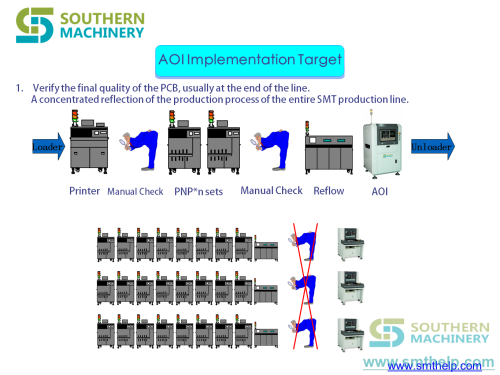
The datasheet places AOI at several points: printing, SPI, chip shooter, pre-oven AOI, oven, plug-in machine, large-field AOI, and wave-solder double-sided AOI. The S-AX520 sits at the wave-solder exit, as the last gate before the board leaves the line. It communicates over SMEMA, so it connects to board handling systems, after a wave soldering machine in a THT line. See also our AOI and SPI range.
How do you estimate the value?
Formula (example only): Monthly saving = (stations replaced x cost per station per month) + (escaped defects avoided x cost per escape) - monthly running cost.
Example with placeholder numbers: replacing two inspection stations with one, at an assumed 1,000 per station per month, gives 2,000 before other terms. Real results depend on configuration and are subject to final technical confirmation. No guaranteed ROI is implied.
FAQ
Does the S-AX520 inspect both sides at once? Yes, per the datasheet, upper and lower detection happen simultaneously.
Can it handle flexible boards? The source describes component-level pad positioning for flexible boards.
Which interfaces does it support? Ethernet and SMEMA; MES instruction support is described for barcode line change.
What is the difference between S-AX520 and S-AX520XL? The source lists AC servo X/Y for the standard model and AC servo dual-drive for XL.
Is a wheel track available? Yes, optional, for high temperature, dirt and heavy load.
What should you do next?
Copy the five-point checklist into your next line audit and score your current final inspection against it. Next in this series: how to set up offline AOI programming and cut false calls. Southern Machinery, founded in Shenzhen in 2011 and serving 237+ global customers, supplies SMT and THT lines with global service, spare parts and training. Request a quote with your board size and defect list.
Comments