
S-AT500 PCB Turnover Machine Setup & Maintenance Guide: Keeping the Flip Cycle Stable in Double-Sided PCB Lines
Setup and maintenance guide for the Southern Machinery S-AT500 PCB turnover machine: installation checks, preventive maintenance, service and spares.
Sep 5, 2026 · Updated Sep 5, 2026 · Southern Machinery
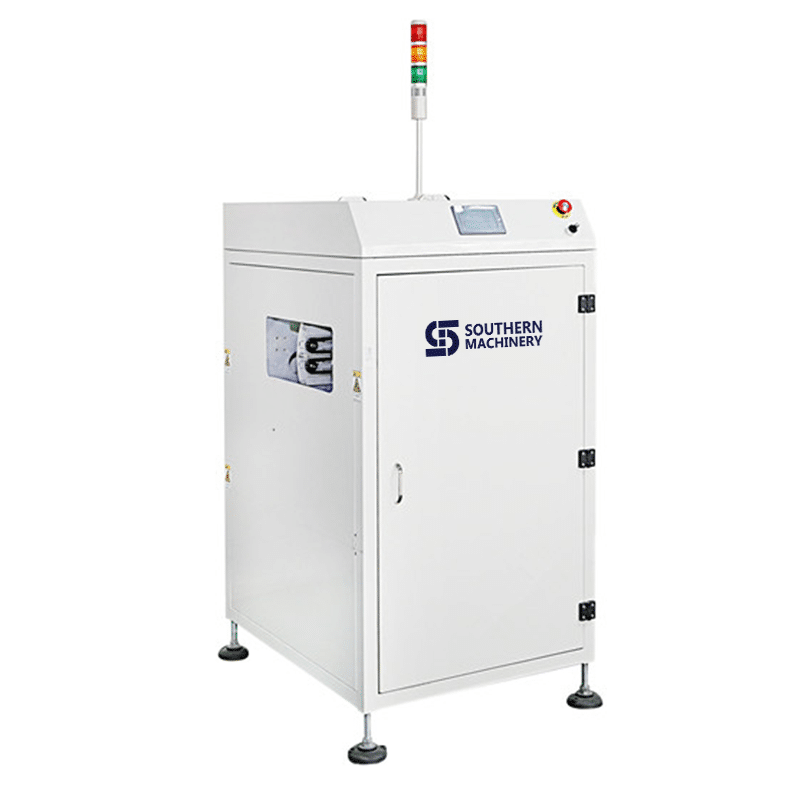
S-AT500 PCB Turnover Machine Setup & Maintenance Guide: Keeping the Flip Cycle Stable in Double-Sided PCB Lines
A PCB turnover machine is only worth having if the flip cycle stays reliable shift after shift. For EMS, ODM, automotive electronics, medical electronics, and industrial control manufacturers running double-sided PCB assembly, the Southern Machinery S-AT500 Auto PCB Turnover Machine—an inline board handling module that rotates a PCB 180 degrees under PLC control—removes the manual flip from the process. But like any mechanical module, it needs correct installation, setup, qualification, and preventive maintenance to protect line uptime.
Southern Machinery (Shenzhen Southern Machinery Sales And Service Co., Ltd) was founded in 2011 in Shenzhen and serves 237+ global customers with SMT/THT PCB assembly automation equipment and complete line solutions covering SMT, THT, wave soldering, board handling, and inspection. This guide is written for process and maintenance engineers who have already decided on automation and now need the practical details: site conditions, first setup, routine checks, board qualification, and service.
What Is This Machine Used For?
Q: What is an S-AT500 PCB turnover machine used for?
An auto PCB turnover machine inverts a PCB 180 degrees (top to bottom) between processes so both sides of a double-sided board can be assembled, inspected, or reworked without manual handling. The S-AT500 performs the flip automatically at a consistent cycle on the conveyor line, so boards arrive at the next machine in the correct orientation every time.
Q: Why does the flip itself need maintenance attention?
The flip is a mechanical motion with a board under it. If the rail width, transfer height, or belt condition drifts, boards can be misaligned entering the next machine, scratched by worn belts, or stopped by a jam—and every jam is unplanned downtime at the heart of the line. A structured setup and maintenance routine is what keeps the module invisible: boards in, flipped, boards out.
S-AT500 Verified Specification Reference
The following parameters are published on the official S-AT500 product page at smthelp.com and are the values to design your installation and maintenance checks around:
| Parameter | Published Value |
|-----------|-----------------|
| Model | S-AT500 |
| Machine dimensions | L600 x W840 x H1400 mm |
| Transfer height | 920 ± 30 mm |
| Rail length | 586 mm |
| Rail width | 50–390 mm, adjustable |
| Max PCB size | L x W 500 x 390 mm; max board weight 2 kg |
| Conveyor speed | 0–4 m/min |
| Belt | 7 mm flat belt |
| Control system | PLC |
| Conveyor direction | L to R, or R to L |
| Power supply | Single-phase 220 V, 50 Hz |
Keep this table with the machine file. Every maintenance interval, spare part order, and new-board qualification starts from these numbers.
Before Installation: Site Conditions to Verify
Southern Machinery publishes installation and safety guidance for its board handling family in the official user manual. Before the machine arrives, confirm these points on site:
- Power and grounding. The machine is rated single-phase 220 V, 50 Hz. Provide a dedicated supply and a reliable ground connection to the factory ground bus. The ground wire must be firmly fixed to the metal frame of the machine. Never operate without proper grounding.
- Environment. Do not install the machine in dust, oil mist, conductive dust, corrosive gases, flammable gases, moisture, shock, vibration, high temperature, or outdoor conditions. Board handling modules are precision conveyors; a clean, stable environment protects sensors and belts.
- Floor space and access. Allow the published machine footprint plus clearance for the conveyor direction you choose (L to R or R to L) and for maintenance access to the rail-width adjustment and electrical enclosure.
- Trained personnel. Only operators and technicians who have completed training should run or maintain the equipment. Do not modify the electrical enclosure hardware or software. Any transformation should be coordinated with Southern Machinery first.
First Setup and Acceptance Checks
When the S-AT500 is first installed, work through these checks before releasing it to production:
- Transfer height matching. Set the machine so its transfer height (published at 920 ± 30 mm) aligns with the adjacent equipment. Height mismatch is the most common cause of boards snagging at the interface.
- Conveyor direction. Confirm the machine is configured L to R or R to L to match your line flow.
- Rail width setting. Adjust the rail width within the published 50–390 mm range for your largest panel, then confirm the smallest panel also tracks correctly. Width adjustment should move smoothly and lock firmly.
- Belt condition. Inspect the 7 mm flat belt for damage and correct tracking before first power-on.
- Cycle versus takt time. Run the module in automatic (pass-through) mode and measure the real flip cycle against your line takt time. The turnover module must complete its cycle faster than the line cycle so it never becomes the bottleneck.
- Alarm and reset behavior. Confirm the reset procedure after a fault alarm and make sure operators know how to return the module to automatic running after an abnormality is cleared.
- Debris check. Before each release to production, check that no debris, loose components, or PCBs are left on the track.
Routine Operation and Process Checks
During normal running, the operator's job is observation plus a small set of checks:
- Watch the flip motion for abnormal noise or hesitation—the first sign of a mechanical or belt problem.
- Confirm each board exits in the correct orientation; a board that leaves misaligned usually means rail width or transfer height drifted.
- On fault alarm, stop, clear the abnormality, reset the module, and only then resume automatic running.
- Keep the track and sensor areas clear of debris at all times.
- When wiping the machine, use a neutral detergent. Avoid corrosive solvents that can damage belts, sensors, and finishes.

Preventive Maintenance Checklist
Preventive maintenance keeps the turnover module at zero surprise. Confirm the exact interval list, torque values, and part numbers in the official user manual or during Southern Machinery operator training. A practical baseline is:
Daily
- Visual check for debris, loose PCBs, or foreign objects on the track.
- Listen for abnormal noise during the flip cycle.
- Confirm automatic pass-through mode starts and resets cleanly.
Weekly
- Clean rails and sensor areas with a neutral detergent; do not use corrosive solvents.
- Inspect the flat belt for wear, damage, and correct tracking.
- Verify the rail-width adjustment still moves smoothly.
Monthly / periodic
- Check that the ground connection to the machine frame is tight and corrosion-free.
- Re-verify transfer-height alignment with adjacent machines (published 920 ± 30 mm).
- Confirm conveyor speed settings still match your line flow (published 0–4 m/min).
- Review alarm history for repeated faults that point to a developing issue.
- Inspect board-contact and edge-gripping surfaces for wear, especially if you handle heavy or rough-edged panels.
Record every check with date and operator name. A simple log turns maintenance from a cost into a line-uptime tool: repeat faults become visible before they become failures.
Qualifying New Boards and Changeover
Every new product introduction should include a short qualification of the turnover module:
- Size and weight envelope. Confirm the panel is within the published maximum (L x W 500 x 390 mm, 2 kg) with margin.
- Component clearance. Tall components on both sides affect gripper and belt clearance. Run sample boards through a full flip and inspect for contact marks before releasing the new product.
- Edge condition. Panels with rough edges or V-score burrs can wear belts faster; check belt condition more frequently for such products.
- Changeover record. Write down the rail width setting for each product so changeover is a lookup, not an experiment.
Troubleshooting, Spare Parts and Service
Most turnover-module problems fall into a few families. Start with the basics before calling for service:
- Board jams at the module—check for debris, verify transfer height alignment with adjacent machines, and confirm rail width matches the panel.
- Misaligned board exit—re-check rail width and belt condition/tracking.
- Fault alarm on start or during run—follow the reset procedure after clearing the abnormality; if the same alarm repeats, log it for the service review.
- Unusual noise during flip—stop the line and inspect belts, drive, and board-contact surfaces before resuming.
Southern Machinery supports the S-AT500 and the whole board handling family with spare parts, sub-assemblies, retrofit kits, repair kits, machine upgrading, operator training, and overhaul services, plus guidance on integrating board handling modules (loader, unloader, buffer, turnover, 90-degree turning conveyor) into a full SMT/THT line.
ROI, Quality and Throughput Angle
The business case for a turnover module is measured in three places:
- Uptime. A maintained flipper never creates a bottleneck; the flip cycle is shorter than line takt and repeats identically.
- Quality. Consistent machine rotation eliminates dropped boards, component knock-off, and misorientation from hand turning—and a clean belt and aligned rails keep it that way.
- Labor and ergonomics. Removing the manual flip task frees an operator from a repetitive, ESD-sensitive handling step on every double-sided board.
A short preventive routine is a small price against the alternative: a manual flip station back at the end of the line, with its labor cost, defect rate, and cycle-time variance.
FAQ
Q: What is a PCB turnover machine used for in SMT assembly?
A PCB turnover (flip) machine rotates a PCB 180 degrees inline so both sides of a double-sided board can be processed—for example, between the first and second placement passes, or to present the soldered side to inspection—without manual handling.
Q: What is the transfer height of the S-AT500?
The published transfer height is 920 ± 30 mm. Confirm the height of your adjacent conveyors and machines before installation so boards transfer without snagging.
Q: What PCB sizes and weights can the S-AT500 handle?
The official specification lists a maximum PCB size of L x W 500 x 390 mm and a maximum board weight of 2 kg, with rail width adjustable from 50 to 390 mm. Verify your actual panel range with Southern Machinery.
Q: What maintenance does the S-AT500 need?
Daily checks for debris and abnormal noise, weekly belt and rail cleaning with neutral detergent, and periodic checks of grounding, transfer-height alignment, speed settings, and board-contact surfaces. The full list and intervals are in the official user manual and operator training.
Q: Can the S-AT500 be added to an existing SMT/THT line?
Yes. It is an inline module with PLC control and supports L-to-R or R-to-L conveyor direction. Confirm SMEMA and MES interface requirements with Southern Machinery when quoting so the module matches your existing line control.
Q: How do I get spare parts or service for the S-AT500?
Contact Southern Machinery directly for spare parts, repair kits, retrofit kits, upgrading, training, and overhaul support. Machine photos are available at ph.smthelp.com and product catalogs and PDFs at file.autoinsertion.com.
Get a Configuration Recommendation
Southern Machinery (Shenzhen Southern Machinery Sales And Service Co., Ltd) designs and manufactures SMT/THT PCB assembly automation equipment and provides complete line solutions covering SMT, THT, wave soldering, board handling, and inspection. Contact the sales team to match the S-AT500—or a complete board handling system with loader, unloader, buffer, and turnover modules—to your PCB size, line layout, and automation level.
- Browse the product catalog and PDFs: file.autoinsertion.com
- See machine photos and albums: ph.smthelp.com
- Product page: smthelp.com (S-AT500 Auto PCB turnover machine)
- Email: jasonwu@smthelp.com | Phone/WhatsApp: +86 13602562576
Comments