
Solder Robot S-A300 / S-B400: Desktop Soldering Automation for THT PCB Assembly
Southern Machinery S-A300/S-B400 solder robots automate THT touch-up, spot welding and multi-point soldering for EMS, power, LED and automotive PCB assembly.
Aug 9, 2026 · Updated Aug 9, 2026 · Southern Machinery
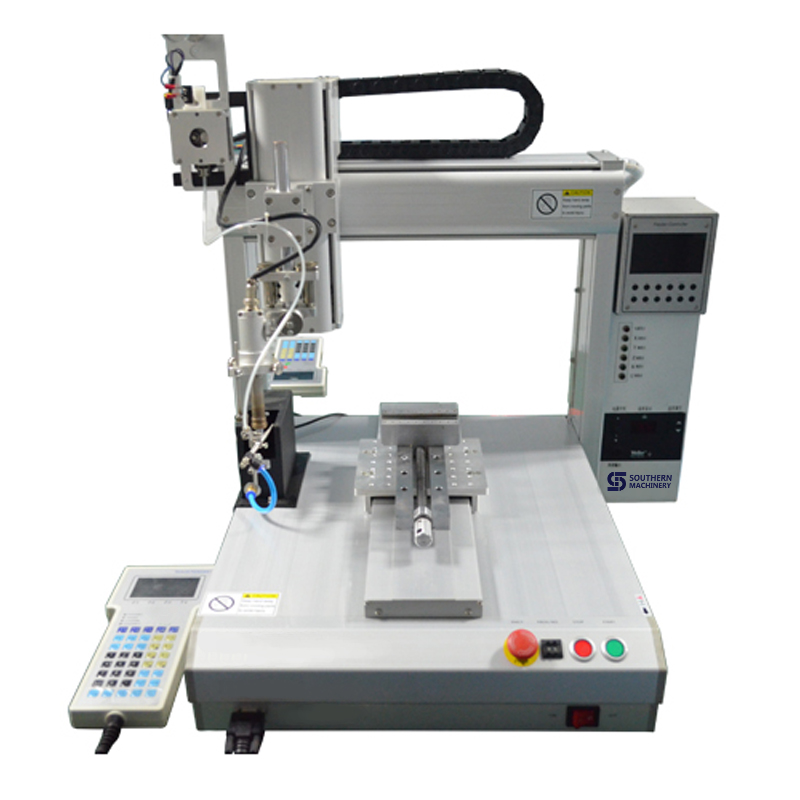
Solder Robot S-A300 / S-B400: Desktop Soldering Automation for THT PCB Assembly
Solder robots are the practical answer for PCB assembly shops that still hand-solder THT joints, touch-up points, and post-wave rework. Southern Machinery's S-A300 and S-B400 solder robots bring programmable three- and four-axis soldering to the desktop: teaching-pendant programming, ±0.02 mm repeatability, and a working range of 300 × 300 × 100 mm. For EMS and ODM factories handling power supplies, connectors, fuses, LED boards, and automotive electronics, these machines convert manual iron work into repeatable, documented soldering.
What is this machine used for?
A solder robot is a desktop XYZ (or XYZR) motion platform that carries a soldering iron and automatically feeds solder wire to each joint. Instead of an operator positioning an iron by hand, the robot moves the iron tip to programmed coordinates, applies heat and solder wire, and completes spot welds, multi-point soldering, and complex in-plane soldering patterns with consistent temperature and dwell time.
The S-A300 is a three-axis solder robot (X, Y, Z); the S-B400 adds a fourth R-axis with ±360° rotation for angled iron approaches and joints that are not perpendicular to the board plane. Both models are programmed with a teaching pendant — an operator jogs the iron to each joint, records the position, and the robot repeats the path. No offline CAM programming is required for most jobs, which keeps changeover fast in high-mix production.
Video: How Desktop Soldering Robot works for Smart EMS factory PCB assembly
Typical Application Scenarios
- Power supply and chargers — THT joints on PSU boards, transformers, and input/output connectors that reflow cannot address.
- Connectors and fuses — multi-point soldering of terminals where a human hand cannot stay consistent across a shift.
- LED lighting and display boards — wire leads, LED pins, and driver board joints needing clean, repeatable fillets.
- Automotive electronics — car audio and vehicle power boards where joint quality is documented for traceability.
- LCD and general PCB assembly — touch-up soldering after wave soldering, and small-batch THT work that does not justify a full selective soldering machine.
- Medical and industrial control electronics — mixed SMT/THT boards with low-volume, high-reliability soldering requirements.
These are exactly the board classes Southern Machinery supports across its customer base: electrical appliances, LED, power supply, vehicle electronics, energy-saving lighting, and general electronics.
How It Integrates into a Complete PCB Assembly Line
A solder robot is a flexible station, not a fixed line block — it fits wherever hand soldering currently sits:
- Post-wave touch-up station — after the wave soldering machine, the robot handles bridging, insufficient-fill, and component-lead joints that need rework before AOI.
- THT assembly cell — after auto insertion or manual insertion, the robot solders connectors, relays, and odd-form parts in a semi-automated cell.
- Offline repair / rework bench — programmed rework of specific joints with repeatable tip temperature and feed rate, replacing freehand iron work.
- Small-batch THT lines — for HMLV (high-mix low-volume) production, a solder robot replaces a manual soldering position without the fixture and nozzle costs of a selective soldering machine.
Because it runs on AC220V and requires only dry air at 4–5 kgf/cm², the robot drops into an existing bench or conveyor-adjacent position without facility changes. Fixtures are simple PCB holding jigs — the same ones your operators already use.
Key Selection Parameters
Verify these against your board mix before specifying:
- Number of axes — 3-axis S-A300 for flat multi-point soldering; 4-axis S-B400 with R-axis ±360° for angled joints and component leads standing off the board.
- Working area — X/Y travel of 300 mm and Z travel of 100 mm define the maximum board size and component height the robot can reach.
- Repeatability — S-A300/S-B400 specify ±0.02 mm on X/Y/Z, which is the parameter that determines joint-to-joint consistency.
- Teaching method — teaching-pendant programming matters for high-mix lines where operators create and adjust programs themselves.
- Soldering iron and tip selection — tip geometry, wattage, and temperature control should match your pad sizes and solder wire diameter; iron tips are consumables and should be easy to source.
- Solder wire feeding — confirm the wire feeder handles your wire diameter and that feed rate is adjustable per program step.
- Facility requirements — AC220V 50/60Hz power and dry air supply; footprint of 650 × 600 × 720 mm.
ROI, Quality & Throughput Perspective
The business case for a solder robot is built on three measurable changes:
- Labor efficiency. One operator supervises a robot that solders continuously; the same operator cannot hold a hand iron for 8 hours at consistent quality. Factories typically redeploy the soldering position to a second line or to inspection.
- Defect reduction. Hand soldering variance — tip temperature drift, dwell time differences between shifts, fatigue — is the main source of cold joints, bridging, and disturbed solder. A robot applies the same programmed profile to every joint, cutting rework downstream at AOI and ICT.
- Documented, repeatable process. Programmed paths are stored per product, so the same board solders identically next month or in the next production run — a real advantage for EMS customers who must prove process control to their OEM clients.
Combined with wave soldering and auto insertion machines from Southern Machinery, a solder robot closes the THT gap between high-volume wave soldering and low-volume hand work — without the capital cost of a full selective soldering line.
FAQ
Q: What is a solder robot used for?
A: A solder robot automates soldering iron work — spot welding, multi-point soldering, and complex in-plane joints on THT PCB assemblies — by moving a temperature-controlled iron and solder wire feeder along programmed paths.
Q: What is the difference between the S-A300 and S-B400 solder robots?
A: The S-A300 is a three-axis solder robot (X, Y, Z). The S-B400 adds a fourth R-axis with ±360° rotation, allowing angled iron approaches for joints that are not perpendicular to the board surface. Both share 300 mm X/Y travel, 100 mm Z travel, and ±0.02 mm repeatability.
Q: Can a solder robot replace manual soldering in a small EMS factory?
A: For repetitive THT joints, touch-up, and post-wave rework, yes — a desktop solder robot removes hand-soldering variance and frees operators for higher-value work. It is a lower-cost alternative to selective soldering for high-mix, low-volume production.
Q: How is the solder robot programmed?
A: Through a teaching pendant: the operator jogs the iron to each soldering position, records the point, and the robot replays the sequence. Programs are stored per product for repeatable runs.
Q: Which industries use solder robots for PCB assembly?
A: Power supply, LED lighting, connectors, fuses, LCD, automotive electronics, medical devices, and industrial control — any THT board with soldered leads, terminals, or post-wave touch-up points.
Q: What support does Southern Machinery provide for solder robots?
A: Southern Machinery (founded 2011, Shenzhen, China) provides sales support, spare parts, soldering iron tips, training, and after-sales service for its SMT/THT equipment, including the S-A300/S-B400 solder robot family.
Contact Southern Machinery for Configuration Advice
Tell us your board size, component mix, and monthly output, and we will recommend the right solder robot configuration and integration plan for your line.
- Email: Jason Wu at jasonwu@smthelp.com
- Website: www.smthelp.com
- Catalogs: file.autoinsertion.com
- Machine photos: ph.smthelp.com
Southern Machinery Sales and Service Co., Ltd — SMT/THT PCB assembly automation equipment since 2011, serving 237+ global customers with full-line solutions: SMT, THT, wave soldering, board handling, and inspection.
Comments