
S-530L Semi-Automatic Lens Placement Machine for LED PCB Assembly
Automate LED lens mounting with Southern Machinery's S-530L semi-automatic lens placer - vision-aligned mounting for tube, bulb and flexible PCBs up to 1.5 m.
Sep 4, 2026 · Updated Sep 4, 2026 · Southern Machinery
S-530L Semi-Automatic Lens Placement Machine: Precision LED Lens Mounting for PCB Assembly
S-530L is a semi-automatic lens placement machine designed by Southern Machinery for mounting optical lenses and irregular components onto LED and optoelectronic PCBs. It pairs flying-vision alignment with soft, lens-safe placement tooling so lighting manufacturers can automate a step that is normally done by hand: putting PC lenses, diffusers and optical covers onto LED tube boards, bulb boards and flexible strips.
What is this machine used for?
The S-530L places optical lenses and similarly shaped SMD parts onto printed circuit boards after soldering. Each of its eight placement heads carries a flying vision camera, so the machine aligns every lens to its pad or mounting mark in motion instead of stopping to check position. That makes it suitable for lens types and LED packages with tight optical tolerances, where a lens that is a few tenths of a millimeter off-center changes the beam angle of the finished luminaire.
Southern Machinery positions the S-530L as a semi-automatic placer: boards are loaded and unloaded with operator assistance, while the machine handles the repetitive, accuracy-critical placement work. According to the official product page, it places SMD components from 0603 up to 7474 — resistors, capacitors, standard and irregularly shaped LEDs — and can assemble LED PCBs up to 1.5 meters long in a single pass, with a maximum placement speed of 0.086 s per chip.
Typical Application Scenarios
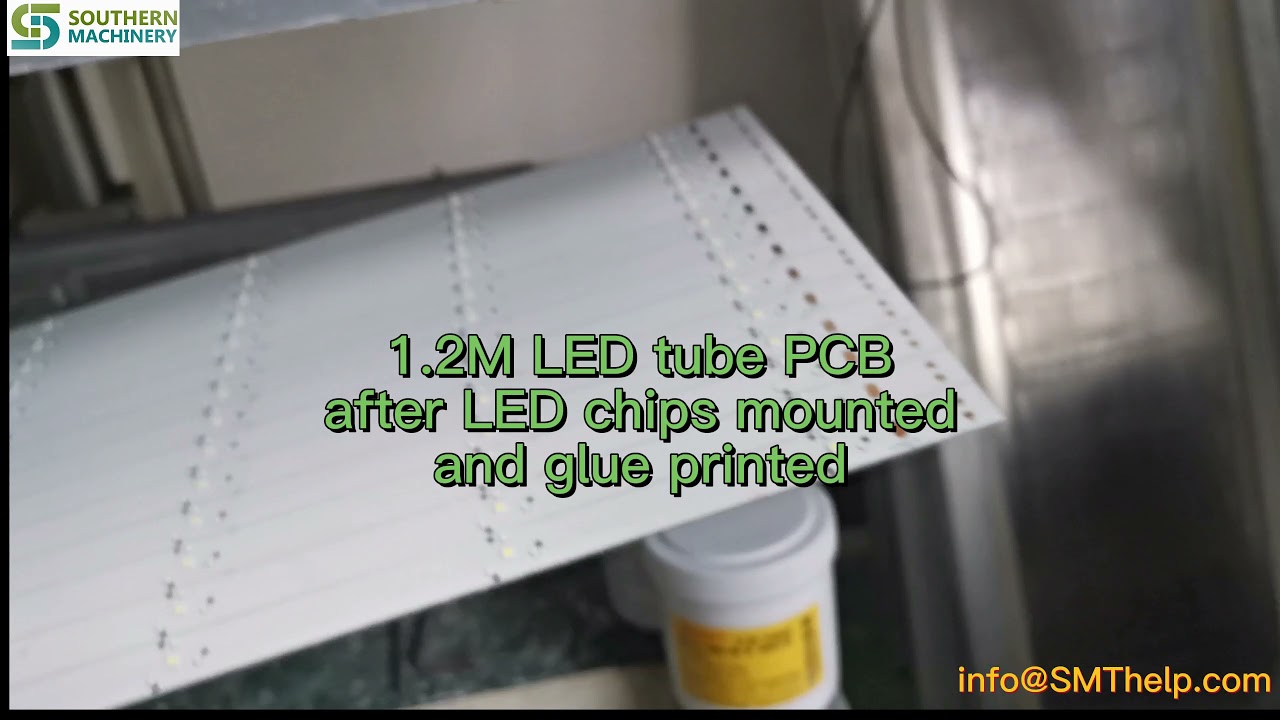
- LED tube and linear lighting (T8/T5/T5 integrated) — 1.2 m and 1.5 m LED tube lighting PCBs are a flagship use case. The machine's long-board capability lets one fixture pass carry a full-length light bar instead of splicing shorter segments.
- LED bulb and circular boards — round and non-rectangular boards that are awkward to fixture on conventional pick-and-place lines.
- Flexible LED strips — thin, bendable substrates that need gentle handling and consistent lens alignment along the strip.
- LED modules, panels and signage — lens and optical-cover mounting for display and sign boards.
- Optics-related assemblies — the product page also positions the S-530L for camera-module style boards and other optics manufacturing where components must be placed without surface damage.
Because lens mounting usually happens after the SMT soldering step, the S-530L is typically run by EMS companies and lighting manufacturers as a dedicated lens cell rather than as part of the chip-placement stage.
How It Integrates into a Complete PCB Assembly Line
A typical LED lighting line flows: solder paste printing → SMT pick-and-place of LEDs and driver components (Southern's S-530S LED placement family) → reflow oven → lens mounting → electrical test → assembly. The S-530L slots into the post-reflow section:
- SMT stage — LEDs, resistors and driver ICs are placed and reflowed on the same board.
- Lens placement stage — the S-530L mounts PC lenses, diffuser covers or optical components onto the finished SMD side.
- THT and final assembly — connectors, wire leads or through-hole driver parts are added, often with wave soldering or selective soldering for the mixed-technology board.
- Inspection and pack-out — AOI or visual inspection before the luminaire housing is assembled.
For lighting factories running a full SMT/THT line, Southern Machinery can supply the printing, placement, reflow, board handling and wave soldering equipment around the lens placement cell, so the entire flow comes from one vendor with one spare-parts and training relationship.
Key Selection Parameters
Confirm these with Southern Machinery when sizing an S-530L configuration for your board mix:
- Board format — maximum board length (the S-530L handles LED PCBs up to 1.5 m per the manufacturer), board width, and whether your products are rigid, flexible or circular.
- Component range — lens diameters and heights, plus the SMD range you need alongside lenses (the S-530L supports 0603 to 7474 parts per the product page).
- Placement accuracy requirement — lens-centric products need positional repeatability tight enough to keep beam and optic alignment consistent; flying vision on each head is the mechanism to verify.
- Throughput class — semi-automatic loading vs. full automatic; the S-530L targets mid-volume, high-mix LED production where full-auto placement is over-capitalized.
- Tooling and feeders — vacuum nozzle design for soft or irregular lens bodies, tray/bulk feeding of lenses, and quick-change tooling for frequent lens changeovers.
- Facility requirements — the S-530L has a built-in vacuum pump (no external air source needed per the product page); confirm power, floor space and any exhaust needs with the supplier.
ROI, Quality & Throughput Perspective
Manual lens mounting is one of the most inconsistent operations in LED assembly: operators tire, lenses get scratched or tilted, and rework on a soldered board is expensive. The S-530L replaces that hand labor with machine-paced placement where every lens is vision-aligned before it is seated.
- Labor reduction — one operator can supervise a semi-automatic cell that replaces several manual mounting stations.
- Quality and yield — consistent lens seating reduces tilted or missing optics, improves optical testing first-pass rates, and cuts field failures from loose lenses.
- Rework avoidance — lenses seated correctly the first time avoid desoldering and rework cycles that can damage LED boards.
- Flexibility — a semi-automatic platform with quick-change tooling suits high-mix lighting production, where the next batch may be a different tube length or lens type.
- Capital efficiency — semi-automatic placement gives smaller and mid-size EMS/lighting plants an automation step without the cost of a fully automatic long-board line.
FAQ
Q: What is a semi-automatic lens placement machine used for?
A: It automatically places optical lenses — PC lenses, diffusers and optical covers — onto LED or optoelectronic PCBs with vision alignment, while an operator handles board loading. It replaces hand placement for LED tube lighting, bulb boards, flexible strips and similar assemblies.
Q: Can the S-530L handle long LED tube boards?
A: Yes. The S-530L is designed to assemble LED PCBs up to 1.5 meters long in a single pass, which suits 1.2 m and 1.5 m LED tube lighting boards without splicing segments.
Q: What component sizes does the S-530L support?
A: According to Southern Machinery's product page, it places SMD components from 0603 to 7474, including resistors, capacitors, standard LEDs and irregularly shaped LEDs, in addition to lens parts.
Q: How does lens placement fit into an SMT line?
A: Lens mounting is a post-reflow process: components are printed, placed and reflowed first, then lenses are mounted on the finished SMD side. The S-530L runs as a dedicated lens cell before electrical test and final assembly.
Q: Which industries use this equipment?
A: LED lighting manufacturers and EMS companies producing LED tubes, bulbs, modules, flexible strips and signage, plus optics-related board assembly where components need damage-free, aligned placement.
Q: Does Southern Machinery support installation and training?
A: Yes. Southern Machinery (founded 2011, Shenzhen, China, serving 237+ customers globally) provides configuration advice, training, spare parts and after-sales support for the S-530L and its full SMT/THT line portfolio.
Contact Southern Machinery for Configuration Advice
Southern Machinery designs and manufactures SMT and THT PCB assembly automation equipment in Shenzhen, China (est. 2011) and supports more than 237 customers worldwide with high-efficiency, cost-effective machines and complete SMT/THT/wave soldering/board handling/inspection line solutions — backed by global support, spare parts and training.
Contact Jason Wu at jasonwu@smthelp.com or +86 13602562576 for a configuration recommendation based on your board size, lens types and target output. Machine catalogs are available at file.autoinsertion.com, machine photos at ph.smthelp.com, and the full product range at www.smthelp.com.
Comments