
S-500G Automatic Dip Soldering Machine by Southern Machinery: Compact THT Soldering for Small-Batch PCBA
S-500G automatic dip soldering machine by Southern Machinery: 350 x 300 mm boards, an 80 kg pot, PID control to 450 C and a 16 s dip cycle.
Sep 17, 2026 · Updated Sep 17, 2026 · Southern Machinery
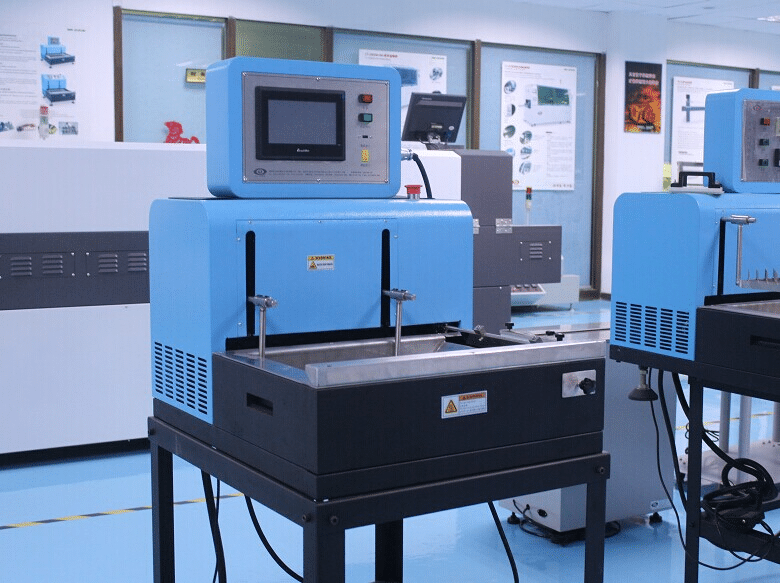
S-500G Automatic Dip Soldering Machine by Southern Machinery: Compact THT Soldering for Small-Batch PCBA
Most mixed-technology boards still finish with a through-hole soldering step. The SMT side is automated — stencil printer, SPI, Pick and Place, Reflow Oven, AOI — and then a handful of connectors, transformers, relays or large electrolytics arrive on the board and someone has to solder them. For plants that do not run enough THT volume to justify a full Wave Soldering line, that step usually falls back to hand soldering, and hand soldering is where labor cost, cycle time and joint-to-joint variation concentrate.
The S-500G Automatic Dip Soldering Machine from Southern Machinery is a compact answer to that problem. It is a bench-scale, single-station dip soldering machine: the board is lowered onto the surface of a molten solder pot, held for a programmed dwell time, and lifted out automatically. It is small enough to sit in a cell, and it is specified for PCBs up to 350 x 300 mm.
What is the S-500G automatic dip soldering machine used for?
The S-500G is used to solder the through-hole (THT) joints of a PCB in a single controlled dip. Unlike a Wave Soldering machine, which pumps a continuous solder wave against a board travelling along a conveyor, a dip soldering machine uses a static pot. The board is positioned above the pot, lowered so that the soldered side contacts the molten solder surface, held for a set dwell time, and then removed automatically.
That mechanism makes the S-500G practical in three situations:
- Low-to-medium THT volume. When a THT line would run at a fraction of its capacity, a static-pot machine gives you controlled soldering without the energy bill and floor space of a conveyorised wave line.
- Long leads and tall bodies. Components whose leads extend well below the PCB — transformers, coils, large capacitors, terminal strips — are difficult to control in a wave because the solder depth is set by the wave crest. On a dip machine the immersion depth is a programmable parameter, documented on the S-500G as adjustable from 0 to 70 mm.
- Small boards in batches. Mobile charger and adapter PCBA, LED driver boards, appliance control boards and instrument boards — where the soldered area fits comfortably inside the pot footprint.
It is worth being explicit about what the S-500G is not. It is not a replacement for a dual-wave lead-free line in high-volume production. If you run thousands of identical THT boards per day, a machine like the S-WS450 or S-WS350B dual-wave platform from Southern Machinery is the correct tool. The S-500G is the compact option for the plants, cells and product families that a wave line cannot serve economically.
Documented S-500G specifications
The following values are published by Southern Machinery for the S-500G. Every figure below is taken from the manufacturer's own product specification:
- Model: S-500G
- Maximum PCB size: 350 x 300 mm
- Solder pot (tin furnace) size: 400 x 340 x 80 mm
- Tin capacity: 80 kg
- Speed: adjustable
- Solder dwell height: 0-70 mm
- Solder dwell time: 1-10 s
- Temperature control: PID
- Temperature range: 0-450 °C
- Preheat time: 0-120 s
- Automatic removal cycle: 11 s
- Dip soldering cycle: 16 s
- Tin stove height: 50-60 mm
- Furnace construction: 316 stainless steel with titanium as an option; pot temperature sensed by K-type thermocouple
- Overall dimensions: 700 x 750 x 620 mm
- Net weight: 75 kg
- Power requirements: 220 V, 50/60 Hz, 3.6 kW
- Consumed power: 1-2 kWh
Two of these figures are worth pausing on, because they tell you how the machine is meant to be installed.
The 75 kg net weight and 700 x 750 x 620 mm footprint put the S-500G in the category of equipment that can be sited in a normal workshop bay or a manual-assembly island, rather than requiring a dedicated line position with heavy floor loading. That matters for EMS plants where THT volume fluctuates by work order.
The 220 V, 50/60 Hz, 3.6 kW input with 1-2 kWh consumed power is a low-demand electrical profile. It is the kind of load that can often be dropped into an existing bay, but it should still be confirmed against your available circuit capacity and your site's electrical standard before the machine is positioned.
For readers who check numbers against each other: the published 80 kg tin capacity is consistent with a 400 x 340 x 80 mm pot, which is roughly 10.9 litres of volume. That internal consistency is a small but useful signal that the specification sheet describes a real pot geometry rather than a rounded figure.
Typical application scenarios
Dip soldering fits board families where the through-hole content is real but the volume is not wave-line scale. Typical scenarios include:
- Power supply boards — transformers, large electrolytic capacitors, bridge rectifiers, long-lead components
- LED lighting and LED driver boards — long-lead LEDs and driver-stage through-hole parts
- Home appliance control boards — air conditioner, microwave oven, induction cooker, electric kettle PCBA
- Transformer and coil assemblies — tall bodies and long copper leads that need deep immersion
- Mobile charger and adapter PCBA — small boards soldered in batches with quick product changeovers
- Industrial control and instrument boards — where a small number of THT parts sit among a dense SMT population
- High-mix, low-volume EMS work — where the board mix changes before a wave line would ever pay back
How the S-500G fits into a complete PCB assembly line
The S-500G is one station in a sequence, and it works best when the stations around it are sized to match. A typical mixed SMT/THT flow looks like this.
The SMT side of the line
Stencil printer (for example the SP-1008 or SP-1200 class) → SPI for solder paste inspection → Pick and Place → Reflow Oven → AOI on the SMT joints. This segment runs at its own takt, set by placement rate and oven profile, and it typically cannot be slowed to wait for a manual THT step.
The THT side of the line
Axial and radial auto insertion (S4000, S3010A class) → odd-form insertion for connectors, relays and transformers (S7020 / S7040 / S7000 class) → dip soldering (S-500G) or Wave Soldering → automatic lead cutting after soldering (S-320AT class) → PCBA cleaning → final AOI or AVI inspection (SVL501T class) → depaneling (routing or V-cut separator) → magazine unloader. The dip soldering station is where the THT side either keeps pace with the SMT side or becomes the constraint.
Board handling between stations
Magazine loaders and unloaders, conveyors, buffers, NG/OK handling and turnover units such as the S-AT500 for double-sided boards. Board handling is the part of a line plan that is easiest to under-specify and hardest to retrofit, because the transfers set the takt the whole line can achieve.
Material supply and Nozzles
Material supply runs on feeders — axial tape, radial tape, tube and bowl feeders — with Nozzle and spare-part support behind them. Insertion Feeder performance determines how often a station stops, which is why Southern Machinery treats feeding as a first-class part of a THT line plan rather than an accessory.
Southern Machinery supplies equipment across all of these stages, which is why the S-500G is usually discussed as part of a line plan rather than as a standalone purchase. If your line already runs an SMT segment and a manual THT island, the dip soldering machine is the station that turns the island into a controlled process.
Key selection parameters buyers should confirm
Published specifications cover the machine. They do not cover your board. Before requesting a configuration, confirm the following against your own product data.
Board and fixture geometry
- Maximum PCB or panel dimensions against the documented 350 x 300 mm envelope
- How many boards a single fixture or pallet holds, since this drives real throughput
- Board thickness range and whether tooling support is needed for thin boards
- Clearance required for tall components on the solder side
Process requirements
- Solder alloy: lead-free (SAC305) or SnPb, and the resulting pot temperature versus the documented 0-450 °C range
- Required immersion depth versus your longest component leads, against the documented 0-70 mm dwell height
- Required dwell time versus the documented 1-10 s range
- Whether your process needs preheat, and to what profile, against the 0-120 s documented preheat time
- Flux application method — the S-500G specification does not document an integrated spray fluxer, so confirm how flux will be applied in your flow
Facility and utilities
- Available power: 220 V, 50/60 Hz at 3.6 kW, with 1-2 kWh typical consumption
- Floor space of 700 x 750 x 620 mm plus operator access and pot maintenance clearance
- Floor loading for a 75 kg machine carrying an 80 kg solder pot
- Fume extraction for flux volatiles
- Whether you need pot level sensing, automatic slag removal or other automated pot management features — confirm which options apply
Volume economics
- Boards per hour required, and how that compares with a 16 s dip cycle and an 11 s removal cycle
- Replenishment cadence implied by an 80 kg pot at your duty cycle
- Whether the THT content will scale past the point where a wave line becomes the better investment
ROI, quality and throughput
Dip soldering earns its place on three fronts.
Labor: converting operator hours into machine cycles
Every board that leaves hand soldering for a machine removes operator time, and operator time is the single most variable input in a manual THT cell. The economics are simplest to model as boards-per-shift rather than as an hourly rate: a 16-second dip cycle sets a theoretical ceiling of about 225 dip cycles per hour at one board per cycle, and the gap between that ceiling and your actual output is a direct measure of how much loading, fixturing and handling are costing you. Reaching any meaningful fraction of that ceiling, of course, depends on having boards staged and fixtured ahead of the machine.
Quality: parameterised joints instead of operator-dependent joints
Hand soldering varies with the operator, the shift and the day. A dip machine sets the immersion depth, dwell time and pot temperature as parameters — 0-70 mm, 1-10 s, and PID control across a 0-450 °C range. Repeatable parameters are what make a THT joint repeatable, and repeatable joints are what prevent rework later in the line.
Energy and footprint: a different cost shape from a wave line
A static pot with PID control and a documented 1-2 kWh consumption profile is a different energy proposition from a conveyorised dual-wave line running continuously. For plants reporting on energy per unit produced, that difference shows up directly in the numbers.
Read together, the case for the S-500G is not that it outproduces a wave line — it does not, and it is not meant to. The case is that it converts a manual, variable, operator-dependent step into a parameterised machine step at a footprint and electrical profile that a single production cell can absorb.
Why Southern Machinery
Founded in 2011 and based in Shenzhen, China, Southern Machinery Sales and Service Co., Ltd. supplies SMT and THT PCB assembly automation equipment and has served 237+ customers worldwide. The portfolio covers SMT placement and print platforms, THT axial, radial and odd-form insertion machines, Wave Soldering and selective soldering, board handling (loaders, unloaders, buffers, conveyors, turnover units), depaneling, cleaning, coating and inspection — so a single supplier can plan and support a complete line rather than a single station.
Support extends past the sale: spare parts supply, sub-assembly and retrofit kits, machine upgrading, operator training, overhaul and component-level repair services for SMT insertion equipment, including laser, motor, driver and PCB-board level repairs.
FAQ
What board size can the S-500G handle?
The published maximum PCB size is 350 x 300 mm. The solder pot itself measures 400 x 340 x 80 mm, so the pot footprint is sized to accept boards within that envelope.
Is the S-500G lead-free capable?
The furnace is documented as 316 stainless steel with titanium available as an option, and the PID-controlled temperature range reaches 0-450 °C. That range covers lead-free alloys, but you should confirm the specific alloy and pot configuration you intend to run with the Southern Machinery team before ordering.
How fast is the S-500G?
The published dip soldering cycle is 16 seconds and the automatic removal cycle is 11 seconds. Real output per hour depends on how many boards you fixture per cycle and how quickly boards are loaded and unloaded. Treat 16 seconds as a per-cycle figure, not as a guaranteed boards-per-hour rate.
What power supply does the S-500G need?
220 V, 50/60 Hz, with a 3.6 kW power requirement and 1-2 kWh consumed power. It weighs 75 kg and measures 700 x 750 x 620 mm.
What is the difference between the S-500G and the S-DS300?
Both are dip soldering machines, but they are different platforms. The S-DS300 is the larger batch machine from Southern Machinery, documented with a 7-inch touch screen plus PLC control, a tracking spray flux system and an 85 kg lead-free tin furnace. The S-500G is the compact platform: 350 x 300 mm maximum board, an 80 kg pot, PID temperature control and a 75 kg machine weight that suits a production cell. If you are uncertain which fits your volume, describe your board and duty cycle and Southern Machinery will advise.
Do I need a Wave Soldering machine as well?
Not necessarily. A dip machine and a wave machine solve different volume problems. If your boards feature long leads, tall components, or a THT content that would leave a wave line underutilised, dip soldering alone may be sufficient. If you run large stable batches of identical boards, a dual-wave platform such as the S-WS450 is the more productive route. Many plants run both — a wave line for the high-volume family and a dip machine for the long-tail.
Talk to Southern Machinery about your dip soldering configuration
Board size, alloy, lead length and required throughput determine which configuration is right, and the fastest way to settle it is a short conversation with an engineer rather than a specification sheet.
- Configuration advice and quotations: contact Jason Wu, Co-Founder and Sales & Service Engineer, at jasonwu@smthelp.com or +86 13602562576
- Product catalogs, manuals and PDFs: browse the file portal at https://file.autoinsertion.com
- Machine photos and product albums: browse https://ph.smthelp.com
- Company and product overview: https://www.smthelp.com
Tell Southern Machinery your maximum PCB size, your solder alloy, your longest component lead and your required boards per shift, and the team can confirm the machine configuration, the fixture approach and the surrounding line stations.
Comments