
S-300B Fully Automatic Molding & Taping Machine: Form, Test and Tape Radial Components in One Pass by Southern Machinery
The S-300B Fully Automatic Molding & Taping Machine from Southern Machinery forms, tests and tapes radial-lead components — LEDs, capacitors and resistors — in one pass at 180 ± 20 parts per minute. A servo drive replaces the traditional clutch, imported precision cams hold grinding accuracy to 0.01 mm, and an optional in-line capacitance and resistance tester sorts good from defective chips before they enter the reel. It handles Φ4–Φ10 mm products with a 12.7 mm standard hole pitch and 2.5/3.5/5.0 mm formed lead pitches, in box or reel packaging. For EMS, automotive and industrial PCB plants, the S-300B replaces a manual forming-and-taping bench, stops defective chips from reaching the insertion line and keeps THT assembly fed. Installation and operator training are included, with 24/7 support.
Aug 27, 2026 · Updated Aug 27, 2026 · Southern Machinery
S-300B Fully Automatic Molding & Taping Machine: Form, Test and Tape Radial Components in One Pass by Southern Machinery
Radial-lead components are the workhorse of THT boards — LEDs, capacitors, resistors — but they only become useful to an automated insertion line after their leads are formed, their values verified and their bodies packed into tape. Done by hand, that chain is slow, inconsistent and invisible to quality systems. The S-300B Fully Automatic Molding & Taping Machine from Southern Machinery compresses the whole job into one machine: form, test and tape radial components at 180 ± 20 parts per minute, with servo control, imported precision cams and an optional in-line capacitance/resistance tester that sorts good from defective chips before they ever enter a reel.
What is this machine used for?
The S-300B is an automatic molding and taping machine for radial-lead electronic components. It forms component leads (LEDs, capacitors, resistors), optionally tests capacitance and resistance values with automatic good/defective sorting, and tapes the parts into carrier tape at 180 ± 20 parts per minute, in box or reel packaging.
It sits upstream of THT insertion: the reels it produces feed radial insertion machines, and the insertion line receives components that are already formed to a consistent lead pitch, value-tested and packed complete. No extra repacking bench, no hand-inspected reels, no missing yield record.
The hidden cost of manual forming and taping
Forming, testing and taping by hand is a bottleneck wearing a disguise. Before radial components can feed an insertion line, their leads must be formed, tested and packed into tape. Done by hand, that chain leaks quality, time and yield:
- Forming by hand is inconsistent — lead pitch and bend accuracy vary operator to operator, and the insertion line downstream pays for every deviation.
- Testing and sorting is manual — capacitance and resistance values checked by hand are slow and error-prone; defective chips slip into good reels.
- Taping speed caps the line — a manual taping bench cannot keep pace with an automatic insertion machine; the reel runs out and the line stops.
- Clamping damage — hand-held and clamp-fed components get scratched or bent before they are ever placed.
- Maintenance eats uptime — clutch-driven machines fail mechanically, and every breakdown is lost production and a repair bill.
- No yield record — without integrated testing and sorting, there is no per-lot yield data to improve against.
How the S-300B forms, tests and tapes in one pass
- Feed — components enter from upstream feeders or feeding equipment; the machine pairs with lead cutting/forming machines for a full forming-to-taping cell.
- Form — a servo control system drives imported precision cams (grinding accuracy up to 0.01 mm) to form leads to the selected pitch.
- Test (option) — when configured with the corresponding tester, the machine measures the capacitance and resistance of each chip.
- Sort — good and defective products are sorted automatically during the taping pass; defective chips never enter the reel.
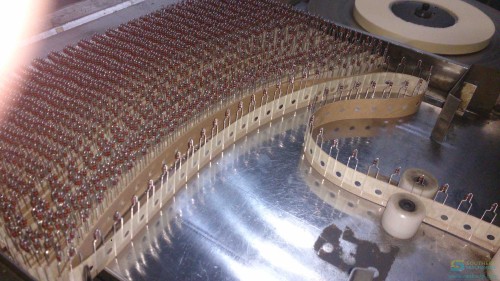
- Tape and pack — components are taped at 12.7 mm standard hole pitch (4.1 mm hole diameter) and packed in box or reel format to match downstream feeding.

Feature, advantage, benefit
| Feature | Advantage | Benefit |
| --- | --- | --- |
| 180 ± 20 parts per minute capacity | Form, test and tape in one pass | Taping no longer caps the insertion line |
| Servo control system | Replaces the traditional clutch drive | Less mechanical downtime and smoother speed control |
| Imported precision cams, grinding accuracy to 0.01 mm | Long precision life (15+ year design service life) | Stable forming quality year after year |
| Optional in-line capacitance/resistance tester | Automatic good/defective sorting | No defective chips in reels; per-lot yield data |
| 12.7 mm standard hole pitch, 4.1 mm hole diameter | Standard tape compatibility; custom pitches on request | Fits existing downstream equipment |
| 2.5 / 3.5 / 5.0 mm formed lead pitches (7.5 / 10 / 15 mm on request) | Configurable to your component drawings | One machine covers multiple product families |
| Box or reel packaging | Matches downstream line feeding | No extra repacking step |
| Touch screen with stable-brand PLC or single-chip control and LCD status simulation | Easy operation and monitoring | Faster changeover, lower training effort |
Typical application scenarios
- EMS and ODM factories with high-mix radial components (LEDs, capacitors, resistors) feeding THT insertion lines.
- LED lighting and display module plants molding and taping Φ4–Φ10 mm radial-lead LEDs.
- Capacitor and resistor lines converting bulk, axial or tube components into insertion-ready radial tape.
- Factories replacing manual forming-and-taping benches to eliminate wrong-value chips and empty pockets in reels.
- Quality-driven automotive, medical and industrial control lines where a single defective chip in a reel means a failed board at wave soldering.
How to integrate into a complete PCB assembly line
The S-300B is an upstream material-formatting station in a THT flow. It pairs with lead cutting/forming machines and upstream component feeders to build a full forming-to-taping cell; the output reels then feed radial insertion machines that place components into PCBs before soldering.
In a complete Southern Machinery line, it slots in naturally: stencil printing → SMT placement → reflow → inspection → THT radial insertion (fed by reels prepared on the S-300B) → wave soldering → board handling, cleaning and inspection. Standardized reel output and SMEMA-style integration keep changeover predictable, and Southern Machinery can supply the whole SMT/THT line — including wave soldering, board handling and inspection — as one system with a single service partner.

Key selection parameter checklist
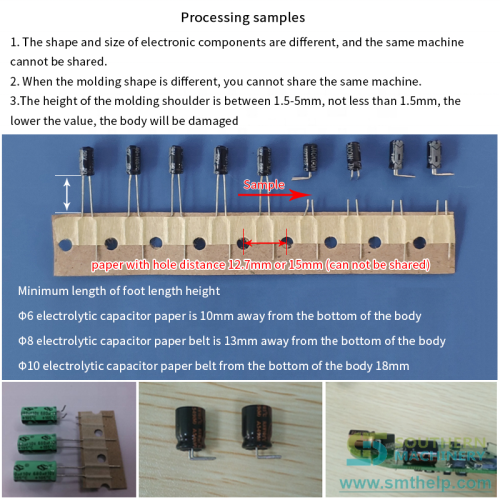
- Component diameter — Φ6–Φ10 mm conventional range (Φ4–Φ10 mm overall); Φ4–Φ6 share one fixture set, Φ8–Φ10 share another.
- Product length — L = 5–30 mm; taping height 17–21 mm.
- Hole pitch — 12.7 mm standard with 4.1 mm hole diameter; other pitches on request.
- Formed lead pitch — 2.5 / 3.5 / 5.0 mm standard; 7.5 / 10 / 15 mm and others on request.
- Required capacity — 180 ± 20 parts per minute reference.
- In-line testing — do you need capacitance/resistance testing with good/defective sorting?
- Packaging — box or reel, matched to downstream feeding.
- Utilities — 220 V / 50 Hz mains at 1.6 kW; compressed air 4–5 kg/cm²; no special foundation.
- Footprint — 2200 × 1200 × 1500 mm, 700–900 kg.
- Final configuration — confirmed after technical review of your component drawings, product range and line layout.
ROI, quality and capacity value
The source data sheet frames the value in three ways — treated here as reference estimates that depend on your component mix and volume, subject to final technical confirmation:
- One machine replaces a manual forming-and-taping bench, adding in-line value testing and sorting, yield data, and no defective chips in reels.
- Servo drive eliminates clutch-related downtime, removing a recurring mechanical failure point.
- At 180 parts per minute, the taping step stops capping the insertion line — reels stay ahead of the mounter instead of the bench setting the schedule.
Southern Machinery prepares a line-specific packaging-process estimate within 24 hours of your inquiry. Numbers above are examples/reference values, not guarantees; the actual payback depends on your product range, monthly volume and line configuration.
FAQ
What does the S-300B do?
It forms the leads of radial-lead components (LEDs, capacitors, resistors), optionally tests their capacitance/resistance values, sorts good and defective parts, and tapes them into carrier tape at 180 ± 20 parts per minute, in box or reel packaging.
Which products can it process?
Components with diameters of Φ6–Φ10 mm (conventional range Φ4–Φ10 mm). Φ4–Φ6 share one fixture set and Φ8–Φ10 share another. Product length is 5–30 mm and taping height is 17–21 mm.
What pitches are available?
Hole pitch is 12.7 mm standard with a 4.1 mm hole diameter; formed lead pitch is 2.5, 3.5 and 5.0 mm standard, with 7.5, 10, 15 mm and other pitches available on request.
How does the testing function work?
When configured with the corresponding tester, the machine quickly measures the capacitance and resistance of each chip and automatically sorts good from defective products during the taping pass — defective chips never enter the reel.
What utilities does it need?
220 V / 50 Hz mains at 1.6 kW and compressed air at 4–5 kg/cm². The machine is 2200 × 1200 × 1500 mm and 700–900 kg, and needs no special foundation.
How do I get a quote and configuration?
Email info@smthelp.com or WhatsApp +86 136 0256 2576 with your component drawings, product range and monthly volume. Configuration, quotation and a process recommendation are provided within 24 hours.
Next step: send your components for a forming-and-taping demo
Tell Southern Machinery which radial components you form and tape today and your monthly volume. You get the tooling set, tester configuration and quotation within 24 hours — plus free installation and operator training, 24/7 worldwide support and 1-day spare-part lead time.
Southern Machinery was founded in 2011 in Shenzhen, China and serves 237+ global customers with high-efficiency, cost-effective SMT/THT PCB assembly automation equipment. From SMT placement lines to THT insertion, wave soldering, board handling and inspection, we deliver complete line solutions with global service, spare parts support and professional training — an automation partner, not just a supplier.
Email for a quote: info@smthelp.com | WhatsApp: +86 136 0256 2576
Comments