
S-1688 Pneumatic Stencil Cleaning Machine: Solvent-Safe SMT Stencil Care by Southern Machinery
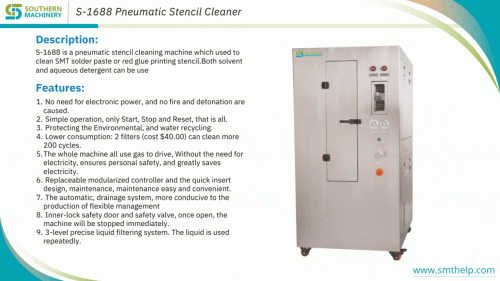
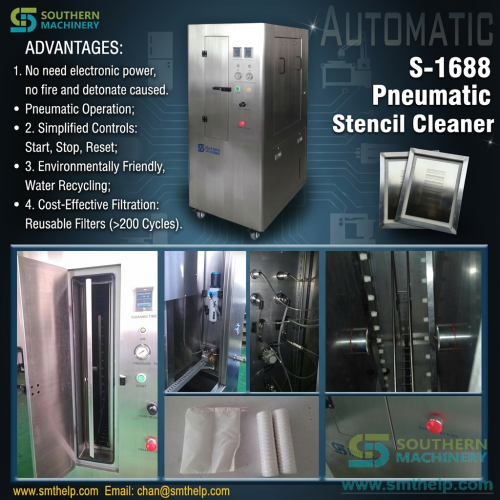
The S-1688 Pneumatic Stencil Cleaning Machine from Southern Machinery is driven entirely by compressed air, with no electric power, so there is no ignition source near flammable cleaning solvents. Rotating spray rods wash both sides of the stencil, a 3-level filter (100/50/1 µm) keeps the liquid clean and recycled, and compressed air finishes with drying. That stabilizes print quality, cuts solvent consumption by roughly 60% (reference estimate), frees one operator per shift and removes direct chemical exposure. Built for solder paste, red glue, resin and copper masks, it integrates into complete SMT/THT PCB assembly lines with professional installation, training and worldwide spare parts support.
Aug 27, 2026 · Updated Aug 27, 2026 · Southern Machinery
S-1688 Pneumatic Stencil Cleaning Machine: Solvent-Safe SMT Stencil Care by Southern Machinery
Stencil cleaning is easy to overlook and expensive to get wrong. Blocked apertures cause paste misprint and rework, hand cleaning varies from operator to operator and shift to shift, and wasted solvent quietly eats the consumables budget. The S-1688 Pneumatic Stencil Cleaning Machine from Southern Machinery changes that math: a full-pneumatic cleaner driven by compressed air, with rotating spray rods, 3-level filtration and air drying — and no electric power at all.
What is this machine used for?
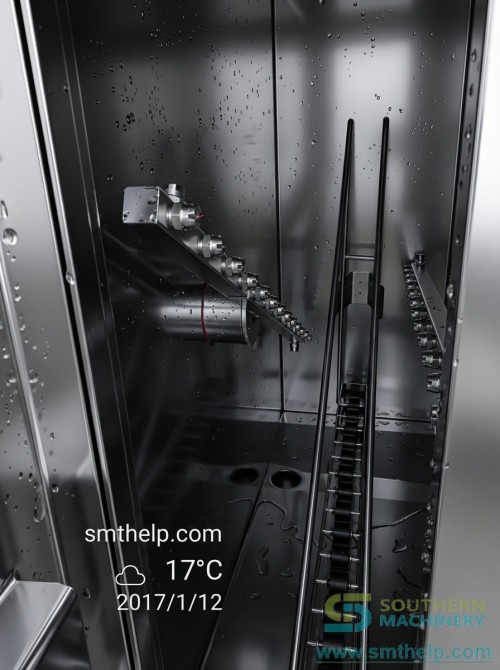
The S-1688 is a full-pneumatic stencil cleaning machine for SMT lines that need a safe, repeatable way to clean stencils. It cleans solder paste stencils, red glue stencils, resin masks and copper masks, removing residue with solvent or water-based detergent. The machine washes both sides with 360° rotating spray rods, filters and recycles the cleaning liquid through a 3-level filter (100 µm / 50 µm / 1 µm), then compressed air dries the stencil so it can go straight back to the printer.
Because the S-1688 is driven entirely by compressed air — no electric power — there is no ignition source near flammable cleaning liquids. That makes it a practical choice when flammable solvents are involved, or when power at the cleaning station is limited.
The hidden cost of manual stencil cleaning
Before looking at the machine, it helps to price what manual stencil care actually costs a line:
- Wasted cleaning liquid — manual cleaning and poor filtration waste solvent and water-based detergent.
- Chemical exposure — hand contact with cleaning liquid puts operators at risk.
- Blocked apertures — residue left in stencil apertures causes paste misprint and rework.
- Inconsistent results — hand-cleaning quality depends on the operator, the batch and the shift.
- Environmental waste — uncontrolled discharge of contaminated cleaning liquid damages the environment.
- Fire and detonation risk — electric cleaning equipment used with flammable solvents carries ignition risk.
How the S-1688 cleans a stencil
- Load the stencil — put the stencil into the cleaning room, set the clean and dry time, close the front door.
- Rotating spray wash — upper and lower spray rods rotate 360° and spray solvent or water-based detergent onto both sides.
- Filter and recycle — 3-level filtration (100 µm / 50 µm / 1 µm) keeps the liquid clean and recycles it each cycle.
- Air dry — compressed air dries the stencil; open the door and the clean stencil is ready for the printer.
Typical application scenarios
- High-mix EMS and ODM lines cleaning multiple stencils per day where manual scrubbing bottlenecks changeover.
- Factories using flammable solvents where an electric ignition source is unacceptable near the cleaning station.
- Plants with reliable compressed air (0.5–0.7 MPa) but limited power available on the SMT floor.
- Automotive, medical electronics and industrial control lines that depend on consistent solder paste print quality.
- Mixed SMT lines that also clean red glue stencils, resin masks or copper masks.
How it fits into a complete PCB assembly line
The S-1688 sits at the solder paste printing stage as an offline cleaning station. Place it near the printer so clean stencils can be swapped in during changeover, then confirm the facility basics: an air supply of 0.5–0.7 MPa, an exhaust vent connected to an outer hose, and floor space around 800 (L) × 950 (W) × 1650 (H) mm (reference).
Southern Machinery provides complete PCB assembly line solutions beyond stencil cleaning — SMT placement, THT insertion, wave soldering, board handling and inspection equipment. The S-1688 therefore slots into a broader line package with one supplier, one installation team and one spare parts channel.
Key specifications for project evaluation
| Parameter | S-1688 |
| --- | --- |
| Drive | Full pneumatic — compressed air, no electric power required |
| Cleaning liquid | Solvent and water-based detergents (water-based must be non-foam) |
| Filtration | 3-level filter: 100 µm (larger materials) · 50 µm (labels, screws) · 1 µm (solder paste balls) |
| Spray | 360° rotating spray rods cleaning both sides |
| Recommended times | Clean 3–10 minutes · dry 3–8 minutes |
| Air supply | 0.5–0.7 MPa |
| Controls | Clean timer · dry timer · cleaning pressure regulator · control box on the right side |
| Machine size | 800 (L) × 950 (W) × 1650 (H) mm (reference) |
| Exhaust | Vent requires connection to an outer hose |
Values support initial evaluation and remain subject to final technical confirmation against your stencils and cleaning liquid.
ROI, quality and capacity value
- ~60% less cleaning liquid consumed with filtration and recycling (reference estimate).
- 1 operator per shift freed from manual stencil scrubbing.
- 0 workers directly exposed to cleaning chemicals.
- <12 months typical payback for a stencil cleaner on a mid-size line (reference estimate).
ROI figures are planning estimates based on reference EMS lines; actual payback depends on stencil volume, liquid cost and quality targets. Southern Machinery calculates a line-specific payback with your numbers during the consultation.
Choosing the right stencil cleaner
Southern Machinery offers pneumatic and electric stencil cleaners. Match the machine to your cleaning task:
- S-1688 pneumatic cleaner — full pneumatic, no electric power. Use when flammable solvents are involved or power is limited at the cleaning station.
- SME800 electric cleaner — electric pump plus air pump with a 4 kW blower. Use when faster drying and higher throughput matter.
- SME-750II dual-stencil cleaner — pneumatic cleaner for two stencils at once. Use for higher stencil volume.
Configuration checklist — send with your inquiry
- Stencil details: stencil size, solder paste / red glue / resin mask type.
- Cleaning liquid: solvent or water-based; foam characteristics.
- Volume: stencils per day and cleaning intervals.
- Facility: air supply (0.5–0.7 MPa), exhaust connection, floor space (reference 800 × 950 × 1650 mm).
FAQ
What does the S-1688 clean?
It cleans solder paste stencils, red glue stencils, resin masks and copper masks, removing residue with solvent or water-based detergent.
Why is the machine full pneumatic?
The S-1688 is driven entirely by compressed air — no electric power — so there is no ignition source near flammable cleaning liquids. That reduces fire and detonation risk.
How does the cleaning process work?
Load the stencil, set the clean and dry time, close the front door and press Start. Rotating spray rods wash both sides, the liquid passes through 3-level filtration and is recycled, then air drying finishes the cycle.
What filtration does it use?
A 3-level filter: 100 µm for larger materials, 50 µm for labels and screws, and 1 µm for solder paste balls — keeping the liquid clean each cycle.
How long does a cycle take?
Recommended clean time is 3–10 minutes and dry time 3–8 minutes, controlled by mechanical timers.
How do I get a price and delivery time?
Email info@smthelp.com or WhatsApp +86 136 0256 2576 with your stencil types, cleaning liquid and volume. Quotation and delivery schedule are provided after technical confirmation — typically the same working day.
Next step: get a cleaning proposal
Send your stencil and liquid details — stencil types, cleaning liquid, volume and quality target — and Southern Machinery replies with a machine recommendation, quotation and delivery schedule.
Southern Machinery, founded in 2011 in Shenzhen, China, serves 237+ global customers with SMT/THT PCB assembly automation equipment. Beyond stencil cleaning, the company provides complete SMT, THT, wave soldering, board handling and inspection line solutions — built around high efficiency, cost-effective automation, global service, spare parts support and professional training.
Comments