
S-1688 Stencil Cleaner Maintenance Calendar by Southern Machinery
Pneumatic stencil cleaning machine maintenance decides whether print quality stays steady. This guide turns the Southern Machinery S-1688 operation manual into a practical calendar: daily air checks, weekly liquid and cl
Oct 25, 2026 · Updated Oct 25, 2026 · Southern Machinery
Pneumatic stencil cleaning machine maintenance is the difference between a stencil cleaner that keeps printing quality steady and one that quietly turns into a bottleneck. The S-1688 from Southern Machinery is a compressed-air-driven SMT stencil cleaner. This guide turns its manual into a practical maintenance calendar you can hand to a line technician.
The cleaner nobody checks until prints go bad
Most stencil cleaners fail slowly. A nozzle clogs, the liquid sinks below its mark, a filter saturates with solder paste balls, and the first person to notice is the printer operator staring at bridging on the board.
If that sounds familiar, you are not alone. Cleaning is rarely anyone's named job. It sits between the print operator and the maintenance crew, so inspection gets skipped until results drop. Southern Machinery, founded in 2011 in Shenzhen and serving 237+ customers worldwide, designs SMT and THT automation around a simple belief: equipment should be easy to keep in good condition.
What is the S-1688 used for?
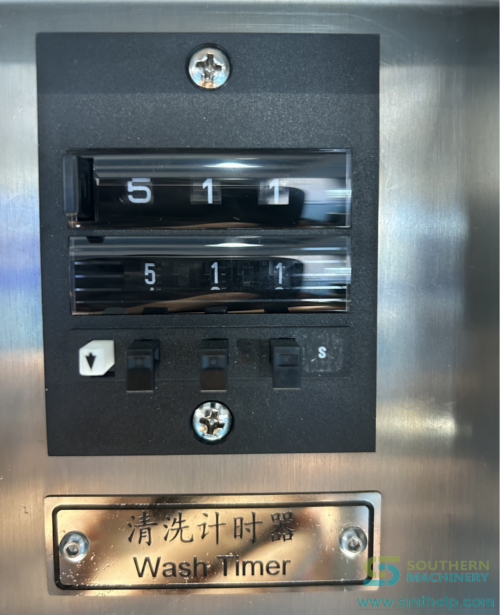
The S-1688 is a pneumatic SMT stencil cleaning system. Per the source manual, it is driven by compressed air, not electric power, and works with both solvent and water-based detergents. You put the stencil into the cleaning room, set clean and dry times, close the doors and press Start. The machine stops automatically when the timers run out.
Key specifications from the manual
| Item | S-1688 (per manual) |
|---|---|
| Max stencil size | 750 mm (L) x 750 mm (W) x 40 mm (H); larger sizes custom made |
| Liquid tank | 40 L max; best fill 25-30 L |
| Cleaning method | 360° rotary liquid and compressed air spray (clean, then dry) |
| Recommended clean time | 3-10 minutes |
| Recommended dry time | 3-8 minutes |
| Filtration | 3 levels: 100 um, 50 um, 1 um (solder paste balls) |
| Air supply | 0.5-0.7 MPa, 400-600 L/min |
| Net weight / size | 230 kg; 800 x 950 x 1650 mm |
Why does a maintenance calendar matter more than a bigger machine?
Because almost every fault in the manual's troubleshooting tables traces back to one of four causes: blocked nozzles, a dirty filter or tank, low liquid, or low air pressure. The manual lists unstable spray pressure and poor cleaning results with exactly those reasons, plus a pump or gauge fault, and a foaming water-based liquid.
A four-step routine you can reuse
- Daily: check the air regulator for sufficient supply and air leaks; clean its air filter with compressed air if dusty.
- Weekly: wipe the machine exterior, and add cleaning liquid in normal working conditions or as the real cleaning situation requires.
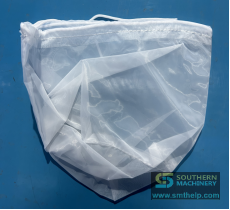
- Monthly: turn the spray rods by hand to confirm smooth rotation, check nozzles for blockage, and clean the filter net at the pump inlet plus the filter bag and box.
- By use: replace the three filter cartridges. The manual gives solder paste cleaning as 2-3 months and red glue cleaning as 1 week.
How do you read the machine's warning signs?
The manual's rule of thumb is simple. If the pump pressure gauge reads lower than normal, nozzles or filters are probably blocked. If the spray device does not rotate or you hear abnormal noise, check for foreign matter, blocked nozzles, low air supply, loose screws, or wrong nozzle angles.
Nozzles are arranged at the same angle between 5° and 15° (10° is the manual's example suggestion). Do not adjust them casually.
Liquid level matters too. The tank scale runs to 40 L, with 20 L as the middle mark. Below 20 L, cleaning results will be affected; below 10 L the machine cannot clean as normal.
How does the S-1688 protect operators?
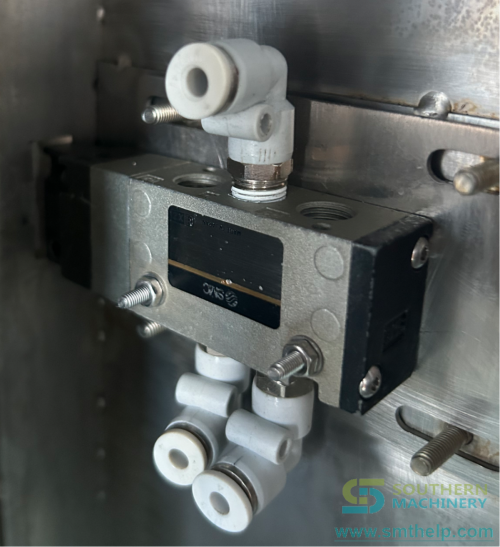
The manual lists a front-door safety protection valve that guards against forgetting to close the door, a door indicator (green closed, red open), an emergency button, double-layer sealed doors that reduce liquid smell, and an all-pneumatic control design. It also notes sound insulation on the doors.
How does it fit a complete PCB assembly line?
Stencil cleaning sits beside printing in the SMT line. Cleaned stencils support consistent paste printing, which feeds placement, reflow and inspection. Southern Machinery also supplies THT machines, wave soldering machines, board handling systems and 3D SPI/AOI inspection, so cleaning can be planned as part of a whole line.
What is the cost logic?
Use a simple formula, then fill it with your own numbers.
Monthly cleaning cost = (liquid volume used x liquid price) + (filter cartridges / months of life x cartridge price) + (technician minutes x labor rate)Example only: the manual recommends 25-30 L of liquid and cartridge changes every 2-3 months for solder paste. Prices, labor rates and real intervals depend on configuration and your process, and are subject to final technical confirmation. The manual states cleaning liquid is reused in the machine to save consumption; it gives no savings figure, so none is claimed here.
FAQ
What power does the S-1688 use? Per the manual, compressed air only, at 0.5-0.7 MPa.
Which cleaning liquids can it use? Solvent and water-based detergent. Avoid foaming water-based types, which the manual lists as a cause of poor results.
How often should filter cartridges be replaced? Solder paste: about 2-3 months; red glue: about 1 week, per the manual.
What is the largest stencil? 750 x 750 x 40 mm; larger sizes are custom made.
Who should install it? The manual says installation and commissioning must be done by a professional or authorized technician, followed by operator training.
Keep the habit going
Print this calendar, pin it next to the machine, and tick it off each week. Next in this series: how to size the air supply and exhaust for pneumatic cleaning equipment.
Ready to review stencil cleaning for your line? Request a quote or contact Southern Machinery for spare parts, training and global service.
Comments