
RTF-1001 Radial THT Tape Feeder for SMT | Southern Machinery
The RTF-1001 Radial THT Tape Feeder feeds taped radial and through-hole components - capacitors, safety capacitors, LEDs, keys and transistors - directly into SMT mounting equipment. Documented features include an 80 mm feeder width, PLC and sensor control, a cycle time of 0.8 second or less, lead clamping before cutting to reduce component jumping and cut-surface deformation, and an integrated floating mechanism for fast lead-length adjustment. For EMS and ODM teams still hand-inserting radial parts on mixed-technology boards, it converts a manual station into a machine-fed step that runs inside the SMT line.
Sep 16, 2026 · Updated Sep 16, 2026 · Southern Machinery
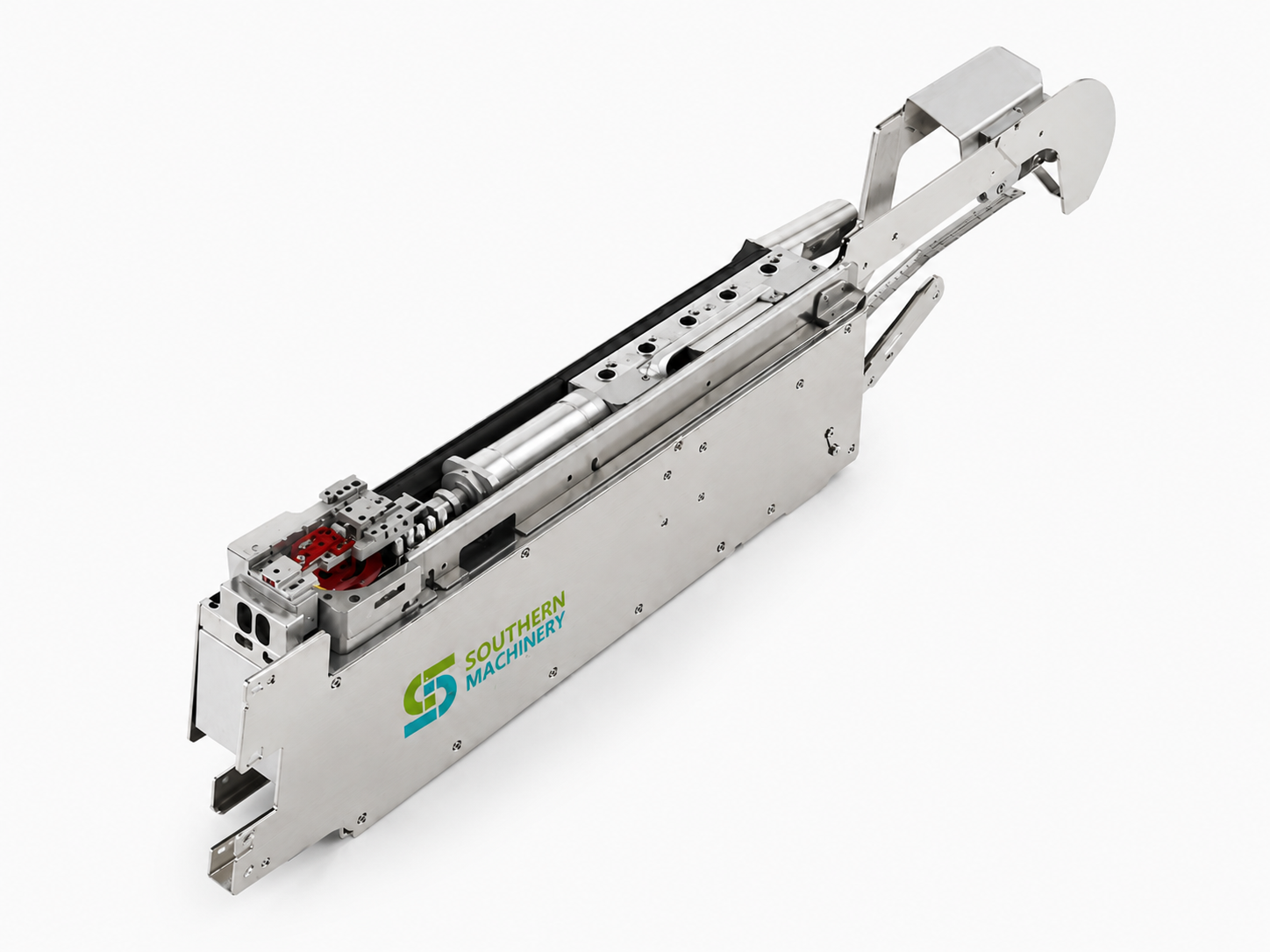
RTF-1001 Radial THT Tape Feeder: Feeding Radial-Taped THT Components into SMT Mounters
Mixed-technology boards are still the norm in power supplies, LED drivers, appliance controls, automotive electronics and industrial instruments. The SMT side of those boards is automated. The through-hole side usually is not. Radial components — electrolytic capacitors, safety capacitors, LEDs, transistors — arrive on tape, get de-reeled by hand, and are inserted at a manual station that adds headcount without adding capability.
The RTF-1001 Radial THT Tape Component Feeder from Southern Machinery attacks that station directly. It is a compact radial tape feeder that feeds taped THT and radial components into SMT mounting equipment, so radial parts are presented to a placement head instead of to an operator's fingers.
What is the RTF-1001 radial THT tape feeder used for?
The RTF-1001 is used to feed radial-taped THT components into SMT pick-and-place machines. It is designed for feeding taped THT and radial electronic components to SMT mounting equipment, which means a radial component tape can be consumed inside the SMT line rather than at a separate manual insertion bench.
For a manufacturing engineer, the practical outcome is simple: radial parts stop being a manual operation and become a machine-fed material stream, programmed the same way as any other feeder position on the mounter.
What components can the RTF-1001 feed?
Southern Machinery documents the RTF-1001 for the following component groups:
- Capacitors
- Safety capacitors (Y capacitors)
- LEDs
- Keys (tact and similar key components)
- Transistors
- Compatible hardware parts
These are the component families that dominate the through-hole population of power supply, LED lighting, appliance and automotive PCBA — exactly the boards where radial insertion volume is high enough to justify automation, but not high enough to buy a dedicated radial auto insertion machine.
How is the RTF-1001 different from a chip feeder or a radial insertion machine?
These three categories are frequently confused in RFQs, and choosing the wrong one wastes capital:
- SMT tape/chip feeders feed SMD reels (0402 to large SMD bodies) to a placement head. They handle surface-mount parts only, and the component is picked from the tape pocket in its final orientation.
- Radial auto insertion machines (the Southern Machinery S3000 / S3010A class) are dedicated THT platforms. They take radial tape, cut and form the leads, insert into the PCB and clinch the leads as a complete process — automated insertion of radial leads at high volume.
- The RTF-1001 sits between the two. Southern Machinery documents it as a feeder that supplies taped THT and radial components to SMT mounting equipment. You are not buying another standalone insertion platform; you are extending the capability of the mounters you already run, so radial parts can be fed and placed inside the SMT flow.
If your bottleneck is a full radial population on a high-volume board, look at a dedicated radial inserter. If your bottleneck is that 20–60 radial parts per mixed board are still being hand-inserted inside an otherwise automated SMT line, the RTF-1001 is the more proportional answer.
Typical application scenarios
The RTF-1001 is aimed at mixed SMT and THT assemblies. Documented component scope and the 80 mm compact feeder width point to these production profiles:
- Power supply and adapter PCBA — radial electrolytics and safety capacitors on one side of the board, SMT on the other.
- LED lighting and driver boards — radial LEDs, capacitors and transistors fed at the mounter.
- Appliance control boards — rice cooker, induction cooker, kettle and similar boards where radial parts are still inserted by hand today.
- Automotive electronics and vehicle power supplies — mixed boards with a stable radial population.
- Industrial control and instrument boards — I/O, relay driver and interface boards with repetitive radial components.
- High-mix EMS cells — where the goal is to remove a manual station rather than to maximise insertions per hour, and where feeder changeover discipline matters more than raw speed.
- Prototype-to-production ramps — where a manual radial station exists as a permanent workaround for lack of automation.
How the RTF-1001 connects to a complete PCB assembly line
A feeder is only useful if it plugs into a line plan. Southern Machinery builds SMT, THT and peripheral equipment, so the RTF-1001 can be positioned inside a defined assembly flow rather than sold as an isolated accessory.
1. In-line integration at the SMT mounter
The RTF-1001 mounts at the mounter and feeds radial tape components to the placement head. It is documented with PLC and sensor control and a compact 80 mm width, so it claims a narrow slice of the feeder bank and is controlled as part of the machine's feeding system rather than as separate bench equipment.
2. Hybrid SMT + THT process flow
A typical mixed-technology line plan around this feeder:
- SMT placement — S-800s, S-600SV, S-200V and comparable pick and place platforms for the SMD population.
- Radial / axial / odd-form THT automation — Southern Machinery S4000 axial inserters, S3000 and S3010A radial inserters, and S7040 / S7900 odd-form inserters for the parts that belong on a dedicated insertion platform.
- Radial tape feeding into the mounter — RTF-1001 for the radial parts you want placed inside the SMT flow.
- Wave soldering — S-WS350 and S-WS450 wave soldering machines for the through-hole joints.
- Post-solder finishing — SF320AT / S-320AT inline lead cutting after wave soldering.
- Board handling — magazine loaders and unloaders (SLD460 / SUL390 class), PCB conveyors (S-H407) and turn-over units (S-AT500).
- Inspection — 3D SPI (SH8650), AOI and X-ray counting (AX6000, ADL100) depending on the quality plan.
3. Material supply and kitting
Feeder performance depends on what happens before the machine. Southern Machinery manufactures a complete feeder and material supply family alongside the RTF-1001, documented in its feeder catalogue:
- Axial tape feeders — SAF1001
- Radial tape feeders — SRF1001, RTF-1001, RTF-2002
- Tube feeders — STF1003, VTF-1007, SSTF01
- Vibratory bowl and mini bowl feeders — SBF1001, MVF01, MBF-2003, BF-2002D
- Belt feeders — SBF2002
- Label feeders — SLF1001
- Tray feeders — STP1001
- Solder chip feeders — SSPC101
- Reel storage and kitting — SIS / SIR / IN-10 intelligent reel storage systems
Standardising on one feeder supplier for the whole material interface reduces the number of interfaces your maintenance team has to understand, and simplifies spares.
4. Control and data
Southern Machinery feeder documentation describes PLC-based control with IO communication, or self-control without communication. That gives you a choice: handshake with the mounter for interlocked production, or run a feeder standalone for offline kitting and trials. Confirm the exact interface for your mounter model at quotation stage.
RTF-1001: documented specifications
The following points are published by Southern Machinery for the RTF-1001:
- Function — feeds taped THT and radial electronic components to SMT mounting equipment
- Feeder width — 80 mm compact width
- Control — PLC and sensor control
- Cycle time — ≤ 0.8 second
- Mechanism — CCL core linkage mechanism
- Lead handling — lead clamping before cutting, documented to reduce component jumping and cutting-surface deformation
- Lead length — integrated floating mechanism for fast lead-length adjustment
- Component scope — capacitors, safety capacitors, LEDs, keys, transistors and compatible hardware parts
Southern Machinery publishes the full parameter sets (power, air, communication, dimensions and weight) on the individual feeder specification sheets in the same radial tape feeder family. Because those values differ between feeder configurations, treat the list above as the verified baseline and confirm the remaining parameters against the datasheet for the exact RTF-1001 configuration you order — that is a normal, healthy step in a feeder purchase, not a red flag.
Key selection parameters to confirm before you order
Feeders are the most common source of "we bought it, it doesn't fit our tape" complaints. Confirm these categories with your supplier before the PO:
- Tape type and hole pitch. Southern Machinery's radial tape feeder specification sheet for the SRF1001 series documents 12.7 mm and 15 mm tape hole pitch, and notes that the two are not interchangeable. State your tape pitch explicitly.
- Component outline and lead geometry. The same sheet documents an outline range of roughly 2 × 2 × 3 mm up to 15 × 15 × 30 mm and a wire-core diameter of 0.3–1.0 mm for the radial feeder platform. Verify your actual component envelope, including the lead-to-lead span.
- Cutting length. 3–6 mm adjustable is documented for the radial feeder platform. Confirm the finished lead length your wave soldering process expects, including the clinch geometry.
- Bending requirement. 90° component bending is documented as an optional function on the radial feeder platform. If your design needs pre-bent leads, specify it — it is a different feeder build.
- Mounter interface. Mounting height, feeder plate and pin arrangement, and the handshake signal. Southern Machinery's newer feeder pages document that mechanical height and communication can be matched to Panasonic, JUKI, FUJI, ASM, Universal and other SMT equipment; confirm the interface against your exact mounter model.
- Communication mode. IO communication or standalone self-control — decide which one your line plan needs.
- Utilities at the machine. Voltage, current and working air pressure are documented per feeder configuration. Check what your line already provides before the feeder arrives.
- Feeder count per mounter. How many feeder positions you can dedicate to radial tape determines how much of the radial population you can move off the manual station.
- Changeover and tape tail handling. Ask how the feeder handles tape tail and empty-tape discharge, and how long a feeder swap takes for high-mix work.
- Verification records. Southern Machinery publishes feeding tests (500 continuous feeds without abnormality) and 48-hour aging tests on feeder models in this family. Ask for the test record for the configuration you are buying.
- Spares, training and service. Feeders are consumable-adjacent tooling. Confirm wear-part availability and who trains your technicians.
ROI, quality and throughput: what to measure
ROI
Do not buy a feeder on a brochure claim. Buy it on your own numbers. Measure the manual station you intend to replace:
- Loaded labour cost of the operators running the radial insertion station per shift
- Hours of radial insertion labour per product per month
- Rework and scrap caused by bent leads, wrong orientation and unseated components
- Number of shifts or products where the station is the documented constraint
Then compare that against the feeder cost plus integration time and the reduced rework. If the station employs even one operator per shift across three shifts, the arithmetic is usually decided by the labour line alone — the yield improvement is upside.
Quality
Documented lead clamping before cutting, combined with an integrated floating mechanism for lead-length adjustment, targets the two defects that hurt most on radial insertion:
- Component jumping during cut, which causes misaligned or unseated parts
- Cutting-surface deformation, which affects the lead finish and, in the worst case, the solder joint
Removing the manual de-reeling step also removes a whole class of handling damage: dropped parts, bent leads from hand forming, and reversed polarity from hand orientation.
Throughput
The RTF-1001 is documented at a cycle time of ≤ 0.8 second. Compare that against the observed time per part at your manual station, measured honestly (including tape handling, de-reeling and rejects). On most mixed boards the result is that the feeder stops being the constraint and the line's throughput is set by the mounter and the wave soldering process — which is the correct place for a bottleneck to sit.
The trap to avoid
Feeders get blamed for problems that belong to tape quality, component tolerances or a wrong build. Insist on a documented cycle time, a compatible-build confirmation against your tape, and a test record. A supplier who can produce those three things is worth the slightly longer quotation cycle.
Why mixed-technology teams work with Southern Machinery
- Founded in Shenzhen in 2011, Southern Machinery specialises in designing and manufacturing SMT and THT PCB assembly automation equipment.
- 237+ customers worldwide rely on Southern Machinery equipment for precision PCB assembly.
- Whole-line capability — SMT placement, THT auto insertion, wave soldering, board handling, cleaning and inspection equipment from one supplier, so the RTF-1001 can be specified as part of a line plan rather than a one-off accessory.
- Custom feeder and nozzle design and manufacturing — axial, radial, tube, vibratory bowl, belt, label, tray and solder chip feeders developed in-house, with documentation showing installations on Panasonic, JUKI, YAMAHA and Mirae odd-form platforms.
- Service ecosystem — spare parts, repair, retrofit, training and overhaul support beyond the initial machine sale.
FAQ
What is the RTF-1001 radial THT tape feeder used for? The RTF-1001 is used to feed taped radial and through-hole (THT) components — capacitors, safety capacitors, LEDs, keys, transistors and compatible hardware parts — into SMT mounting equipment, so radial components are placed inside the SMT line instead of at a manual insertion bench.
Does the RTF-1001 replace a radial auto insertion machine? No. A radial auto insertion machine such as the Southern Machinery S3000 or S3010A is a dedicated THT platform that cuts, forms, inserts and clinches radial leads at volume. The RTF-1001 is a feeder that supplies radial-taped THT components to SMT mounting equipment. It removes manual insertion work from a mixed line; it does not replace a dedicated insertion platform.
What are the documented RTF-1001 specifications? Documented feeder width is 80 mm, control is PLC plus sensor, the documented cycle time is ≤ 0.8 second, the lead handling features lead clamping before cutting and an integrated floating mechanism for lead-length adjustment, and the linkage is described as a CCL core linkage mechanism. Power, air, dimensions and weight are published on the individual feeder specification sheet — confirm them for your configuration.
Can the RTF-1001 be matched to my SMT mounter? Southern Machinery's feeder documentation states that mechanical height and communication can be matched to Panasonic, JUKI, FUJI, ASM, Universal and other SMT equipment. Confirm the mounting interface and handshake signal against your exact mounter model before ordering.
Is the RTF-1001 suitable for high-mix, low-volume production? Yes — its value in high-mix work is removing a manual station and a handling step rather than maximising insertion rate. For high-mix environments, plan feeder positions and changeover discipline carefully, and ask for the tape-tail handling and swap procedure when you specify the feeder.
What information do I need to send for a quotation? Send: tape type and hole pitch, component outline and lead diameter, required cutting length, whether 90° bending is needed, your mounter make and model, the number of feeder positions available, and your line's voltage and air supply. Southern Machinery will confirm the feeder build and interface against your data.
Next step: get a configuration recommendation
Tell Southern Machinery what you are hand-inserting today and how many radial parts are on the board. The team will confirm whether the RTF-1001 is the right feeder for your tape and mounter, or whether a dedicated radial insertion machine or a different feeder in the family is the better fit.
- Email: jasonwu@smthelp.com
- Phone / WhatsApp: +86 13602562576
- Website: https://www.smthelp.com
- Product catalogues and PDFs: https://file.autoinsertion.com
- Machine photos: https://ph.smthelp.com
Southern Machinery — your smart EMS factory partner for SMT and THT PCB assembly automation.
Comments