
Reflow Oven Maintenance for S-6600-PC by Southern Machinery
Reflow oven maintenance schedule for a 12-zone lead-free oven: seven documented intervals, four fault checks and the specs to verify before ordering.
Oct 7, 2026 · Updated Oct 7, 2026 · Southern Machinery
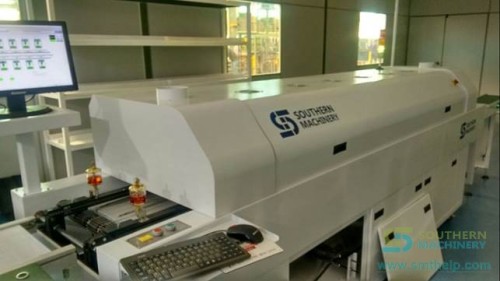
Reflow oven preventive maintenance on a lead-free SMT line is a short documented routine, not a rebuild. The Southern Machinery S-6600-PC is a 12-zone lead-free reflow oven with a 2300 mm heated tunnel, a 350 mm mesh conveyor and industrial PC control quoted at ±1 °C. This guide sets out the reflow oven preventive maintenance schedule from the machine's own manual, the fault paths it documents, and the parameters to verify before you specify an oven.
The short answer: seven maintenance intervals and twelve pre-start checks keep the tunnel repeatable while the chamber is at 350 °C.
What does reflow oven preventive maintenance actually cover?
The three ways a reflow oven loses money without breaking down
A reflow oven rarely fails loudly. It drifts.
- The thermal path. A zone loses a few degrees, a thermocouple drifts, or a relay begins to fail intermittently. Nothing stops, but the joint is no longer the joint the profile was measured for, and on a profile running to 210–230 °C there is little margin between a cold joint and thermal damage.
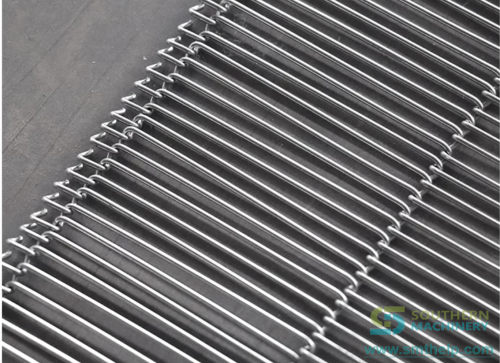
- The conveyor path. A rail that is stiff at room temperature can deform at 350 °C. That is board jamming on the machine in the middle of your line.
- The air and gas path. Holding a tunnel at reflow temperature is a continuous power draw, and a badly sealed chamber wastes the nitrogen bought to keep oxygen down.
The twelve-check pre-start routine
The S-6600-PC operation manual puts twelve checks in front of every shift. They take a few minutes and they cover every fault in the fault table.
- Supply is 3-phase 5-wire 380 V plus neutral and ground, and the machine ground is continuous.
- Main circuit conductors tight, no foreign object in the electrical box, control card seated.
- Nothing is jamming the mesh belt; drive chain carries high-temperature lubricant.
- Transmission bearings lubricated; high-temperature terminals not loose or burnt.
- The exhaust pipe is clear; the air circulation motor turns freely; the inverter extension cable is not loose.
Why is an unscheduled reflow oven stop so expensive?
By the time a board reaches the tunnel, the printing and placement work has already been spent on it. A stop does not idle one machine; it holds printed boards and the panels behind them. Every documented fault — a missing phase, a burnt terminal, a foreign object in the mesh — is cheap to find on a planned stop.
What is the documented S-6600-PC maintenance schedule?
Seven intervals, quoted from the operation manual exactly as printed.
- Drive chain: every 7 days. High-temperature grease.
- Bearings: monthly. High-temperature grease.
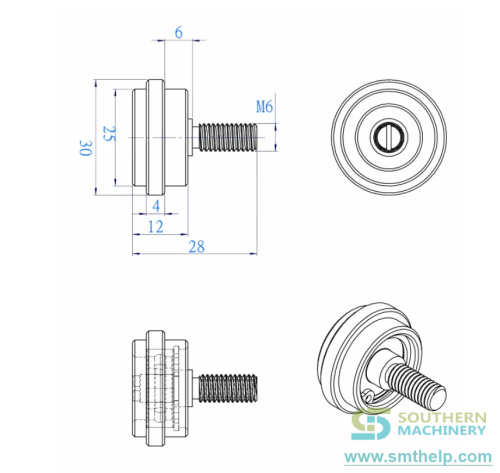
- Roller and tension rail: every 2 months. Molybdenum disulphide oil.
- Conveyor motor: at least twice a week. High-temperature shaft oil.
- Fans: weekly. Clear the flux residue that sticks to the blades and the motor.
- Main case and exhaust: daily. Clean the shell and the outlet residue.
- Ground continuity: before every start. Check that the ground wire is continuous.
Where does the manual disagree with itself?
These pages come from a specification sheet, an operation manual and two brochures, and they do not agree everywhere. Rather than average the figures, Southern Machinery prints both.
- Drive chain lubrication. Section 1.3 says high-temperature grease every 7 days; section 2.9, four pages later, says molybdenum disulphide every two months. They describe different lubricants on the same assembly: weekly for the chain, two-monthly for the roller and tension rail.
- Warm-up power. The specification sheet and the configuration matrix both say 24 kW; the manual says 12 kW, but that table is a series template whose row was never filled in for this model. Southern Machinery quotes 24 kW and recommends confirming it against the nameplate on your own build.
Which faults does the manual walk a maintenance team through?
Four, each with the checks in the order the manual gives them.
- Red alarm lamp lit. Check the main circuit for a missing phase, the thermocouple for an open circuit, and the SSR control segment for damage.
- Machine will not start. Check the incoming supply, the control power supply, and that the emergency stop is reset.
- Conveyor stops. Check the drive controller, inverter wiring, conveyor motor, chain, and for a foreign object in the mesh.
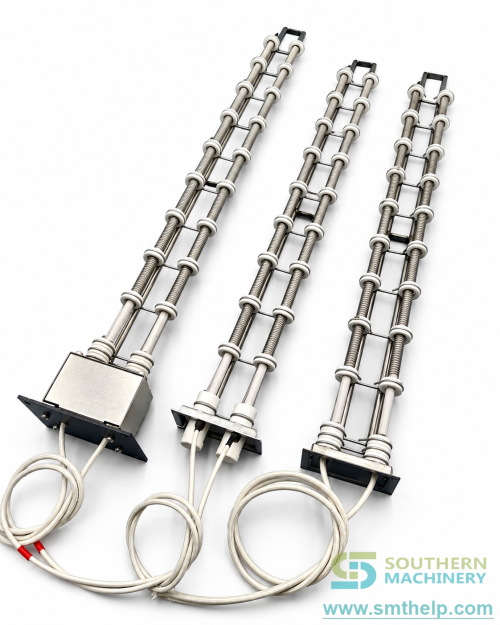
- No heating. Check the air circulation and drive switches, the heating switch, the SSR switch and then the SSR.
The control station makes this practical: every zone shows setpoint against measured value, and each zone's heater and alarm lamp can be switched individually, so a failed SSR is findable without dismantling the tunnel.
How does the reflow oven connect to the rest of the assembly line?
The oven takes boards from the placement step and hands them on to inspection, so its interface conditions matter as much as its profile. The published envelope is a 350 mm maximum board width, a mesh belt 560 mm wide on a 9.2 mm pitch with 1.4 mm SUS304 wire, a conveyor height of 880 ± 20 mm, left-to-right flow as standard, and a 0.5 MPa air drop if pneumatics run downstream. Loaders, buffers and conveyor sections either side come from the same line diagram, and Southern Machinery builds that board handling as part of the line solution.
Key selection parameters to verify before you specify a reflow oven
- Heating and cooling: 12 zones, top 6 and bottom 6, over a 2300 mm heated length, with 2 cooling zones. Up to 350 mm board width on a mesh belt at 0–2000 mm/min.
- Thermal control: room temperature to 350 °C, ±1 °C control precision, ±3 °C distribution error, industrial PC with PID closed loop to SSR drive.
- Power: 24 kW warm-up, 3–5 kW operating, 5-wire 3-phase 380 V 50/60 Hz.
- Warm-up and footprint: about 20 minutes per the specification sheet; L3600 x W700 x H1430 mm, approximately 450 kg.
- Site services: ambient 5–40 °C, humidity 20–95 percent, a reliable ground wired by a qualified electrician, levelling until the chain tracks horizontally.
- Options: sealed nitrogen-ready chamber with a flux-reclaiming filter, dual-rail conveyor, right-to-left direction. The base S-6600 has 1800 mm of heating, a 300 mm board, 0–1500 mm/min and an instrument controller; the S-6600-PC extends all four.
The specification sheet carries the machine values quoted here, and the reflow oven range carries the next model up.
What does planned maintenance return? A method, not a promise
Maintenance activity removes unplanned stops; it does not replace operators, so a labour claim would be dishonest here. The arithmetic that works compares stop time with planned time.
Annual downtime avoided
  = unplanned reflow stops per year x average stop hours x line cost per hour
Annual maintenance cost
  = planned stop hours per year x line cost per hour + spares and lubricant
Benefit ratio = annual downtime avoided / annual maintenance cost
Example only, with your own numbers: an oven that stops unplanned 6 times a year for 3 hours each, held to 2 such stops by a planned programme, avoids 12 line hours — about $4,800 at $400 per line hour — against roughly 12 hours of planned stop time and a small consumable spend. Figures are illustrations subject to final technical confirmation; the intervals themselves are documented.
FAQ
How often does a reflow oven need maintenance?
The S-6600-PC manual documents seven intervals: drive chain every 7 days, bearings monthly, roller and tension rail every 2 months, conveyor motor at least twice a week, fans weekly, case and exhaust daily, and a ground check before every start.
What is the most common cause of an unplanned reflow oven stop?
The documented fault list points at four paths: a zone alarm (missing phase, open thermocouple or damaged SSR control segment), a machine that will not start, a stopped conveyor, and no heating. Conveyor and heating faults are the two that stop production outright.
Does the S-6600-PC need nitrogen, and what does it consume?
The chamber is sealed against gas loss and includes an integrated filter that reclaims flux and returns filtered air to the tunnel. The quoted floor is 150 ppm and consumption is 20–22 m3/h in the 300–800 ppm band. Ask for a measured oxygen curve on your own board before budgeting.
How many heating zones does the S-6600-PC have?
Twelve: six upper and six lower, over a 2300 mm heated length. The control screen displays ten channels per side because the HMI is a shared series platform, and the manual records a tenth-zone alarm; the documented zone count remains 6 upper and 6 lower.
Can an operator see a zone drifting before it fails?
Yes. The controller scans every zone once per second and cuts heater power and raises an alarm if a channel leaves its band, and every zone event is timestamped against an operator name and exportable by date.
Contact Southern Machinery
Send us the board thickness, the largest component and the paste you use, and we will run a profile on a machine and send back the curve with the zone setpoints and belt speed that produced it. Southern Machinery has designed SMT and THT PCB assembly equipment in Shenzhen since 2011, supporting more than 237 customers worldwide with spare parts, training and line integration.
Email info@smthelp.com, call +86 0755 8320 3237, or message WhatsApp +86 136 0256 2576. You can also request a quotation on the Southern Machinery site.
Comments