
Reed Switch Auto Insertion Machine: Automated THT Assembly for PCB Production
Reed switch insertion was always manual work. Southern Machinery's reed switch auto inserter brings this glass-bodied THT component onto the automated line.
Sep 18, 2026 · Updated Sep 18, 2026 · Southern Machinery
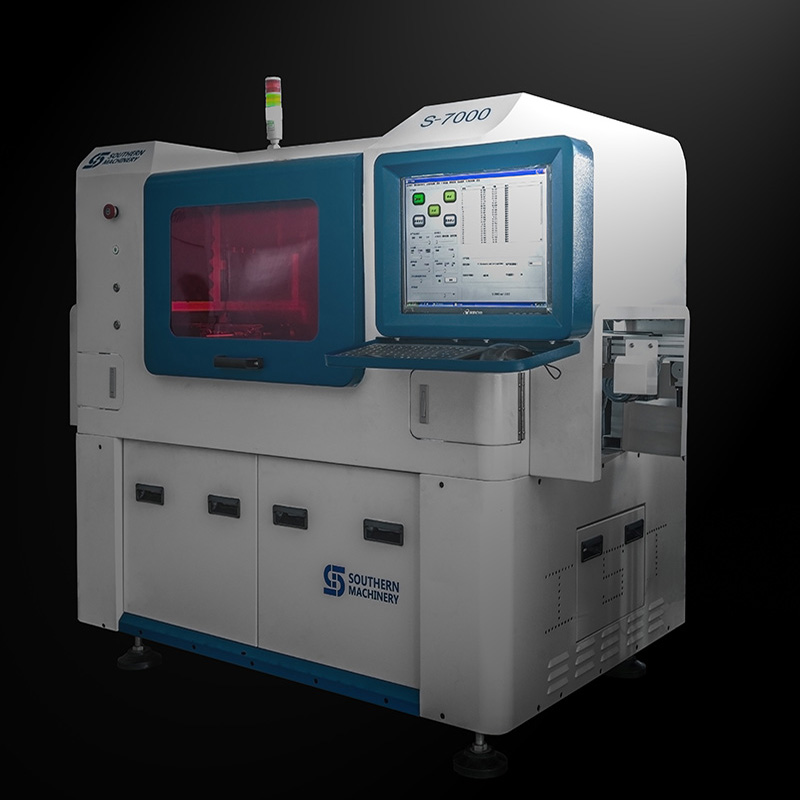
Reed Switch Auto Insertion Machine: Automated THT Assembly for PCB Production
Reed switch insertion has been a manual operation for as long as reed switches have existed. Glass-bodied, magnetically sensitive and axial-leaded, they are exactly the kind of component that general-purpose odd-form equipment handles poorly and hand operators handle inconsistently. Southern Machinery brought the first reed switch auto insertion machine to the market in February 2023, moving this component class onto the automated through-hole line.
Watch the machine run: Reed Switch Auto Insertion Machine to Assemble PCB by Through Hole Technology
What Is a Reed Switch Auto Insertion Machine Used For?
A reed switch auto insertion machine feeds, orients and inserts reed switches into through-hole PCB positions automatically, replacing the manual placement step on a THT assembly line. Reed switches — also called Herkons — operate by magnetism: in the presence of a magnetic field the reed contacts either open or close, depending on their original positioning and purpose. Because the switch body is hermetically sealed, it can operate in almost any environment, which is why it appears in applications from security sensors to high-voltage relays.
That same construction is what makes the component difficult to automate. The switching element sits inside a sealed glass envelope, so the insertion head cannot clamp the body the way it clamps a plastic connector or a terminal. Feed orientation matters twice over: the leads must align with the PCB holes, and the switch must sit in the correct orientation for the circuit to function. A dedicated reed switch insertion machine is built around those two constraints, whereas a general odd-form inserter is not.
Why Hand Insertion Was the Bottleneck
Reed switch insertion into PCBs was historically carried out by hand. As auto insertion mechanisms advanced, mechanized equipment became available that can accommodate these switches through through-hole technology (THT), so an assembly line that requires reed switch insertion no longer has to be a manual line. The practical difference on the floor is consistency: a machine presents every switch to the same hole pattern with the same insertion force and the same orientation, shift after shift, instead of relying on operator dexterity with a fragile glass body.
Typical Application Scenarios
Reed switches show up wherever non-contact switching, low contact resistance and a long service life matter. Common applications include:
- Security and access control — window and door sensors for alarm systems
- Power and energy — high-voltage relays in the power industry
- Automotive and industrial sensing — gear speed and direction sensing, ferrous part detection, safety vane sensors
- Process and utility equipment — fuel pumping station sensors, bridge operator controls in airplane docking
- Consumer and appliance electronics — control panels, hibernation mode sensing when laptops are closed
For an EMS or ODM manufacturer, that translates into product families such as alarm and sensor modules, metering and power boards, appliance control boards, automotive modules and industrial control units — all board types that also carry axial, radial and odd-form components. A reed switch inserter belongs in the THT section of those lines.
How the Machine Integrates into a Complete THT PCB Assembly Line
The reed switch inserter is a station, not a line. A typical configuration runs:
- Flux and SMT side — solder paste printing, SMT placement, reflow and AOI complete the surface-mount side.
- THT insertion — radial and axial inserters, odd-form inserters and the reed switch machine populate the through-hole positions, with lead clinching to hold parts before soldering.
- Wave soldering — boards pass through spray fluxing, preheat and the solder wave (lead-free or conventional alloy).
- Post-solder stations — lead trimming, PCBA cleaning, inspection (AOI/AVI), test and board handling conveyors.
Because reed switch positions are through-hole, the machine has to be matched to the same conveyor height and rail width as the rest of the THT equipment so boards flow without manual transfer. Southern Machinery supplies the surrounding line — wave soldering, board handling, cleaning, inspection, feeders and spare parts — so the reed switch station can be specified as part of one coordinated THT solution rather than a standalone island.
Key Selection Parameters
Reed switches are not a single component. Body length, glass diameter, lead span, lead diameter and lead form all vary between products, and every one of those variables changes what the machine has to do. Before a configuration is quoted, confirm:
- Component envelope — the reed switch body dimensions and lead span/pitch of the specific parts you place, for every product in the family
- Feed format — how the switches arrive (bulk, tray, tube or taped) and whether more than one format must be supported
- Orientation control — how the machine verifies orientation before insertion, and how a rejected orientation is handled
- Lead forming and clinching — whether leads are cut/formed to a fixed span and clinched after insertion
- Throughput class — cycle rate required to keep up with the rest of the line, and the number of reed switch positions per board
- Integration — standalone cell vs inline station, conveyor height/width, and communication with adjacent equipment
- Changeover — how programs and tooling move between board variants, and how much of that is done by the operator
Specific values for your application are confirmed by Southern Machinery against sample components and board data — not assumed from a catalogue page.
ROI, Quality and Throughput Perspective
The business case for automating reed switch insertion rests on three things that manual insertion does badly at volume:
- Breakage and scrap. A glass-bodied switch is easy to damage by hand. Mechanical feeding and controlled insertion force reduce the damaged-component rate.
- Consistency. Orientation and insertion depth repeat exactly, which reduces the rework and touch-up that follow mis-oriented or partially seated parts after wave soldering.
- Labour released. Every reed switch position moved off the bench is labour that can be redeployed to positions a machine cannot do — and unlike a manual station, the inserter does not fatigue across a shift.
Because reed switches are low in count but high in consequence on a board, the return typically shows up as yield and rework savings rather than raw speed. Where a line already assembles alarm, metering or appliance boards with several reed switch positions per panel, removing that manual step also removes one of the last reasons to keep the THT section partly manual.
FAQ
What is a reed switch auto insertion machine?
It is automated through-hole equipment that feeds, orients and inserts reed switches (Herkons) into a PCB, replacing manual placement of this component class.
Why can't a general odd-form insertion machine place reed switches?
Reed switches are glass-bodied and their orientation determines circuit behaviour, so they need feed, handling and verification designed around that component rather than a general-purpose insertion head.
Does the machine work with lead-free wave soldering?
The insertion station itself prepares and seats the component; the solder joint is formed at the wave soldering stage, which can run lead-free or conventional alloys. Confirm the full process route with Southern Machinery.
What industries use reed switch insertion machines?
Security and access control, power and energy, automotive, industrial sensing, utility and appliance electronics — anywhere reed switches are used for non-contact switching.
Can it be integrated with an existing THT line?
Yes, as an inline station or a standalone cell. Conveyor height, rail width and communication with adjacent equipment are confirmed against your line during specification.
Where can I see the machine running?
The demonstration video is linked above, and more product videos are available on the Southern Machinery YouTube channel.
Contact Southern Machinery for Configuration Advice
Southern Machinery (Shenzhen, China — founded 2011, serving 237+ customers worldwide) designs and supplies SMT and THT PCB assembly automation equipment: insertion machines, wave soldering, board handling, cleaning, inspection, feeders, nozzles and spare parts, with global support and training.
Send your reed switch part number, board drawing and target output to Jason Wu — jasonwu@smthelp.com for a configuration recommendation. Browse catalogues and documentation at file.autoinsertion.com and machine photos at ph.smthelp.com, or visit www.smthelp.com.
Comments