
Radial Tape Feeder Pitch 12.7 vs 15 mm by Southern Machinery
Radial tape feeder pitch decides whether taped electrolytics, Y-caps and terminals feed at the pick position. SRF1001 runs 12.7 mm or 15 mm, not both.
Oct 7, 2026 · Updated Oct 7, 2026 · Southern Machinery

Direct answer. Radial tape pitch is the distance between the sprocket holes in the paper tape that carries upright radial components — electrolytics, Y-capacitors, square capacitors, terminals, springs and bent resistors. The SRF1001 radial tape feeder from Southern Machinery runs two published pitches, 12.7 mm and 15 mm, and the product document states plainly that the two are not interchangeable. Settle the pitch before you order a reel, and the tape path presents every part at the mounter's beat; get it wrong, and the head reaches into a pocket that is not where the machine was told it would be.
What is radial tape pitch, and why does it decide whether a feeder works?
Radial parts ship standing up. Their leads are short, so suppliers tape them upright in a paper carrier — packaging that protects the lead span but defeats reel-to-reel feeding. A vertical radial tape feeder bridges that gap: two motor-driven feeding wheels index the sprocket holes, the movable cutting module trims the leads, and the head takes one part at a time from a fixed pick position. The pitch is what makes the chain repeatable, because the feeding wheels do not measure the tape. They count holes.
The pitch is mechanical, not optical. The SRF1001 advances tape one sprocket pitch per action cycle under a 42-type or 86-type stepper up to 600 rpm, PLC controlled with button operation. Nothing in that chain reads the component. A reel cut to the wrong pitch mis-indexes on every cycle, and the error accumulates instead of averaging out.
The two published pitches
12.7 mm and 15 mm — and nothing in between. Both figures come from the SRF1001 product document, which states that the two are not interchangeable. Treat pitch as a build option of the feeder, not a setting somebody adjusts on the day.
12.7 mm or 15 mm — which radial tape pitch do you need?
The pitch is set by your parts, not by the machine. That sounds obvious until you count how many radial part numbers reach the line and how few of their pitches anyone wrote down.
Pull your top ten radial part numbers — the ten that consume the most placements, not the most money.
Read the pitch off the tape — check the printed pitch, or measure hole centre to hole centre with a caliper. Suppliers label it inconsistently.
Group, then record it — add tape pitch as a required part-master field beside the outline and the lead span, so purchasing is caught before the line is.
Choosing the second lane honestly
Most factories find two camps, and the camps are where the automation plan gets written. One lane covers the dominant pitch; for a part that only ships on the other pitch, the honest answer is a second feeder configured to it — one lane, one pitch. Rolling the odd reel through anyway is how an operator ends up clearing mis-picks by hand, the exact manual work the feeder was bought to remove.
What goes wrong when the pitch is unmanaged
Mis-index, then mis-pick. A 12.7 mm reel in a 15 mm setup lands short of the pick position. The head grabs air or drags the part, and the front-end optical fibre — which alarms after three consecutive no-material cycles — flags a fault without naming it.
Failure at wave solder, not at placement. A part taken at an angle can survive the pick and fail later, when the board is expensive.
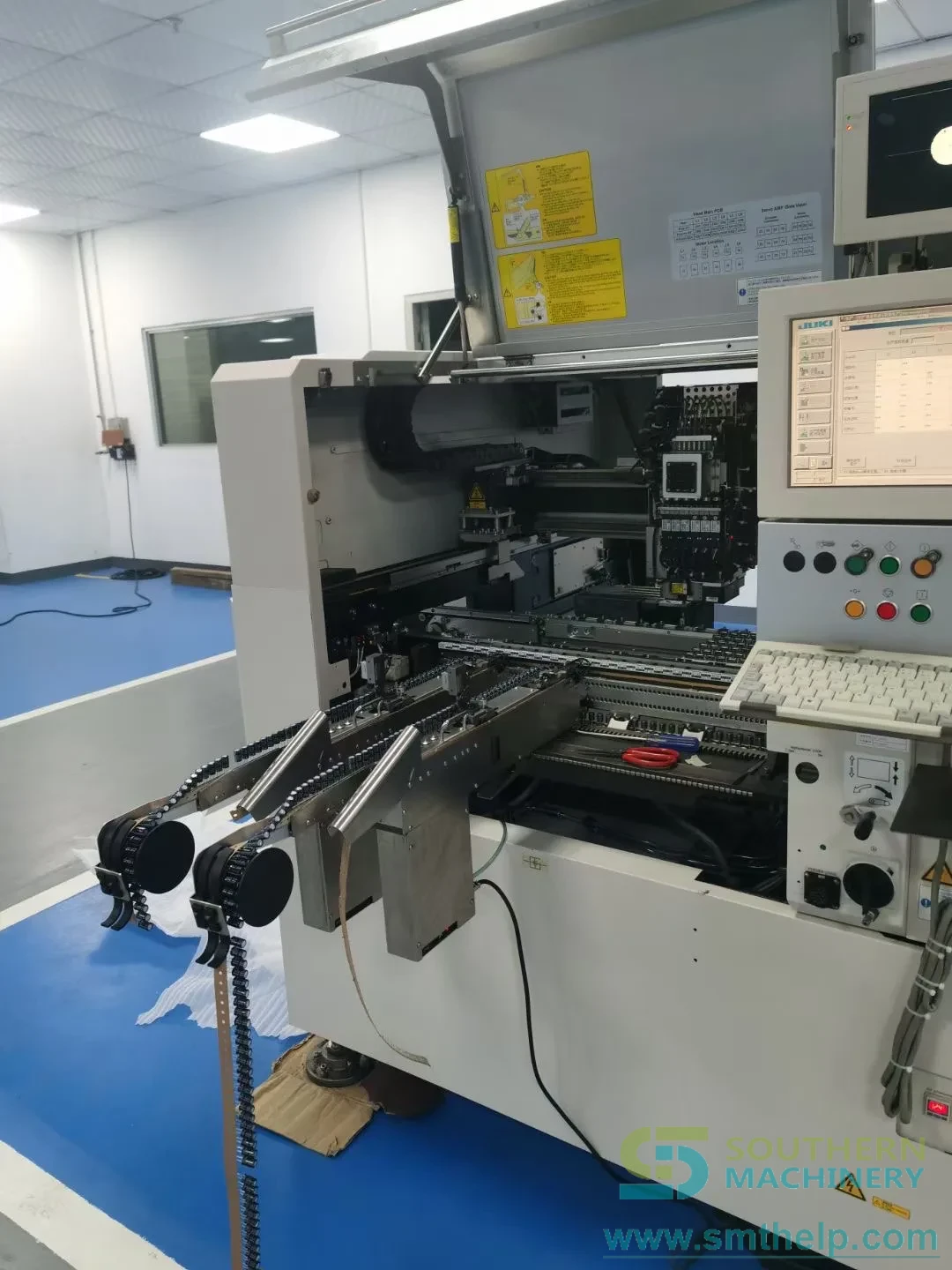
How does a radial tape feeder connect to a full PCB assembly line?
A feeder earns its place by keeping the steps either side of it fed. The SRF1001 integrates with SMT mounters for automatic DIP insertion, carries an 8-core φ16 mm aviation plug for IO communication or standalone operation, and supports non-standard equipment through a custom interface. The Yamaha YSM20 deck is documented; the family catalogue covers Fuji, Juki, Panasonic, Yamaha, Samsung and ASM interfaces.
A typical THT flow runs board loading, SMT placement, fluxing and preheat, wave soldering, then board handling and inspection. The radial tape feeder sits at the insertion stage, so upright components no longer depend on a bench operator. Our THT machine range and feeder range cover that stage, the DIP assembly line page shows the sequencing, board handling covers the flow around it, and parts outside the tape path move to the odd-form insertion machines.
What belongs in a radial tape feeder RFQ?
Everything below is published in the SRF1001 product document. Send these numbers and there is nothing left for a supplier to guess.
- Model and function — SRF1001 radial tape feeder: automatic feeding, shaping, cutting and bending of radial components for SMT mounters.
- Applicable materials — electrolytics, Y-capacitors, square capacitors, terminals, springs, bent resistors.
- Component outline range — 2 × 2 × 3 mm to 15 × 15 × 30 mm; wire core 0.3 – 1.0 mm.
- Tape hole pitch — 12.7 mm or 15 mm; not interchangeable.
- Cutting length — 3 – 6 mm via the movable cutting module.
- Shaping and bending — shaping molds per material spacing; optional 90° lead bend.
- Positioning — dividing plates in Y, limit-block position in X.
- Tape discharge — carrier rotated back through the feeding wheel; optional tail cut-off.
- Electrical and pneumatic — 24 V DC, 4 A average / 6 A peak; 0.4 – 0.6 MPa dry clean air.
- Control and interface — PLC, 42-type / 86-type stepper to 600 rpm; 8-core φ16 mm aviation plug, IO or standalone.
- Footprint — 720 × 92 × 165 mm, 10 kg.
- Performance — 1 s action cycle, ±0.2 mm feeding accuracy, three-cycle no-material fibre alarm.
- Consumable — cutting blade rated at 5 million cycles, named as a consumable.
The document also records a 1000-consecutive-feed test and a 48-hour aging test with no abnormalities, and a one-day spare parts lead time. Anything beyond that list — a non-standard interface, an unusual part attitude, a custom mold — is a quotation item, not an assumption.
What does a wrong pitch decision cost?
Pitch errors are cheap in isolation and expensive in aggregate, and the aggregate is arithmetic you can do before you order anything.
Annual labour addressed = radial components per board
                        × boards per day
                        × seconds per hand placement
                        × share the feeder takes over
                        ÷ 3600 × loaded wage per hour
                        × working days per year

Simple payback (months) = feeder price ÷ (annual labour addressed ÷ 12)
Worked example — illustrative only, depends on configuration, subject to final technical confirmation. Take 40 radial components per board, 300 boards per day, 6 seconds of hand pick-and-place per component, a feeder taking over 80 percent of those picks, and a loaded wage of USD 12 per hour. Hand work replaced is 40 × 300 × 6 × 0.8 = 57,600 seconds per day, or 16 operator-hours; the annual labour addressed is about 16 × 12 × 240 = USD 46,080, so payback lands in months. Every input is an assumption to be replaced with your own measured values — the SRF1001 document publishes no price, no time study and no savings claim, and neither does this example.
The real cost of an unmanaged pitch is absent from that equation. It hides in scrap tape, in the operator who clears mis-picks, and in the returns that arrive three weeks after the board shipped.

FAQ
Does the SRF1001 accept both 12.7 mm and 15 mm tape?
The product document publishes both pitches as supported and states they are not interchangeable. Because the feeding wheels index by sprocket pitch, configuring a lane to one pitch is what makes the pick position repeatable — so the practical reading is one lane per pitch, and no operator pitch selector is published. Confirm your mix with Southern Machinery before ordering reels for both.
Which components can the SRF1001 feed?
Taped electrolytics, Y-capacitors, square capacitors, terminals, springs and bent resistors, with outlines from 2 × 2 × 3 mm to 15 × 15 × 30 mm and a wire core of 0.3 – 1.0 mm. Parts outside that window, or parts that arrive loose in a tray rather than on tape, are a different conversation.
What cycle time and accuracy are published?
One second per action cycle and ±0.2 mm feeding accuracy at the pick position, with a recorded 1000-consecutive-feed test and a 48-hour aging test showing no abnormalities — the evidence that the one-second figure is a sustained rate rather than a showroom number.
Will it work with our mounter brand?
The SRF1001 integrates with SMT mounters for automatic DIP insertion and is documented for the Yamaha YSM20 deck; the family catalogue covers Fuji, Juki, Panasonic, Yamaha, Samsung and ASM interfaces. Non-standard equipment is supported through a custom interface. Tell us the machine and we quote the interface.
What if our part is not on any standard tape?
The document publishes the feeder as customizable for odd-form and non-standard equipment with tape cutting and component bending options, backed by a five-day design service. Three photographs and two dimensions usually start it: the part out of the package beside a coin for scale, the part taped or loose to show the lead span, and the board to show spacing and neighbours.
Next step: send us your tape
Take the ten radial part numbers that consume the most placements, note or measure the pitch on each reel, and send that list to Southern Machinery. We will tell you which lane each part belongs in, which one needs a second lane, and what the interface to your mounter requires — before you order a single reel. The full figures sit in the SRF1001 product document and the feeder catalogue.
Comments