
Radial Insertion Feasibility Check: S3000 Radial Inserter by Southern Machinery
A radial insertion feasibility check confirms, before purchase, whether your components, tape packaging and PCB fit an automatic radial inserter. This guide walks EMS and THT manufacturing teams through a five-step evaluation using the Southern Machinery S3000 Radial Inserter: component limits (max. height 20 mm, body diameter 13 mm, lead diameter 0.7 mm), supported lead spans, PCB size of 50 x 50 to 400 x 300 mm, feeder station planning and sample testing. It explains why the source lists 20,000 CPH specification speed and 10,000 CPH actual speed, how the S3000 connects into a complete THT line with board handling, wave soldering and inspection, and how to model labor savings with an example formula that depends on configuration.
Oct 22, 2026 · Updated Oct 22, 2026 · Southern Machinery
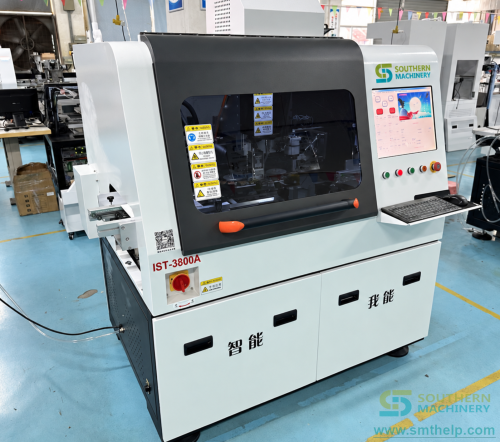
Most radial insertion projects that disappoint were never really machine problems. They were evaluation problems: someone bought on a headline speed figure before checking whether the parts, the tape and the board actually fit the machine's envelope.
What is the S3000 radial insertion machine used for? The S3000 Radial Inserter from Southern Machinery automates the through-hole insertion of radial, vertical taped components such as capacitors, resistors, transistors, LEDs, fuses, connectors, coils and potentiometers. It feeds taped parts, moves the PCB to programmed coordinates on an X-Y worktable, inserts each component, then cuts and bends the leads to hold it in place. A radial insertion feasibility check tells you, before purchase, whether your component, package and PCB fall inside that envelope.
Why Do Radial Insertion Purchases Stall After the Quote?
The hidden cost of a "general machine request"
Many THT teams at EMS, LED lighting and appliance-control manufacturers send a one-line inquiry: "We need a radial inserter, what's the price?" The quote arrives, the machine arrives, and only then does the team discover a tall electrolytic, a 7.5 mm lead span on one revision, or a board edge that does not suit the worktable.
The Southern Machinery S3000 material says it plainly: a practical review starts with the component and board data, rather than a general machine request alone. If you are the manufacturing engineer who will own the line after the purchase order is signed, that sentence is about you.
Why speed figures mislead
The S3000 specification lists 20,000 CPH as the specification speed and 10,000 CPH as the actual speed. Both numbers come from the same source document. The gap between them is exactly why feasibility matters more than the brochure: real output depends on your component mix, feeder arrangement and board layout.
How Do You Check Radial Insertion Feasibility in Five Steps?
This is a repeatable framework you can apply to any radial THT project, not only the S3000.
Step 1: Map every radial part against the component limits
List each radial part on the BOM with body height, body diameter and lead diameter. For the S3000, the source limits are max. height 20 mm, max. body diameter 13 mm and max. lead diameter 0.7 mm. Anything outside goes to a separate path (manual, odd-form or another platform).
Step 2: Confirm lead span and packaging
Check that each part is supplied as vertical taped (tape-packaged) components and that its lead span is one the machine supports: 2.5 / 3.5 / 5.0 / 7.5 / 10.0 mm, with dual, triple and quad span listed in the source.
Step 3: Check the board envelope
Compare panel size and thickness with the machine: PCB size 50 x 50 to 400 x 300 mm and thickness 0.79 to 2.36 mm. Note the hole pattern, since the lead cut and bend stage acts underneath the board.
Step 4: Plan feeder stations
Count unique radial part numbers per board. The S3000 standard specification lists 10 stations as the recommended number of feeder stations, with compact and standard feeder choices available according to customer need.
Step 5: Send samples, then confirm configuration
Ship a component photo, dimensions, packaging method, lead span, PCB file or board photo and your production target. Southern Machinery then recommends the machine and feeder arrangement, subject to final technical confirmation.
What Does the S3000 Bring to Each Step?
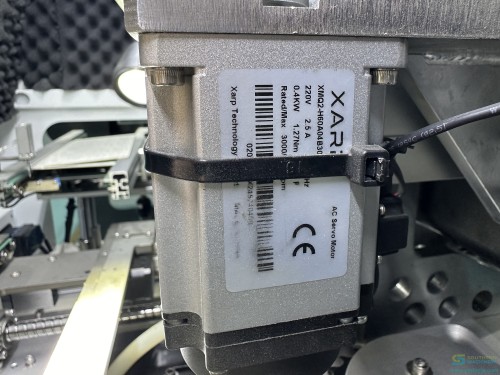
A four-stage insertion process you can verify
The supplied manual describes a simple cycle: Feed (taped parts enter the programmed path), Position (the PCB moves to the insertion coordinate), Insert (the insertion head places the part into the holes) and Finish (leads are cut and bent to secure the component). The insertion unit uses a servo motor and lead screw assembly for controlled handling, and the feeder separates taped components according to the insertion program before transferring them to the chain clips.
S3000 key selection parameters
| Parameter | S3000 Radial Inserter (source data) |
|---|---|
| Insertion speed | 20,000 CPH (specification); 10,000 CPH (actual speed) |
| Available PCB size | 50 x 50 to 400 x 300 mm |
| PCB thickness | 0.79 to 2.36 mm |
| Lead span | 2.5 / 3.5 / 5.0 / 7.5 / 10.0 mm; dual, triple and quad span |
| Component limits | Max. height 20 mm; max. body diameter 13 mm; max. lead diameter 0.7 mm |
| Lead trimming length | 1.5 ± 0.3 mm (short blade); 2.0 ± 0.3 mm (long blade) |
| Lead bend angle | 10 to 15 degrees, adjustable |
| Feeder stations | 10 stations (recommended number) |
| Air source | 0.6 to 0.8 MPa |
| Power supply | 220 V, 50 Hz |
| Machine dimensions | 1700 x 1500 x 1600 mm (L x W x H) |
| Net weight | 880 kg |
| Placement accuracy / certifications | Not specified in source — contact Southern Machinery to confirm |
Listed values are standard data and do not replace project-specific confirmation.
Typical applications
The product material names power conversion boards, LED drivers and lighting products, home appliance controller boards, air-conditioning and audio control boards, set-top box and motherboard projects, and high-mix PCB assembly environments.
How Does a Radial Inserter Fit Into a Full PCB Assembly Line?
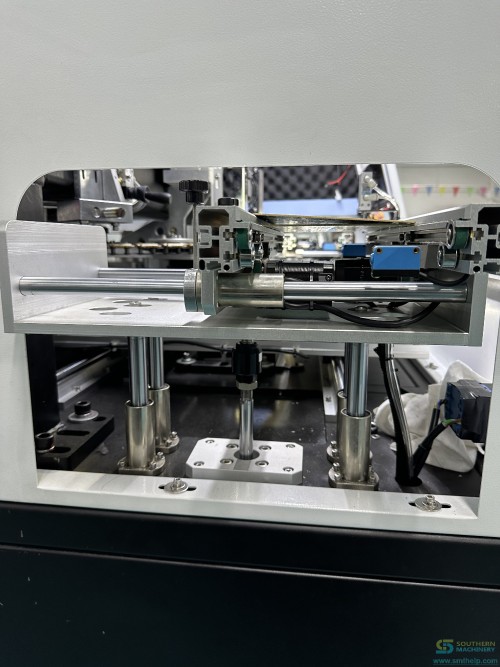
Board flow in and out
The S3000 manual describes PCB connection stations for sending boards into and out of the equipment, and the product material describes existing-line integration. Confirm the required line interface and board direction during evaluation.
Building the complete THT line
A typical mixed-technology flow pairs radial insertion with THT and auto insertion machines, board handling systems for loading and buffering, wave soldering after insertion, and SPI/AOI inspection. Southern Machinery, founded in Shenzhen, China in 2011 and serving 237+ global customers, supplies SMT, THT, wave soldering, board handling and inspection equipment as one line, with installation, professional training and spare-parts service.
Is the S3000 Cost-Effective for Your Volume?
A simple throughput and labor formula
Use this structure rather than a promised payback figure:
Boards per hour (example) = Actual CPH ÷ radial parts per board
Annual labor saving (example) = (manual insertion hours replaced × hourly labor cost) − added machine operating cost
Payback (months, example) = machine investment ÷ (annual labor saving ÷ 12)
Worked example (illustrative only)
Take the source's 10,000 CPH actual speed and a hypothetical board with 40 radial parts: 10,000 ÷ 40 = 250 boards per hour of insertion time, before board transfer, changeover and feeder reloading. Your own labor rate, shift pattern and machine price determine the saving. This is an example only; results depend on configuration and are subject to final technical confirmation. No ROI is guaranteed.
Frequently Asked Questions
What information should I send for a radial insertion evaluation?
A component photo, dimensions, packaging method, lead span, PCB file or board photo, and your required production target.
Can the S3000 handle my component?
The manual lists capacitors, resistors, transistors, LEDs, fuses and fuse holders, connectors, coils and potentiometers in vertical tape packaging. Southern Machinery evaluates the actual part, package and PCB before confirming suitability.
What is the difference between 20,000 CPH and 10,000 CPH?
The source lists 20,000 CPH as the specification speed and 10,000 CPH as the actual speed. Real output on your boards depends on component mix and layout.
Can feeder configuration be discussed before purchase?
Yes. Compact and standard feeder choices exist; the arrangement depends on the component and planned production.
Can the machine connect to my existing PCB line?
The manual describes PCB connection stations for board in and out. Confirm the interface and board flow during evaluation.
Your Radial Insertion Series: What to Read Next
This article is part one of our THT feasibility series. Keep the five-step checklist above as your pre-purchase worksheet and reuse it for every new board revision. Next in the series: how to plan feeder stations and changeovers for a high-mix radial insertion line, so your 10 stations work harder across product families.
Send Your Component for a Free Feasibility Review
Ready to check your parts? Send your component photo, dimensions, packaging method, PCB data and production target through Get a Quote or contact Southern Machinery. Our engineers will recommend a suitable insertion machine and feeding solution for your application.
Comments