
Automatic PCBA Brush Cleaning Machine, Southern Machinery
PCBA brush cleaning machine selection: four-level wet and dry brushing, S-168-200 vs S-168-460 board sizes, line integration and a worked payback model.
Oct 9, 2026 · Updated Oct 9, 2026 · Southern Machinery
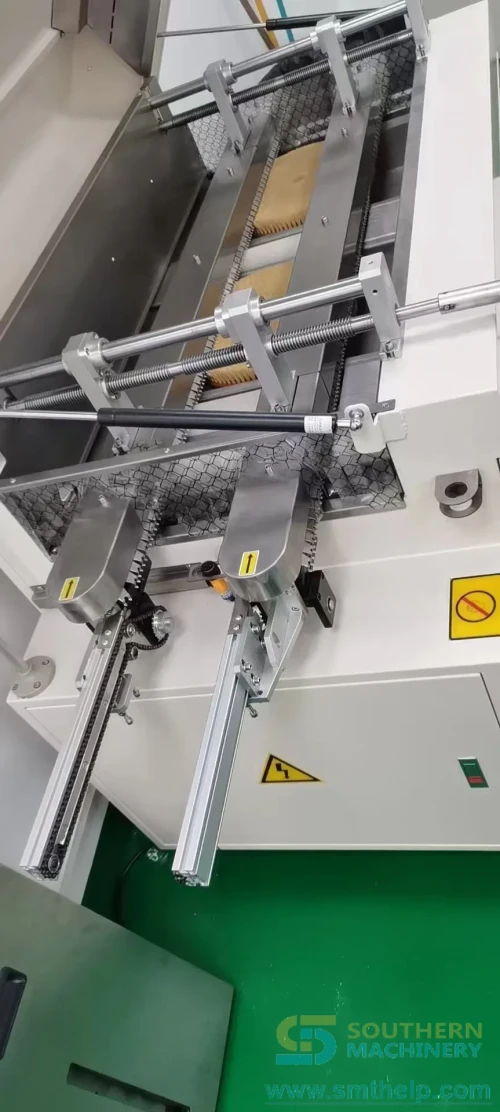
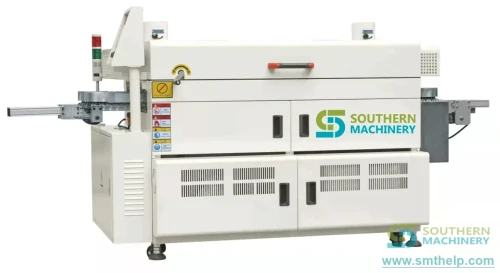
An automatic PCBA brush cleaning machine washes, rinses, dry-brushes and air-dries assembled boards in one automatic pass, so flux residue, solder balls and slag leave the line with the board instead of travelling on to inspection. The Southern Machinery S-168 uses four levels — wool-drum wet washing, a rinse, a stainless roller-brush wash and a stainless disc-brush dry wash — then air drying. It sits after soldering and before inspection, depaneling or final assembly.
Specifications below come from the S-168 user manual and the reference configuration. Cycle time, throughput, power rating, cleaning-agent consumption, price and lead time are not specified in source — contact Southern Machinery to confirm.
What is an automatic PCBA brush cleaning machine used for?
Removing flux residue and solder balls after soldering
Wave-soldered and hand-soldered boards leave the soldering step carrying flux residue, solder balls and slag on the surface and around the joints. A brush cleaning machine moves each board through wet brushing, a rinse and a dry-brush level so those residues come off mechanically rather than under an operator's hand brush.
Typical applications
THT and mixed-technology boards after wave or selective soldering; power and control boards with visible flux residue; and low-to-medium volume builds where one operator also solders and inspects. Where a customer audits cleanliness, a fixed sequence of brush levels is far easier to document than hand washing, which varies by operator, batch and shift.
Wet wash vs dry wash: why the S-168 uses four brush levels
A single wet wash leaves a wet, residue-carrying board; a single dry brush has no liquid to lift the flux. The S-168 splits the duty across four levels and two brush families.
Levels 1 and 2 — wool-drum wet washing
Wool drum brushes work with the spray lines to wash both sides of the board as it travels through. Cleaning liquid that has passed over the board returns to the circulation system instead of being discarded at the point of use.
Level 3 — stainless roller brush, after the rinse
The board is rinsed to clear loosened residue, then level 3 continues removing it mechanically with a stainless roller brush.
Level 4 and drying — stainless disc-brush dry washing
The final level is a dry wash carried out with a stainless disc brush. Because it is dry, it does not drag a liquid film of dissolved flux back across the board. Air drying then finishes the cycle and the board exits automatically, with no operator step between the four levels.
What carries the board — the chain drive transmission
The S-168 uses a chain drive, described in the source document as high strength, heavy bearing, no skid and synchronized; the coated roller reference is φ90 × L460 mm on the S-168-460. The chain drive is what holds a steady board rate through all four levels, which is the mechanical precondition for a repeatable result.
How does the S-168 fit into a complete PCB assembly line?
Where the cleaning step sits
The machine goes after the soldering operations — on most Southern Machinery lines after the wave soldering machine and after THT insertion work — and before inspection, depaneling or final assembly. Cleaning there removes residues before they are sealed under conformal coating or read as cosmetic defects.
Board handling before and after
Because the machine is board in, clean board out, the moves either side of it are transport steps. Southern Machinery normally brackets a cleaning step with the board handling system range, and specs it alongside the SMT line it serves. Southern Machinery is based in Shenzhen, was founded in 2011, has served 237+ customers worldwide, and supplies SMT, THT, wave soldering, board handling and inspection equipment as full line solutions. The machine directory is at file.autoinsertion.com.
Which model and configuration should you specify?
Use this list as the technical part of your RFQ. Every value below is quoted from the S-168 specification block; anything the document does not state is marked as such.
- Model range — S-168-200 and S-168-460, with customization available
- Maximum PCB size — 200 × 200 mm on the S-168-200; 460 × 460 mm on the S-168-460
- External dimensions — S-168-200: L1660 × W710 × H1160 ± 2 mm; S-168-460: L2180 × W970 × H1160 ± 2 mm
- Cleaning process — level 1-2 wool-brush wet washing → rinse → level 3 roller brush (SUS) → level 4 dry washing, disc brush (SUS) → air drying
- Brushes — wool drum brushes on the wet levels; stainless roller brush and disc brush on the dry levels
- Reference roller — coated roller φ90 × L460 mm (S-168-460 reference)
- Transmission — chain drive, high strength, heavy bearing, no skid, synchronized
- Function — automatic board entry, cleaning, dry cleaning, air drying and board exit
- Working environment — flat, dry, ventilated workshop; 5-45 °C; no fire source nearby
- Safety — cleaning tank low-level and over-limit alarms with a three-colour light
- Not stated in the document — board thickness limit, cycle time, throughput, power rating, air supply, cleaning-agent consumption, price and lead time. Contact Southern Machinery to confirm each of these against your board.
What does automated brush cleaning cost compared with manual washing?
The comparison is not machine price against zero, but machine price against the operators, the re-cleaning and the residue escapes the current method already costs you. For a line washing boards by hand today the source document gives three reference values: 1 operator per shift freed, about 4× faster cleaning than manual one-by-one washing (reference estimate), and 0 boards re-cleaned when the process runs to the documented settings. It also cites a typical payback of under 18 months on a mid-size line (reference estimate).
The arithmetic behind those numbers is simple enough to run with your own cost base:
Labour saved per year = operators freed per shift x shifts per day x hours per shift x loaded hourly rate x working days
Payback (months) = machine and installation cost / monthly labour and rework saving
Worked example (illustrative only). If one operator per shift is freed on a two-shift, 300-day operation, the annual saving is the freed hours times your loaded hourly rate, plus the rework avoided when boards come out clean first time. These figures are an example and depend on configuration; the 4× speed and sub-18-month payback are reference estimates and are subject to final technical confirmation.
What changes on your floor: quality, labour and capacity
- Quality — the same four levels run in the same order on every board, so cleanliness stops depending on which operator washed the batch.
- Labour and capacity — the machine takes over board washing and frees operator time; cleaning stays inside the board flow instead of becoming an off-line detour, which is where WIP queues normally form.
- Hard-to-reach residue and documentation — brushing on both the wet and the dry levels reaches residues simple washing leaves behind, and a fixed process is easier to record for customers who audit cleanliness.
Utilities, environment and daily operator checks
The user manual sets three pre-start checks that keep the process repeatable, and they are worth putting on the shift checklist:
- Power — confirm the rated two-phase three-wire supply and grounding before start-up
- Cleaning agent — confirm the capacity in the liquid storage tank
- Fluid circuit — confirm that brush rotation returns the cleaning fluid through the filter to the circulation system
The machine is specified for a flat, dry, ventilated workshop between 5 °C and 45 °C with no fire source nearby. Cleaning tank low-level and over-limit conditions are signalled by a three-colour light. Brush replacement intervals, filter intervals and recommended cleaning-agent chemistry are not specified in source — contact Southern Machinery to confirm.
FAQ — automatic PCBA brush cleaning machine
How many cleaning levels does the S-168 have?
Four: wool-brush wet washing at level 1-2, a rinse, level 3 with a stainless roller brush, then level 4 dry washing with a stainless disc brush, followed by air drying.
What is the difference between the S-168-200 and the S-168-460?
Board size. The S-168-200 accepts boards up to 200 × 200 mm and measures L1660 × W710 × H1160 ± 2 mm; the S-168-460 accepts boards up to 460 × 460 mm and measures L2180 × W970 × H1160 ± 2 mm. Both are available with customization.
Do the brushes damage boards or components?
The document specifies wool drum brushes for the wet levels and stainless roller and disc brushes for the dry levels, with a chain drive described as heavy bearing and no skid. That is the reference set; Southern Machinery confirms the brush set against your component heights during technical review.
What cleaning liquid and water does the S-168 use?
The machine uses a cleaning agent held in the liquid storage tank, and the fluid circuit returns cleaning fluid through a filter back into circulation. Agent chemistry and consumption rate are not specified in source — contact Southern Machinery to confirm.
Can it be integrated into an existing SMT or THT line?
Yes. Board entry, cleaning, dry cleaning, air drying and board exit all run automatically, so the machine is bracketed with board handling equipment after soldering and before inspection.
What is the lead time and price?
Not specified in source — contact Southern Machinery to confirm against your board size, configuration and quantity.
Next step: send your board and residue profile
Send Southern Machinery your maximum board size, board thickness, the preceding soldering process and the residues to remove, and we will confirm the model — S-168-200 or S-168-460 — with the brush set, cleaning agent and line interface. Email info@smthelp.com or WhatsApp +86 136 0256 2576, or request a quote via file.autoinsertion.com.
Comments