
PCB Extend & Retract Gate Conveyor: Telescopic Aisle Access for SMT Lines
A telescopic gate conveyor from Southern Machinery opens a temporary aisle across SMT lines without stopping PCB flow. PLC controlled, with 880–920 mm adjustable height.
Aug 22, 2026 · Updated Aug 22, 2026 · Southern Machinery
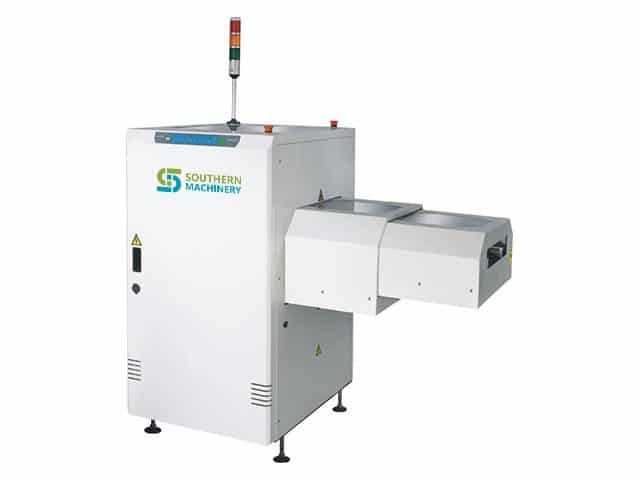
PCB Extend & Retract Gate Conveyor: Telescopic Aisle Access for SMT Lines
The PCB extend & retract gate conveyor — also known as a telescopic gate conveyor — is a board handling module that keeps PCB flow continuous while opening a temporary aisle through the line for operators, engineers, and maintenance staff. Southern Machinery, the Shenzhen-based SMT/THT PCB assembly automation specialist founded in 2011, designs and builds this conveyor as part of its full board handling range for EMS and electronics manufacturers worldwide.
Watch the SMT Telescopic Gate Conveyor in operation: https://www.youtube.com/watch?v=E5d272qEqUE
What is this machine used for?
An extend & retract gate conveyor is installed inline between PCB assembly machines. During normal operation, it transports boards from the upstream machine to the downstream machine. When personnel need to cross the line — for changeover, sampling, inspection, or maintenance — the gate extends or the docking platform moves to create a temporary aisle, then retracts to resume automatic PCB transport.
The key benefit is straightforward: nobody has to climb over conveyors, walk around the whole line, or stop production just to reach the other side. The machine offers an automatic mode for normal inline running and a manual mode with dedicated Extend and Retract buttons for controlled aisle opening. According to Southern Machinery's official user manual, the conveyor uses button-based Panasonic PLC control, a stepping-motor drive with precision ball screw, and a transport surface that handles PCBs from 0.7 mm to 30 mm thick at a conveying height adjustable between 880 and 920 mm. It runs on AC220V 50/60Hz with a rated power of 50W and standard left-to-right PCB transport direction.
Typical Application Scenarios
- EMS and contract manufacturing: high-mix lines with frequent operator access, changeovers, and customer audits — an aisle that appears on demand without shutting the line.
- Automotive electronics: long mixed SMT/THT lines for ECUs, controllers, and power boards where engineers move between stations constantly.
- Medical electronics: regulated clean environments where samples are pulled for inspection and documentation at multiple points along the line.
- Industrial control and power supply: lines combining SMT placement, wave soldering, and testing where staff need safe, fast access to both sides.
- LED lighting and general electronics: compact factories where floor space is tight and every square meter counts — a telescopic gate avoids dedicating a permanent walkway.
How It Integrates into a Complete PCB Assembly Line
The gate conveyor is a drop-in board handling module for SMT and THT lines. Typical positions include:
- Between a solder paste stencil printer and a pick-and-place machine.
- Between a reflow oven and AOI inspection, where operators pull first-article samples.
- Between a wave soldering machine and post-wave lead cutting or cleaning stations.
- At test and rework zones where boards circulate back across the line.
Its conveying height is adjustable (880–920 mm per the manual), which lets it match adjacent loaders, printers, mounters, ovens, and conveyors in the same line. Combined with Southern Machinery's other board handling equipment — PCB loaders, unloaders, buffer conveyors, shuttle conveyors, 90° turn conveyors, and inverting conveyors — it forms a complete, SMEMA-compatible material flow system around the core SMT and THT processes.
Key Selection Parameters
- Conveying height range: verify it matches your line's transport height (Southern's unit adjusts between 880 and 920 mm).
- PCB thickness range: confirmed 0.7–30 mm on the standard machine; confirm against your board stack-up.
- Transport direction: standard configuration is left to right — specify your line layout when ordering.
- Control interface: button plus Panasonic PLC as standard; ask about SMEMA interface, light towers, or MES integration options.
- Power and facility requirements: AC220V 50/60Hz, rated 50W; the manual recommends a supply capacity above 200W and a properly grounded connection. The gate mechanism includes pneumatic actuation, so confirm air supply if applicable to your configuration.
- Gate type: automatic extend/retract telescopic gate versus a manual lift gate variant — choose based on how often staff need to cross.
ROI, Quality & Throughput Perspective
- No line stoppage for crossing: a temporary aisle replaces the old choice between stopping the line or climbing over it — both of which cost time and risk dropped boards.
- Faster changeover and sampling: operators reach fixtures, feeders, and first articles without detours, shortening changeover time on high-mix lines.
- Damage and defect reduction: boards stay on the transport path instead of being hand-carried across the line during audits and maintenance.
- Ergonomics and safety: eliminates awkward climbing and reaching, reducing ESD handling risk and improving 5S housekeeping.
- Quick payback: for a small footprint and low power draw, the gate conveyor removes recurring interruptions from daily operation — especially valuable in high-volume EMS plants where every minute of uptime counts.
FAQ
Q: What is a telescopic gate conveyor for SMT lines?
A: It is an inline PCB conveyor whose docking platform extends to open a temporary aisle across the line for personnel, then retracts to resume automatic board transport — so the line never needs to stop for someone to cross.
Q: Does opening the gate stop PCB flow?
A: When used as designed, the operator controls the gate in manual mode and resumes automatic mode after crossing; board flow is paused only for the seconds needed, instead of shutting down the entire machine chain.
Q: What PCBs can it handle?
A: Per Southern Machinery's manual, the standard machine transports boards from 0.7 mm to 30 mm thickness on a strip transport surface, with conveying height adjustable between 880 and 920 mm to match the line.
Q: Can it integrate with existing SMT lines?
A: Yes. It is designed as a standard board handling module for SMT and THT lines and can be positioned between printers, placement machines, reflow ovens, wave soldering, and inspection stations, with height adjustment to match adjacent equipment.
Q: What are the power requirements?
A: AC220V 50/60Hz with a rated power of 50W. The manual recommends a dedicated 220V single-phase supply of at least 200W capacity and reliable grounding.
Q: What support does Southern Machinery provide?
A: Southern Machinery has served 237+ global customers since 2011 with SMT/THT, wave soldering, board handling, and inspection solutions, backed by spare parts supply, training, and global support through its service hub in Shenzhen.
Contact Southern Machinery for Configuration Advice
Contact Jason Wu at jasonwu@smthelp.com to discuss line layout, height matching, and gate configuration for your factory. Browse the equipment catalog at file.autoinsertion.com, view machine photos at ph.smthelp.com, and explore the full product range at www.smthelp.com.
Comments