
PCB Depaneler Lower Blade D508S4601007 by Southern Machinery
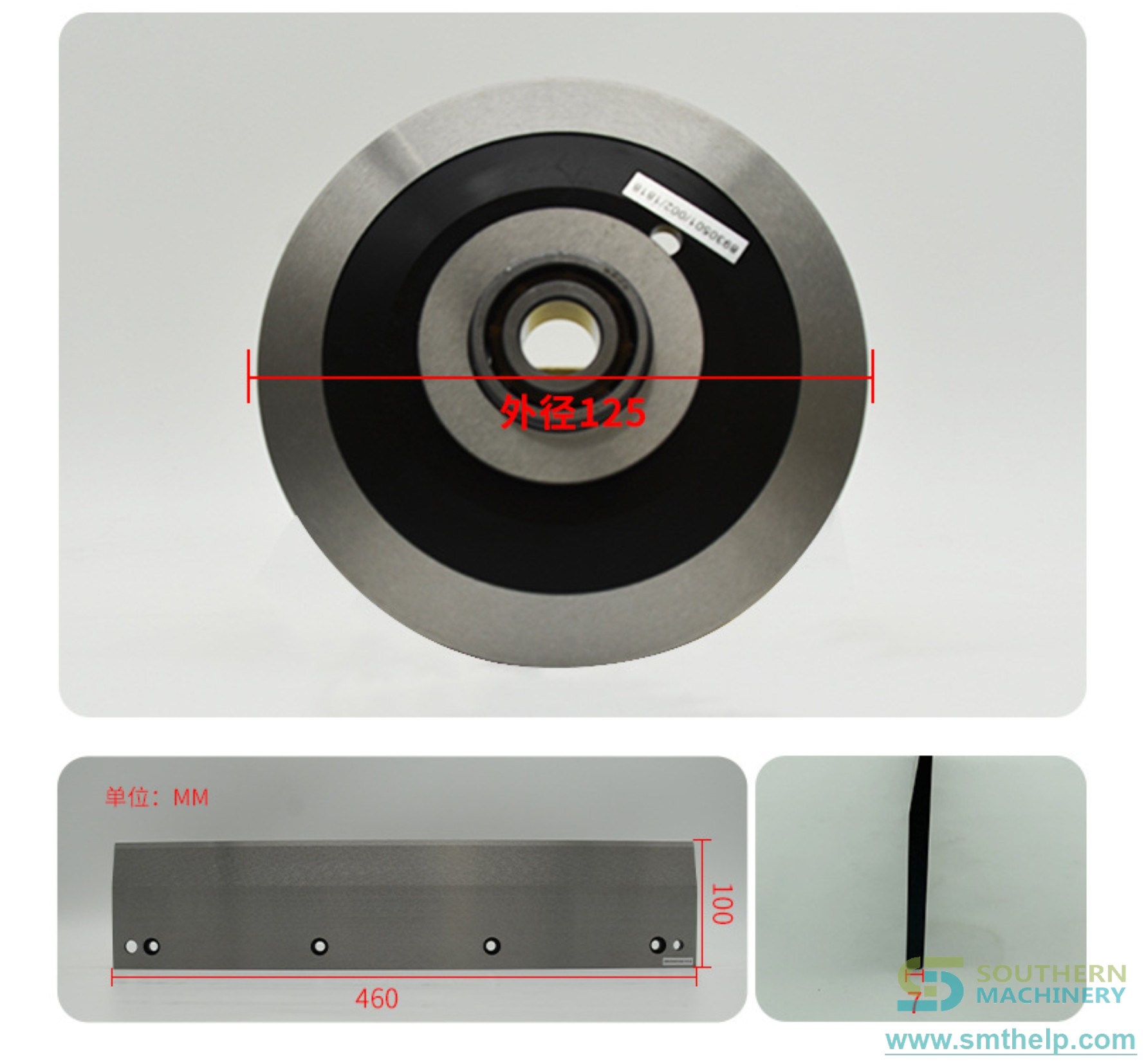
A PCB depaneler lower blade is the fixed straight blade a V-cut separator cuts against, and on the Southern Machinery S-D508 it is Part D508S4601007, nominal 460 x 100 x 7 mm, running against a 125 mm upper circular blade. This guide covers what the blade does, how to tell a worn edge from a bad V-groove, which measurements identify the right version for your machine, the manual's blade-change steps, the 0.1 to 0.2 mm gap and 0.1 mm plane rules, a value calculation for stocking a spare, and the care routine that keeps high-speed steel edges clean between changes.
Oct 15, 2026 · Updated Oct 15, 2026 · Southern Machinery
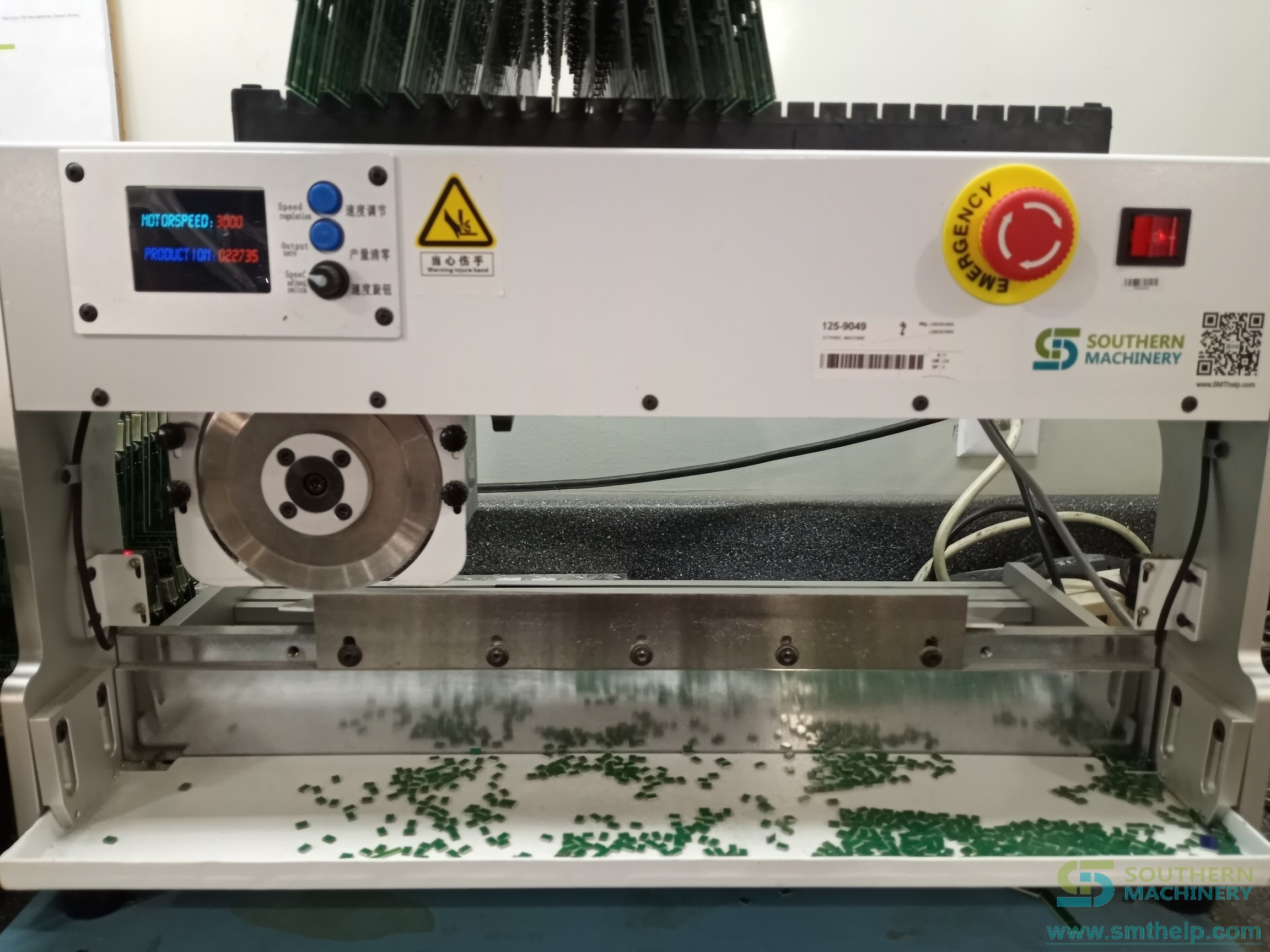
The Southern Machinery PCB depaneler lower blade D508S4601007 is the fixed straight blade that carries every V-groove a guillotine-type V-cut separator cuts. Part D508S4601007 is the nominal 460 x 100 x 7 mm lower blade for the S-D508, running against a 125 mm upper circular blade; the same blade family is made in versions for separators of other brands. Choosing the right one is a measurement job — machine nameplate, old blade dimensions, hole pattern.
What is a PCB depaneler lower blade used for on a V-cut separator?
The board arrives already scored with a V-groove, and the separator finishes that cut and nothing else. The groove rests on the fixed lower blade while the travelling upper circular blade splits the thin web left at the bottom of the groove. On the S-D508 the lower blade is Part D508S4601007, a straight fixed blade of nominal 460 x 100 x 7 mm, mated to a 125 mm circular upper blade that travels along the groove between preset points of 0 to 400 or 600 mm.
Two blades, one cut
The lower blade is the reference surface: every panel runs over it, so its edge condition decides how cleanly the web splits. Ordered as a set, both sides of the cut come from the same supplier, so neither side is an unknown part when the gap is set. The manuals state a board thickness range of 0.2 to 5.0 mm, a cutting speed of 300 to 500 mm/s with a high/low switch, a blade gap of usually 0.1 to 0.2 mm, and both cutters in one plane with an error of no more than 0.1 mm. The machine is documented for pre-scored V-cut boards only; tall components near the cut line may need a pre-processed blade version.
Is it a worn lower blade or a bad V-groove? Compare the evidence first
Half of all blade complaints start upstream, at the PCB supplier's scoring machine. A dull lower blade and a shallow or off-centre V-groove give a similar symptom — a ragged, stressed edge — and they are fixed in two different places.
Check the blade when the onset follows time, volume and material mix; when the lower edge under strong light shows chips, rust pits, a rolled edge or resin build-up; and when the remaining web at the bottom of the groove is still inside the board drawing. Check the V-groove when the onset follows a panel lot or a supplier batch, when the blade edge is clean and even, and when the remaining web is too thick, too thin or off-centre.
Check the board before you blame the blade
The S-D600 separator sheet gives typical score-line guidance: a remaining thickness of about one third of the board thickness, between 0.2 and 0.8 mm, and a V-groove depth of at least 0.25 mm. The V-cut thickness meter manual shows how to measure the remaining web. Only when the panels sit inside their drawing is the blade the next variable.
What a tired lower blade leaves behind
A chipped or blunt edge needs more force to split the web, so the board flexes before it breaks and the stress travels into solder joints and ceramic parts near the cut. The defect usually appears later and somewhere else — at final test or in the field. A worn edge also tears the web instead of splitting it, leaving fibres, burrs and an oversize edge.
Which measurements decide the right D508S4601007 blade version?
Three numbers on a part name describe a rectangle, not a blade. What decides the fit is the hole or slot pattern, the number and size of the fixing screws, the edge geometry and the steel grade. The selection parameters, D508S4601007 against the other versions of the same blade family:
- Blade type — lower straight (fixed) blade, parts-list item 10; other versions keep the same upper-circular-over-lower-straight arrangement.
- Nominal size — 460 x 100 x 7 mm for D508S4601007; thinner versions, such as about 6 mm, are made.
- Mating upper blade — circular, outer diameter 125 mm; by machine for other versions.
- Material — SK61D high-speed steel for the S-D508; SKD61 or SKH-9 for other versions.
- Hardness — by version, stated on the quotation, and it differs with the steel grade.
- Fixing — the S-D508 blade-seat pattern; other machines use four screws or five M6 screws.
- Machine — S-D508 V-cut PCB depaneler; other versions fit guillotine separators of other brands.
Five facts and two photos
Send the separator model with a nameplate photo; the old blade's length, width and thickness; a photo of the blade beside a ruler showing the holes or slots; the board material and thickness you cut; and the quantity of lower and upper blades. Measure the old blade before it leaves the machine — once it is scrapped, the reference is gone.
How do you change and set the lower blade on an S-D508?
According to the S-D508 manuals: power off, remove the M5 screws under the cutting platform with a 4 mm hex key, lift the platform, loosen the screws above the straight blade, take the blade out, fit the new one and tighten the screws evenly.
The 0.1 mm rule: gap and plane
A new blade is not finished until the gap and the plane are rechecked. Set the upper blade height with the knob for the board thickness, keep the blade gap usually 0.1 to 0.2 mm and both blades in one plane with an error of no more than 0.1 mm, start on low speed and cut a scrap panel before releasing production boards. Blade changes fail more often at the setting than at the steel: too wide a gap tears the web instead of splitting it, and out-of-plane blades push the board sideways.
Fault-to-check sequence
Work from a safe state — power off, upper blade at its origin. Note the board type, thickness, edge condition and defect location; check the V-groove depth and remaining web against the drawing; inspect both edges for chips and rust; then check gap and plane. Change the blade only when the cause is confirmed, trial cut and record — otherwise tag the machine and escalate.
What does a spare lower blade cost you per year?
Every money figure in this calculation is yours: panels separated, how many a worn blade would damage, and what rework costs in your plant.
Rework hours avoided / month = panels per month x share damaged by a worn blade x rework minutes per damaged panel / 60
Rework cost avoided / month  = rework hours avoided x cost of one rework hour
Blade upkeep cost / month    = panels per month x blade upkeep minutes per panel / 60 x upkeep cost per hour
Net value / month            = rework cost avoided - blade upkeep cost - amortised blade price
Example arithmetic only: 20,000 panels a month, 0.5 % damaged by a worn blade (100 panels), 30 rework minutes each (50 hours) and USD 25 a rework hour give USD 1,250 avoided. At 0.05 upkeep minutes per panel and USD 20 an hour, upkeep is about USD 333, leaving roughly USD 900 a month before the blade price is amortised. The figures are an example, depend on your configuration and volumes, and are subject to final technical confirmation — not a performance claim by Southern Machinery.
Why a spare belongs on the shelf
Without a spare, a chipped blade turns a five-minute job into days of waiting, and the temptation to keep cutting with a damaged edge — or to snap boards by hand — moves the cost into quality. Keep one greased, labelled spare per machine for every wear part that can stop the line; for an S-D508 that means one D508S4601007 lower blade, usually with one 125 mm upper blade.
How does the separator and its blade fit a complete PCB assembly line?
Depaneling sits after soldering and before final assembly and test, so a stressed edge from a tired blade is carried into everything downstream. The S-D508 and its blade are one station in a full line — SMT placement, reflow, THT insertion, wave soldering, board handling and inspection — with separation before boards are packed or built into the housing. Matching categories on the Southern Machinery site are board handling, PCB assembly and THT automation; blades and other consumables sit under SMT spare parts.
Material mix changes the interval, not just the calendar
Short FR-4 boards go through a separator all day without complaint; then a run of long aluminium LED strips starts and the edges look different within weeks. Metal-core and long LED boards ask more of a blade, because the cut is longer and the material is harder on the edge. Plan inspection by material and length, not only by time, and note the material and panel length in the blade record.
How do you care for the blade so it lasts?
The manuals fit the routine on one card: power off and clear scraps after work; apply anti-rust grease to both blades regularly; check that all screws, including the blade fixing screws, are tight; before a long idle, remove both blades, coat them with oil and wipe them before use. Rust and trapped debris shorten blade life more than cutting does — a rust pit on the edge is a chip waiting to happen. Tie the routine to the shift change, with one signature per shift, so it is visible when it stops happening.
Southern Machinery has built SMT and THT PCB assembly equipment in Shenzhen since 2011 and serves 237+ customers worldwide, with spare parts support, operator training and remote fitting guidance after delivery. Published references: the S-D508 PCB Depaneler User's Manual, the S-D508 operation manual for gap, plane and blade removal, the 3D view of the V-cut blade set and the product catalogue board.
FAQ: PCB depaneler lower blade questions buyers ask
Which separator does the D508S4601007 blade fit?
It is the lower straight blade of the Southern Machinery S-D508 V-cut depaneler; other versions fit guillotine separators of other brands, matched from your nameplate and old blade.
Is this the upper or the lower blade?
It is the lower straight blade, nominal 460 x 100 x 7 mm, working against an upper circular blade of 125 mm outer diameter that can be ordered with it.
What steel is the blade made of?
SK61D, SKD61 or SKH-9 high-speed steel by version; the S-D508 manuals state SK61D, while the grade and hardness for your order are stated on the quotation.
How do I change the lower blade on an S-D508?
Power off, remove the M5 screws under the cutting platform with a 4 mm hex key, lift the platform, loosen the screws above the straight blade and take it out, then refit and reset gap and plane.
Which boards can the S-D508 cut?
Pre-scored V-cut boards 0.2 to 5.0 mm thick, at 300 to 500 mm/s; tall components near the cut line may need a pre-processed blade, so ask before ordering.
How long does a blade last, and what does it cost?
Blade life depends on board material, thickness, V-groove depth, volume and care, so no figure is published; price, lead time and payment terms are quoted per order, and resharpening is not stated in the manuals.
Send the separator model and the old blade, not just the enquiry
Most blade enquiries start with "please quote depaneler blade", and the answer then takes five e-mails. Send five facts and two photos instead — separator model plus nameplate photo, old blade length, width and thickness, a photo of the blade beside a ruler showing the holes or slots, board material and thickness, and the quantity of lower and upper blades — and the matching blade or the exact remaining question comes back in one reply. Email the details to info@smthelp.com to request a quotation for a spare set per machine.
Comments