
PCB Conveyor & Board Handling Solutions: S-460C Rail, S-350C Buffer & Dual-Link by Southern Machinery
Manual board transfer between SMT and THT machines quietly drains labor and creates handling defects. Southern Machinery's PCB conveyor family - S-460C rail conveyors, S-350C buffer conveyors, dual-link lanes and SFBC flat belt units - automates board transport with a standard SMEMA handshake, so boards flow from printer to mounter to oven without operators acting as couriers. Reference S-460C conveyors handle boards from 50 x 50 to 460 x 460 mm at 0.5-12 m/min with a 900 mm working height, and lengths from 0.5 to 2 m fit most line layouts. Conveyorized handling frees roughly one operator per line and removes dropped-board defects at hand-off. Get a layout-based recommendation and quotation from Southern Machinery.
Aug 27, 2026 · Updated Aug 27, 2026 · Southern Machinery
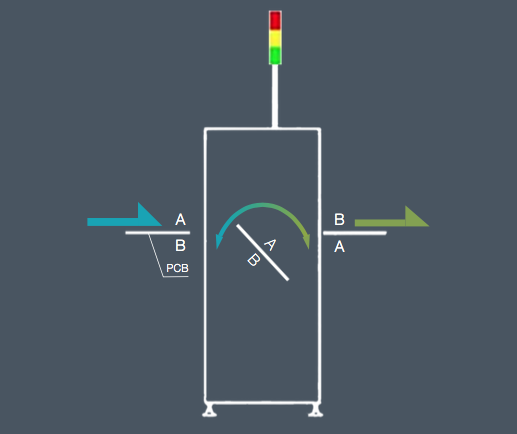
PCB Conveyor & Board Handling Solutions: S-460C Rail, S-350C Buffer & Dual-Link by Southern Machinery
Between the printer, the placement machine, the reflow oven, the auto inserter and the wave soldering machine sits the part of the line that is easiest to overlook: board transport. When PCBs are walked between machines by hand, operators become couriers, boards get dropped or scratched, and every hand-off is a potential line stoppage. A conveyorized board handling system changes that math by carrying boards automatically - and it connects into your existing line through the same SMEMA handshake your machines already use.
Southern Machinery, founded in 2011 in Shenzhen, China, designs and manufactures SMT/THT PCB assembly automation equipment for 237+ customers worldwide. This guide covers the conveyor family from the company's PCB Conveyor & Board Handling Solutions page: the S-460C reference rail conveyor, the S-350C buffer conveyor, dual-link conveyors, and SFBC flat belt units - with the transport specs, selection logic and ROI questions that procurement and manufacturing engineering teams actually ask.
What is this machine used for?
A PCB conveyor is a board handling module that moves printed circuit boards automatically between process machines - and, depending on the model, queues them when downstream equipment runs at a different speed. Instead of an operator lifting a board and walking it to the next station, the conveyor receives the board via a SMEMA handshake, transports it at a controlled speed, and hands it off to the next machine without a human touching it.
The family in this guide covers four jobs:
- Standard rail conveyor (S-460C reference) - carries boards between printers, mounters, reflow ovens and testers in a straight line.
- Buffer conveyor (S-350C reference) - adds queue capacity between machines with different cycle times, so the faster machine does not starve or push boards.
- Dual-link conveyor - runs two parallel lanes for double-track lines or separates OK/NG boards after inspection.
- Flat belt conveyor (SFBC05 / SFBC10 / SFBC20) - provides gentle, ESD-safe transport for boards and carriers in high-volume transfer.
Typical application scenarios
- EMS and ODM high-mix lines: frequent changeovers mean rail width and working height must adapt to different board sizes quickly; a manually adjustable rail conveyor with stop/detection sensors keeps changeover time short.
- Automotive electronics: heavier boards and strict traceability make controlled, sensor-tracked transport and ESD-safe belts a priority.
- Medical electronics: boards are sensitive to shock and contamination; conveyorized handling removes the dropped-board and scratched-board risks of manual transfer.
- Industrial control: mixed SMT/THT flows need conveyors that bridge placement lines, insertion machines and wave soldering without operators re-handling boards.
- After inspection (OK/NG separation): a dual-link conveyor diverts good boards and rejected boards onto separate lanes, keeping rework boards out of the main flow.
How to integrate conveyors into a complete PCB assembly line
Conveyorized transport replaces the gaps between machines with a continuous, SMEMA-linked flow. The integration points are simple and standard:
- Layout review first. Share which machines the conveyor connects, the available space, and your board dimensions. Southern Machinery confirms the conveyor type, length, rail width and working height before you commit.
- Match the working height. The S-460C reference operates at 900 ± 20 mm working height, aligned to the upstream and downstream equipment.
- Wire the SMEMA handshake. On the S-460C reference, front and rear board-present signals (Y2/CM2, X1/GND and Y3/COM3, X2/GND) connect the conveyor to adjacent machines so boards transfer without collisions.
- Install and commission in a day. The reference procedure covers site preparation, leveling and alignment, power and signal wiring, belt tension and rail width checks, then a test run in Normal (manual) and Bypass (automatic) modes.
- Extend to the line end. An unloader such as the SUL-250 completes the flow by stacking boards automatically at the exit, removing the last manual handling step.
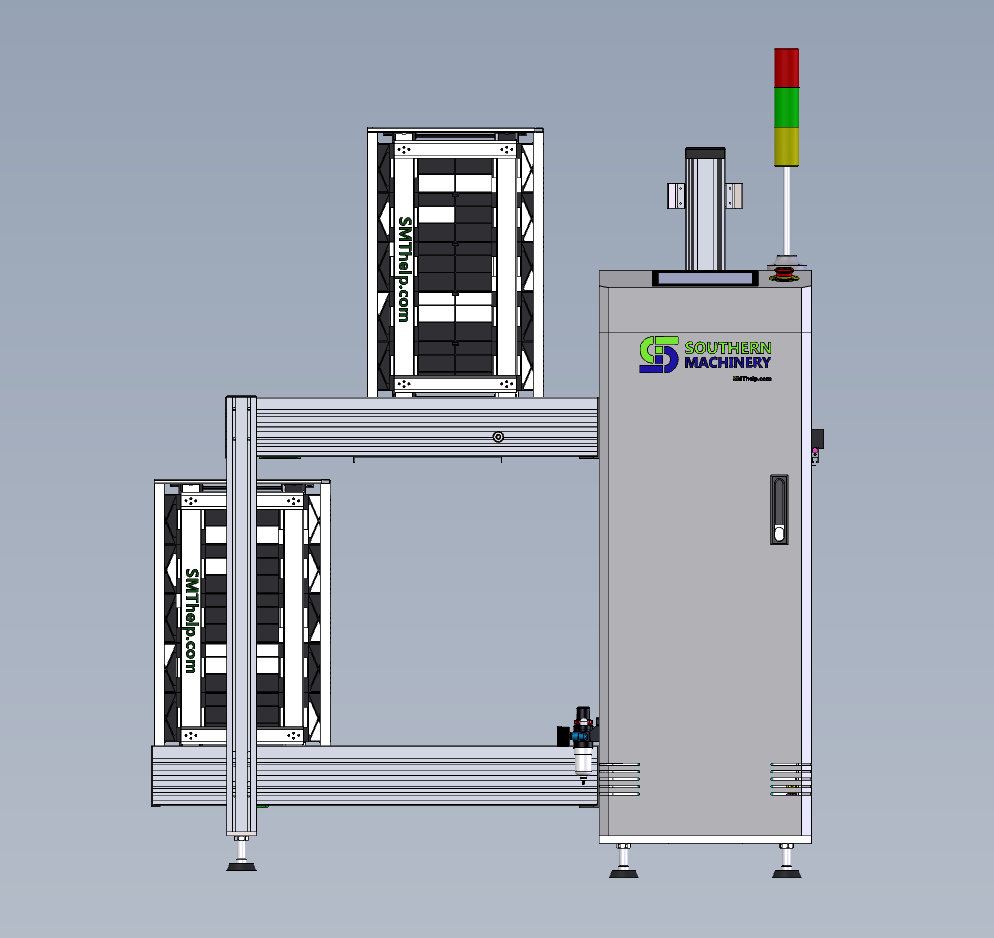
Which conveyor type fits your line?
Standard rail conveyor (S-460C reference)
The workhorse between two machines: single or double rail, belt or roller transport, lengths from 0.5 / 0.6 / 0.8 / 1 / 1.2 / 1.5 to 2 m. Use it between printers, mounters, ovens and testers to carry boards automatically. The S-460C reference handles boards from 50 x 50 to 460 x 460 mm and transports them at 0.5-12 m/min (or a customer-specified speed).
Buffer conveyor (S-350C)
When one machine runs faster than the next, boards pile up or starve the line. A buffer conveyor adds queue capacity between machines with different cycle times, storing boards on the rear sensor until the next machine is ready. This is the cheapest way to absorb cycle-time mismatch without slowing your fastest station.
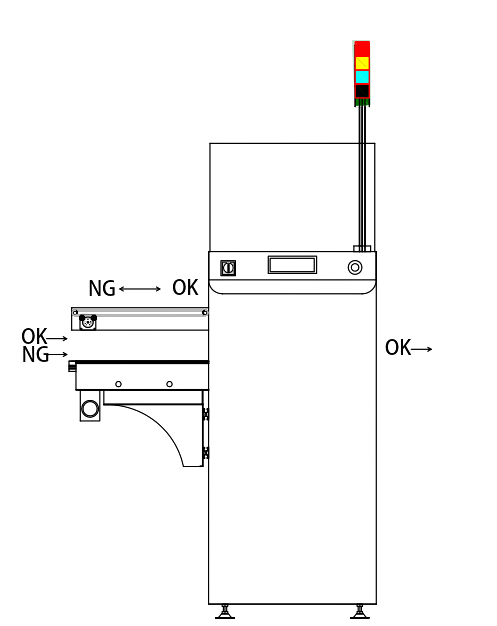
Dual-link conveyor
Two parallel lanes serve double-track lines or separate OK and NG boards after inspection. Use it when your line has parallel processes, or when post-AOI sorting should happen inline instead of at a rework bench.

Flat belt conveyor (SFBC05 / SFBC10 / SFBC20)
Gentle, high-volume transfer for boards and carriers, with an ESD belt to DIN EN 61340-5-1. Lengths are 0.5 m (SFBC05), 1 m (SFBC10) and 2 m (SFBC20). Choose it for delicate boards or carrier-based transport between line stages.
Key specifications for project evaluation
Values below are from the Southern Machinery S-460C user manual and SMThelp conveyor brochures; they support initial evaluation and remain subject to final technical confirmation against your board set and line layout.
Reference specifications - S-460C rail conveyor
| Parameter | Reference value |
| --- | --- |
| Application | Board transport and operator test bench in SMD/PCB assembly lines |
| Board size | 50 x 50 to 460 x 460 mm |
| Working height | 900 ± 20 mm (standard) |
| Transport speed | 0.5-12 m/min or customer specified |
| Control | POWER switch; Normal/Bypass (manual/automatic) selection; board stop on rear sensor |
| Interfaces | SMEMA front/post signals (Y2/CM2, X1/GND; Y3/COM3, X2/GND) |
Conveyor family reference
| Type | Reference details |
| --- | --- |
| Standard rail conveyor | Single or double rail; 0.5 / 0.6 / 0.8 / 1 / 1.2 / 1.5 / 2 m lengths; stop/detection; lamp frame optional |
| Buffer conveyor | S-350C - connects machines and buffers boards between different cycle times |
| Dual-link conveyor | Two parallel lanes for double-track lines or OK/NG separation |
| Flat belt conveyor | SFBC05 (0.5 m), SFBC10 (1 m), SFBC20 (2 m); ESD belt to DIN EN 61340-5-1 |
| Drive | Stepper or PLC controlled; 5th-generation stepper reference on some models; 3-year warranty reference |
| Frame | Cold-hardened steel reference; ESD worktable type available |
ROI, quality and capacity value
These are planning estimates based on reference EMS lines; actual payback depends on line length, board volume and labor rates. Southern Machinery calculates a line-specific payback with your numbers during the consultation.
- Labor: roughly 1 operator per line freed from manual board carrying, reassigned to value-added work.
- Recovered time: about 2.5 hours per shift recovered when operators stop walking boards between machines (reference estimate).
- Quality: manual dropped or damaged boards during transfer can be eliminated - the conveyor transports boards in a controlled path with stop/detection sensors.
- Payback: typically under 12 months for a conveyorized board-handling retrofit on a mid-size line (reference estimate).
FAQ
Which conveyor type do I need?
Standard rail conveyors connect two machines; buffer conveyors add queue capacity when cycle times differ; dual-link conveyors serve parallel lanes or OK/NG separation; flat belt conveyors suit gentle high-volume transfer. Send your line layout and Southern Machinery will recommend the right type.
How is the conveyor controlled?
Reference models use PLC or stepper drive with a POWER switch and Normal/Bypass (manual/automatic) modes. Boards stop on the rear sensor until the next machine is ready, then transfer automatically.
What is SMEMA?
SMEMA is the standard board handshake between SMT machines: board-present signals pass upstream and downstream so boards transfer without collisions. The S-460C reference uses Y2/CM2, X1/GND and Y3/COM3, X2/GND signals.
What sizes are available?
Standard conveyor lengths are 0.5 / 0.6 / 0.8 / 1 / 1.2 / 1.5 / 2 m with custom rail widths. The S-460C reference handles boards from 50 x 50 to 460 x 460 mm at a 900 ± 20 mm working height.
How long does installation take?
With the reference S-460C procedure, a standard conveyor is leveled, wired, belt-checked and test-run within a day: site preparation, alignment, power and SMEMA signals, belt check, then a Normal/Bypass test run.
How do I get a price and delivery time?
Email info@smthelp.com or WhatsApp +86 136 0256 2576 with your board sizes, line layout and quantity. Quotation and delivery schedule are provided after technical confirmation - typically the same working day.
Send your line layout and board sizes for a conveyor quote
Tell Southern Machinery which machines the conveyor connects, your board dimensions and the available space. The engineering team replies with a type recommendation, configuration, quotation and delivery schedule - with installation, operator training, spare parts support and after-sales follow-up included as part of the service. That is the Southern Machinery difference: complete SMT, THT, wave soldering, board handling and inspection line solutions from one supplier, built for high-efficiency, cost-effective production.
Email for a quote: info@smthelp.com
WhatsApp: +86 136 0256 2576
Comments