
PCB 90 Degree Turn Conveyor: S-460 and SCN250 by Southern Machinery
Rotate PCBs 90 or 180 degrees between SMT lines with Southern Machinery turn conveyors. Save floor space, protect boards, and cut manual handling.
Aug 18, 2026 · Updated Aug 18, 2026 · Southern Machinery
PCB 90 Degree Turn Conveyor: S-460 and SCN250 by Southern Machinery
Turning conveyors are the quiet workhorses of a modern SMT line. When a printed circuit board has to change direction between a pick-and-place line, a wave soldering machine, and an inspection station, a turn conveyor rotates the board 90 or 180 degrees and passes it on without a human touching it.
Southern Machinery designs and manufactures turn conveyors for exactly this job: dependable direction change inside SMT, THT, and mixed-technology PCB assembly lines.
What is this machine used for?
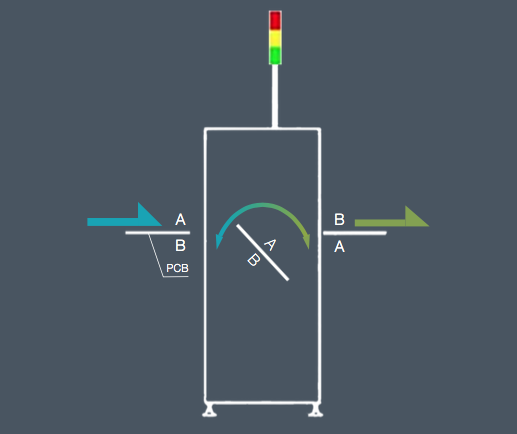
A PCB turn conveyor (also called a turning conveyor, 90-degree conveyor, or U-turn conveyor) is a board handling module that receives a PCB from one conveyor and delivers it to a conveyor running at a right angle. The board is rotated on the machine, then transferred to the next station.
It is used whenever an assembly line cannot run in a straight line. Typical reasons: the factory floor is L-shaped or U-shaped, a reflow or wave oven must sit perpendicular to the placement line, or an existing line must be re-routed to add a new process step. Instead of an operator lifting boards and walking them to the next machine, the turn conveyor does the transfer automatically.
Southern Machinery's turn conveyor family includes the S-460 series and the SCN250/SCN330 series, both built for inline SMEMA-standard operation.
Typical Application Scenarios
- EMS factories running L- or U-shaped lines — where floor space forces a 90-degree turn between printing, placement, reflow, and wave soldering.
- THT insertion lines — where boards must turn between auto-insertion machines, wave soldering, and lead cutting stations.
- Automotive and industrial control electronics — mixed SMT/THT boards with connectors, relays, and power components that need inspection after soldering.
- LED lighting and power supply production — panel boards and long formats that are easier to handle with a turn station than by hand.
- Small and medium factories — the U-turn option lets a compact line fold back on itself, fitting more process steps into a small footprint.
- Double-sided assembly — paired with flippers and buffer conveyors so boards can be flipped and re-routed without manual re-loading.
How It Integrates into a Complete PCB Assembly Line
A turn conveyor slots into the board handling chain exactly like any other conveyor module. It connects to the upstream machine's exit conveyor and the downstream machine's entrance conveyor using standard SMEMA interface signals, so the machines hand off boards automatically.
A typical integration looks like this:
- Solder paste printing (stencil printer)
- Pick-and-place (SMT placement)
- Reflow oven
- Turn conveyor (90 degrees) — redirects boards toward the THT section
- Auto-insertion (radial, axial, or odd-form)
- Wave soldering
- Lead cutting and cleaning
- Inspection (AOI / SPI)
Because the conveyor uses standard transport height and SMEMA signaling, it can be installed into an existing line with minimal changeover. Southern Machinery also offers customized transport heights and left-to-right or right-to-left directions to match the line layout.
Key Selection Parameters
- Board size range — check the maximum PCB width the conveyor accepts; the S-460A handles boards up to 530 x 460 mm, the SCN250 is sized for 250 mm-class boards, and the SCN330 for 330 mm-class boards. Confirm your largest panel.
- Rotation angle — 90 degrees is standard; confirm whether 180-degree U-turn operation is needed.
- Transport height and direction — the S-460 series runs at 900 ± 20 mm (customizable) with L-to-R or R-to-L flow; match it to the rest of the line.
- Cycle time — the S-460 series completes a turn in approximately 5 seconds; confirm the cycle fits your line's takt time.
- PCB thickness — the S-460 series supports boards from 0.6 mm minimum thickness.
- Facility requirements — the S-460 series uses 100-230 VAC (customized), single phase, max 250 VA, and 4-6 bar compressed air at max 10 L/min.
- SMEMA compatibility — verify the interface matches your existing loaders, conveyors, and unloaders.
ROI, Quality & Throughput Perspective
The business case for a turn conveyor is usually labor and floor space, not raw speed. Each manual board transfer means an operator, a hand-off point, and a chance for handling damage — dropped boards, scratched solder mask, or misaligned boards entering the next machine.
Automating the turn removes that operator from the process and lets the line run with fewer people. On a typical L-shaped line, one turn conveyor can replace a full-time material handler position. Boards move in a controlled, edge-guided path, which reduces damage compared to manual carrying, especially for larger or heavier boards. And because the conveyor is a passive, low-power module, it adds almost no energy cost while keeping the line balanced.
For an EMS factory quoting new work, a compact line that turns back on itself also means more process capability inside the same footprint — which can be the difference between winning and losing a job that requires a full SMT/THT process.
FAQ
Q: What is a PCB turn conveyor used for?
A: It rotates printed circuit boards 90 or 180 degrees and transfers them between inline machines, so an assembly line can change direction without manual board handling.
Q: Can a turn conveyor be added to an existing SMT line?
A: Yes. Turn conveyors use standard SMEMA interface signals and standard transport heights, so they connect to existing loaders, placement machines, ovens, and unloaders with minimal changeover.
Q: What board sizes can the S-460 series handle?
A: The S-460A accepts PCBs up to 530 x 460 mm, with a minimum board thickness of about 0.6 mm. Other sizes are available on request.
Q: Does a 90-degree turn conveyor need compressed air?
A: The S-460 series uses 4-6 bar compressed air at low consumption (max 10 L/min) and 100-230 VAC single-phase power at max 250 VA. Confirm exact requirements with the supplier for your configuration.
Q: How does a turn conveyor improve PCB assembly quality?
A: It eliminates manual lifting and carrying between machines, reducing dropped boards, scratches, and misalignment. Boards are transported edge-guided, so they arrive at the next station in the correct orientation and position.
Q: What industries use 90-degree PCB turn conveyors?
A: EMS factories, automotive electronics, industrial control, LED lighting, and power supply manufacturers all use turn conveyors to fit complete SMT/THT processes into compact floor layouts.
Contact Southern Machinery for Configuration Advice
Southern Machinery is an SMT/THT PCB assembly automation equipment specialist founded in 2011 in Shenzhen, China, serving more than 237 customers worldwide. From board handling and turn conveyors to auto-insertion, wave soldering, cleaning, and inspection, we supply complete line solutions with spare parts, training, and global after-sales support.
Contact Jason Wu at jasonwu@smthelp.com or +86 13602562576 for configuration advice, or visit:
- www.smthelp.com — product catalog and company information
- file.autoinsertion.com — machine catalogs and documentation
- ph.smthelp.com — machine photos and application images
Watch the S-460 and SCN250 turn conveyors in operation on our YouTube channel:

Comments