
Panasonic SMT Nozzle Manufacturer: NPM & CM Nozzles by Southern Machinery
Panasonic-compatible SMT nozzles for NPM and CM heads: match the tip to the head, stop pick-position drift, and cut your nozzle spares cost.
Oct 6, 2026 · Updated Oct 6, 2026 · Southern Machinery
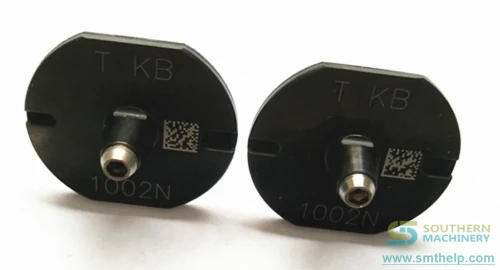
What are Panasonic SMT nozzles used for? Panasonic SMT nozzles are the vacuum, gripper and calibration tips that fit a Panasonic NPM or CM mounter head - the last millimetre between the head and a good board. Southern Machinery designs and manufactures Panasonic-compatible SMT nozzles for smart EMS PCB assembly, from a 0.35 x 0.35 mm micro-chip tip up to a Φ10.0 mm large-component tip, matched to the NPM-D3, NPM-W, NPM-TT2, NPM-VF, CM402, CM602 and CM603 heads your line runs.
Which Panasonic SMT nozzle fits your NPM or CM head?
Start with the mounter and the head
The head fixes the shank, the holder interface and the vacuum take-off, so the mounter model and head position come first: NPM-D3, NPM-W, NPM-TT2, NPM-VF, or a CM402, CM602 or CM603. The mounter family then narrows the nozzle series, and the component you place narrows the tip and its bore.
The part numbers you will see on a Panasonic nozzle
Panasonic nozzles carry an N6100xxxxx part number with an A or C suffix. Legacy tips appear under the 1001N-1006N, 110N-162N and 204CN-256CSN numbering, or under the VVS, VS, S, M, L, LL and LLL size series.
Which series covers which head
- NPM-D3, NPM-W, NPM-TT2 - N6100xxxxx (A / C), ceramic, Φ0.6 / Φ0.4 up to Φ5.5 / Φ4.5, for 0402, 0603, 1005, 1608, MELF and IC.
- NPM and CM high-speed heads - 1001N-1006N, ceramic or metal, 0.65 x 0.35 up to 4.0 x 3.0, for 0603, 1005, 1608, 3216, SOP and QFP.
- CM402, CM602, CM603 - 204CN-256CSN, ceramic, 0.35 x 0.35 up to Φ2.4 / Φ1.8, for 0402, 0603, 1005, 1608 and MELF.
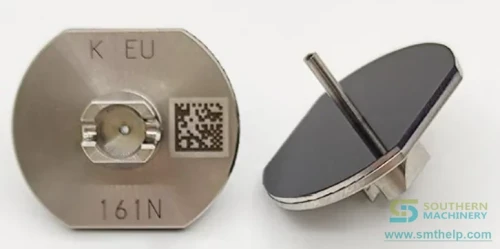
- CM and NPM (110N-162N) - 110CN-162SN, metal or rubber, Φ0.6 / Φ0.4 up to Φ10.0, for 1005, 1608, 2125, 3216, IC and large components.
- VVS / VS / S / M / L / LL / LLL - ceramic or rubber, Φ1.3 / Φ0.9 up to Φ10.0, for 0603 through 4532 and large components.
- Calibration / verification - the reference tip that teaches and verifies the head's pick position across a bank.
Why does a drifting Panasonic SMT nozzle decide your yield?
A mounter does not pick a component; it picks a position through a tip, and on a Panasonic head that position was taught and calibrated. As the tip wears by microns the real pick centre drifts away from the taught one: the program still reports the same coordinates, the nozzle no longer agrees, and the reject rate climbs while the program looks perfect.
Separate the nozzle from the program before you change anything
Freeze the program and the feeder, run the same part on a known-good nozzle of the correct series, and re-verify with a calibration tip. If the mispick follows the nozzle, it was the tip. If calibration reads true but the part still mispicks, look at the feeder next.
The calibration nozzle is the reference point
A calibration nozzle is a known-good reference tip the head uses to teach and verify its pick position. It keeps a whole bank of tips trustworthy and quickly proves whether the nozzles or the teaching has drifted.
Ceramic, metal, metal-plastic or rubber: what should the tip be made of?
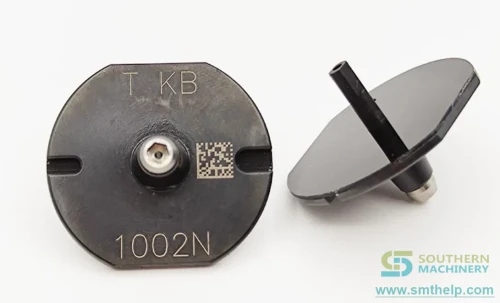
Material is a wear-and-grip decision, and the component decides it. Ceramic suits fine-pitch 0402, 0603 and 1005 chips: low static, hard and wear-resistant, so the pick centre does not drift. Metal suits rugged larger parts and SOP/QFP bodies where a ceramic edge on a big bore would chip. Metal-plastic and rubber suit sensitive or irregular bodies where a hard tip would mark the part. A terminal or connector that vacuum cannot hold wants a mechanical gripper that closes on the lead.
What does the Panasonic nozzle specification state?
Every value below is quoted from Southern Machinery's SMT Nozzle Supplier document (Panasonic pages) and cross-referenced against the Panasonic NPM/CM nozzle reference.
- Nozzle types: vacuum, mechanical gripper, calibration, custom odd-form.
- Tip materials: ceramic, metal, metal/plastic, rubber, calibration reference.
- Tip size window: 0.35 x 0.35 mm micro-chip tip up to Φ10.0 mm large-component tip.
- Component coverage: 0402, 0603, 1005, 1608, 2125, 3216, 4512, 4532, IC, octagon, rectangle, SOP, QFP, MELF, large component.
- Mounter families: NPM-D3, NPM-W, NPM-TT2, NPM-VF, CM402, CM602, CM603.
- Part numbers: N6100xxxxx (A / C suffix); legacy 1001N-1006N, 110N-162N, 204CN-256CSN.
- Size series: VVS, VS, S, M, L, LL, LLL.
- Vacuum bore, inner / outer: Φ0.6 / Φ0.4 up to Φ5.5 / Φ4.5, and Φ6.0 / Φ4.0 mm.
- Special geometries: MELF, octagon, rectangle, Y-shape (王), 2-hole.
- Shank and fit: dimensional match to the head holder, so the nozzle drops in with no head rework.
- Custom design: 5-day design service from a part photograph, no CAD drawing required.
- MOQ: single-piece replacement to full production batch, with a documented one-day spare-parts lead time on the standard family.
- Verification: tip diameter, bore, concentricity and shank fit checked before ship.
- Other brands supported: Yamaha, JUKI, FUJI NXT, ASM / Siemens, Hitachi, custom.
How do Panasonic SMT nozzles fit into a complete PCB assembly line?
Nozzles are a spare-part layer, so integration is about what sits around the placement head. Southern Machinery covers the SMT machine range, the THT machine range, the board handling system and the odd-form insertion machines that frame those heads, and the Panasonic pages sit inside the SMT Nozzle Supplier document.
Pair the nozzles with a cleaning programme
Bore and channel integrity keep suction stable and resist the clogging that becomes intermittent mispicks. Pairing the nozzles with an S-6200 or SCM24 automatic nozzle cleaner recovers suction between swaps and extends tip life.
What does a Panasonic nozzle spares programme actually save?
Nozzle savings are purchase price plus downtime, and both lines are driven by your own numbers:
Annual purchase saving = nozzles replaced per year x (OEM price - Southern price) x share switched
Annual downtime avoided = changeover hours saved per year x downtime cost per hour
Total annual saving     = annual purchase saving + annual downtime avoided
A worked example - illustrative placeholder inputs, not a quotation. Take a line that replaces 120 Panasonic nozzles a year, at a placeholder OEM price of $180 against a placeholder Southern price of $95, switching 60 percent of that spend: 120 x ($180 - $95) x 0.60 = $6,120 a year of purchase saving. If the programme also avoids 40 changeover hours at a placeholder $60 an hour, the downtime line adds $2,400, for $8,520 in total. The source calculator hard-codes no price; its defaults are placeholders, not claims about your factory. Treat these figures as an example only - they depend on configuration and are subject to final technical confirmation.
The method deliberately leaves out the harder-to-prove savings: fewer tombstoned and skewed parts, the rework and scrap they cause, and the reject spikes a drifting nozzle hides until reflow. Those are yours to measure.
FAQ
Do these nozzles fit genuine Panasonic NPM and CM heads? Yes. The shank and holder interface are matched dimensionally to the OEM nozzle for the mounter family you run - NPM-D3, NPM-W, NPM-TT2, NPM-VF, CM402, CM602 and CM603 - so the nozzle drops in without re-tramming. Send the exact part number and the fit is confirmed before you order.
What is the minimum order and the lead time? From a single replacement piece to a full production batch. The standard nozzle family carries a documented one-day spare-parts lead time; custom or odd-form tips follow the quoted schedule after the design step.
Can you make a Panasonic nozzle that is not in the list? Yes. The documented 5-day design service starts from a photograph rather than a drawing. Send the part, a handful of them and the board, plus your daily volume, and a nozzle concept follows: geometry, bore, material and the head interface.
How do I identify a worn Panasonic nozzle whose part number has rubbed off? Three facts and one photograph: the mounter model, the head position, and the component you place there, plus a straight-on and a side view of the tip. The Panasonic reference then narrows the series and the tip.
What is a calibration nozzle and do I need one? It is a known-good reference tip the head uses to teach and verify its pick position. If the reject rate drifts while the program looks perfect, a fresh calibration tip is the quickest way to prove whether the nozzles or the teaching is the cause.
How do I get more life out of a Panasonic nozzle? Keep the vacuum channel clean, re-verify with the calibration tip and track cycle counts. Pair the nozzles with an S-6200 or SCM24 automatic nozzle cleaner, and swap on a schedule from a named part number rather than waiting for a reject spike.
Next step
Send the mounter model, the head position and the nozzle part number printed on the tip - or a clear photograph of it. Southern Machinery will match the nozzle against the Panasonic NPM/CM reference, confirm the tip geometry, bore and material for the component you place, and quote a dimensionally matched replacement with a documented one-day spare-parts lead time on the standard family. Email info@smthelp.com or message WhatsApp +86 13602562576.
Shenzhen Southern Machinery Sales and Service Co., Ltd. has supplied SMT and THT automation equipment, spare parts and nozzles for smart EMS factories worldwide since 2011.
Comments