
Offline AOI Programming: Create, Test and Deploy AOI Programs Without Stopping Your Line
Offline AOI programming lets EMS factories build and test inspection programs away from the line, cutting changeover time and false alarms in PCB assembly.
Sep 8, 2026 · Updated Sep 8, 2026 · Southern Machinery
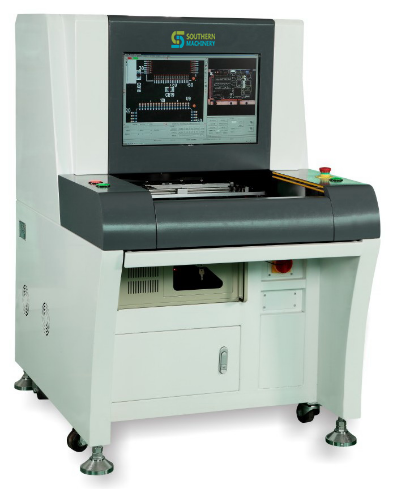
Offline AOI Programming: Build Inspection Programs Without Stopping Your SMT Line
Every time an AOI machine stops for programming, your inspection bottleneck moves to the front of the line — and in high-mix EMS production, that stop happens several times a day. Offline AOI programming solves the problem by moving program creation off the machine entirely.
Southern Machinery's AOI family — the online S-AO600C, the offline S-AO680C and the inline S-L680B — supports a programming workflow that keeps inspection running: create the program on a PC, verify it, and only then load it onto the machine. This guide explains what offline AOI programming is, how the workflow runs, and what it means for changeover time, false alarms and inspection quality.
What Is Offline AOI Programming Used For?
Offline AOI programming is the process of creating, editing and testing an AOI inspection program away from the AOI machine itself. Instead of occupying the machine while an operator walks through every component, the program is built on separate software — typically from CAD or Gerber data, a scanned PCB image, or an existing program library — and transferred to the machine when it is finished.
For an EMS factory running many board types, the benefit is direct: the AOI keeps inspecting the current product while the next product's program is being prepared. The inspection head never idles during programming, and new products reach the line with a tested program instead of an untested first attempt.
Southern Machinery's AOI machines list three programming modes in their published specifications: manual programming, auto-written programming, and CAD data import with automatic component-library matching. The same capability is offered as a free offline AOI programming software download on smthelp.com, with a full video teaching series — the same training videos used to walk operators through login, PCB scanning, mark point making, component editing, false-alarm debugging and formal inspection.
Typical Application Scenarios
Offline AOI programming matters most where changeovers are frequent and quality requirements are strict:
- EMS / electronics manufacturing services — high-mix, low-to-mid volume lines where several board types run per shift; programming time is directly lost production.
- Automotive electronics — PCBAs with strict solder-joint and component-placement requirements where inspection programs must be documented, repeatable and traceable.
- Medical electronics and industrial control — long-life products where the same board is re-run for years; a stored, tested AOI program means every new lot starts with proven inspection coverage.
- SMT lines inspecting solder paste before and after reflow — paste-printing defects (presence, offset, less tin, more tin, open circuit, even tin, contamination, scratches) are caught by programs built from the same CAD data used for placement.
- THT / DIP lines after wave soldering — inspection of through-hole solder joints (excess solder, solder balls, pins not exposed, contamination) without holding up the wave soldering output.
How Offline AOI Programming Fits into a PCB Assembly Line
AOI programming is not a separate station — it is a parallel workflow that feeds the inspection step already in your line. A typical SMT/THT line places AOI in three positions:
- After solder paste printing (paste inspection) — the first quality gate, before components are placed.
- After reflow or after wave soldering (post-solder inspection) — where placement and soldering defects are caught before they reach testing or shipping.
- Before and after DIP wave soldering — checking both the inserted-component side and the soldered side of through-hole boards.
With offline programming, the program for each of these positions is prepared on a PC while the previous product still runs. When the product changes, the operator calls up the stored program, confirms the first board, and the line continues. For double-sided boards, Southern Machinery's AOI models support inspection of both sides, with mark-point and bad-mark handling built into the detection mode.
The AOI itself connects to the rest of the line through standard board-handling interfaces. The online S-AO600C is a conveyor-fed, SMEMA-linked machine designed to run inline with printers, mounters and reflow ovens; the offline S-AO680C is a manual-load system for programming, first-article checking and small-batch inspection where an inline machine is not justified.
Key Selection Parameters for an AOI with Offline Programming
When evaluating AOI equipment for an offline programming workflow, confirm these parameters with your supplier — they determine how well the machine fits your board mix and defect profile:
- Programming modes — manual teaching, auto-written programs, and CAD/Gerber data import with automatic component-library matching.
- Applicable process steps — solder paste before/after SMT reflow, and before/after DIP wave soldering (Southern Machinery's S-AO600C/S-AO680C spec covers all four).
- Detection coverage — paste defects, component defects (missing, offset, skew, tombstone, flipped, wrong part, reverse) and solder-joint defects (excess solder, solder balls, pins not exposed, contamination).
- Smallest component / finest pitch supported — published capability for the S-AO series includes 01005 chips and 0.3 mm-pitch ICs at 15 µm/pixel.
- PCB size range — e.g. S-AO600C online handles 50×50 mm to 400×360 mm; S-AO680C offline handles 20×20 mm to 460×350 mm (confirm against your largest and smallest boards).
- Component height clearance — top and bottom clearance for tall through-hole parts.
- Data output — SPC statistical recording so inspection results feed quality analysis and MES.
- Lighting and optics — camera resolution and multi-channel color lighting matched to your defect types.
- Offline software availability and training — whether the supplier provides offline programming software and operator training for it.
ROI, Quality and Throughput Perspective
The ROI case for offline AOI programming is built on machine utilization, not inspection speed:
- Less line downtime. Programming moves off the machine, so changeover minutes are recovered on every product switch. In high-mix EMS, that saving repeats daily.
- Fewer false alarms. Programs can be tested and debugged before deployment. Southern Machinery's own AOI training series devotes an entire module to debugging false alarms — a sign of how much real-world inspection time is lost to over-sensitive programs.
- Faster first-article setup. CAD import plus automatic component-library matching removes the most time-consuming part of manual programming for new boards.
- Consistent quality. A stored, version-controlled program inspects the same board the same way every time it runs — eliminating operator-to-operator variation in manual inspection.
- Better data for process control. SPC statistics from the AOI identify repeating defect patterns, letting process engineers act on the printing or placement step instead of only reworking boards.
FAQ
Q: What is offline AOI programming?
A: Offline AOI programming means creating and editing AOI inspection programs on separate software rather than on the AOI machine, so the machine keeps running during program preparation. Programs are transferred to the machine when ready.
Q: Which AOI machines support offline programming?
A: Southern Machinery's AOI family — including the online S-AO600C, the offline S-AO680C and the inline S-L680B — supports manual, auto-written and CAD-data-import programming. A free offline AOI programming software download is available on smthelp.com.
Q: What defects can an AOI inspection program detect?
A: Depending on the program, AOI detects solder paste printing defects (presence, offset, insufficient or excess solder, open circuits), component defects (missing parts, offsets, skews, tombstones, flips, wrong parts) and solder joint defects (solder balls, excess solder, pins not exposed, contamination).
Q: Does offline AOI programming work for THT / DIP lines after wave soldering?
A: Yes. Southern Machinery's AOI specification covers inspection before and after SMT reflow and before and after DIP wave soldering, with lighting and detection configured for through-hole solder joints.
Q: How long does it take to program a new board?
A: It depends on board complexity and the programming mode. CAD data import with automatic component-library matching is significantly faster than manual teaching, and offline programming means the time is spent away from the production machine.
Q: How does AOI improve quality compared with visual inspection?
A: AOI inspects every board consistently at high speed using the same programmed standard, capturing defects that manual visual inspection misses — and its SPC data shows where the process itself needs correction.
Contact Southern Machinery for Configuration Advice
Southern Machinery Sales and Service Co., Ltd — founded in 2011 in Shenzhen, China — supplies SMT/THT PCB assembly automation equipment to more than 237 customers worldwide, from individual AOI machines to complete SMT, THT, wave soldering, board handling and inspection lines.
Email Jason Wu at jasonwu@smthelp.com for configuration advice and current specifications. Download catalogs at file.autoinsertion.com, view machine photos at ph.smthelp.com and browse the full product range at www.smthelp.com. Training videos, including the offline AOI programming series, are on the Southern Machinery YouTube channel.
Comments