
Odd Form Insertion Machine Programming: Mark Points, Teaching & Setup Explained
Odd form insertion machine programming explained: nozzle data, PCB mark points, insert teaching and pickup positions, from Southern Machinery training.
Sep 9, 2026 · Updated Sep 9, 2026 · Southern Machinery
Odd Form Insertion Machine Programming: Mark Points, Teaching & Setup Explained
When an EMS factory is evaluating its first odd-form (special-shaped) THT insertion machine, the most common question is not about mechanics — it is about programming. How do you teach the machine where components go? How long does a new PCB take to set up? Can your existing operators learn it?
Southern Machinery (founded 2011, Shenzhen, China; 237+ global customers) publishes a complete operator training series for its odd form insertion machines on its public YouTube channel. The lessons walk through every stage of machine programming — from nozzle data to PCB mark points, insert point teaching, and automatic learning. This guide explains what that programming workflow actually involves, so you can evaluate any odd form inserter against the way your line really works.
What this guide covers: what odd form insertion machines do, how programming works step by step, where they fit in an SMT/THT PCB assembly line, and the selection parameters you should confirm before buying.
What Is an Odd Form Insertion Machine Used For?
An odd form insertion machine automatically places through-hole components that standard radial and axial inserters cannot handle. "Odd form" refers to the component body and lead geometry: transformers, relays, connectors, switches, large electrolytic capacitors, pin headers, eyelet pins, jumper wires, coils, and other non-standard parts that arrive in tubes, trays, bowls, or bulk rather than on uniform tape.
The machine picks each component with a dedicated nozzle, orients it with a vision system, inserts the leads into the plated through-holes (PTH) of the PCB, and can cut and clinch the leads underneath so boards stay put through wave soldering. Southern Machinery's odd form range includes machines such as the S-70LD Odd Form Insertion Machine, the S7000 family, and related THT platforms.
For a DIP (dual in-line package) line, the alternative to such a machine is manual insertion — and that is where quality problems such as missing components, mis-insertion, reversed polarity, and floating leads (leakage, wrong insertion, and "floating high" defects) creep in, along with operator-dependent output.
Why Programming Skill Matters as Much as the Machine
An odd form insertion machine is only as good as the program it runs. On a mixed PCB with dozens of different connectors, relays, and electrolytic capacitors, every component position needs:
- the right nozzle and pickup settings for the part body,
- a component data record describing the part,
- a PCB mark point so the vision system can align the board,
- a taught insert point for every lead set,
- correct material settings for the feeder or tray that supplies the part,
- and array data when the same pattern repeats across a panel.
Get those right, and changeover between products becomes a routine job measured in minutes. Get them wrong, and the same machine produces rework no faster than a manual line.
The Programming Workflow, Step by Step
Southern Machinery's public training series ("Odd Form Machine" lessons on the @Smthelping YouTube channel) demonstrates the programming sequence used on its insertion machines:
| Lesson | Programming stage | What it does |
|--------|-------------------|--------------|
| Lesson 2 | Nozzle data and settings | Defines which nozzle picks each component type and how the machine handles the part body |
| Lesson 3 | Component data and editing | Builds the library entry for each component (dimensions, pickup points, orientation) |
| Lesson 4 | PCB data and mark points | Loads the board data and sets vision mark points for board alignment |
| Lesson 5 | Insert point teaching | Teaches the exact X/Y insertion coordinates for every lead on the PCB |
| Lesson 6 | Pickup position setting | Aligns the pickup position so the nozzle takes the component reliably every cycle |
| Lesson 7 | Material settings | Maps each feeder, tray, or bowl to the component slot in the program |
| Lesson 8 | Array data and automatic learning | Repeats taught patterns across panel arrays and lets the machine learn positions automatically |
Supporting videos cover picking and photographing position setting (the vision camera's view of the part before insertion), camera calibration, and correcting the machine head — the day-to-day adjustments a line technician needs after maintenance or a head change.
The same teaching philosophy carries across the THT family: radial machines, axial machines, and terminal/pin insertion machines all use mark points, component data, and taught positions. Once an operator understands one Southern Machinery platform, the others follow the same logic.
▶ Watch: How to program an auto insertion machine (Southern Machinery training video)
Typical Application Scenarios
Odd form insertion programming pays off fastest in factories that run frequent product changes and high component variety:
- EMS/ODM contract manufacturing — many board types, dozens of odd form parts per board, short production windows where fast changeover decides profitability.
- Automotive electronics — relays, connectors, large electrolytics, and power devices on engine control and body electronics boards, where insertion reliability is a safety issue.
- Industrial control and instrumentation — terminal blocks, transformers, and relays on PLC and drive boards.
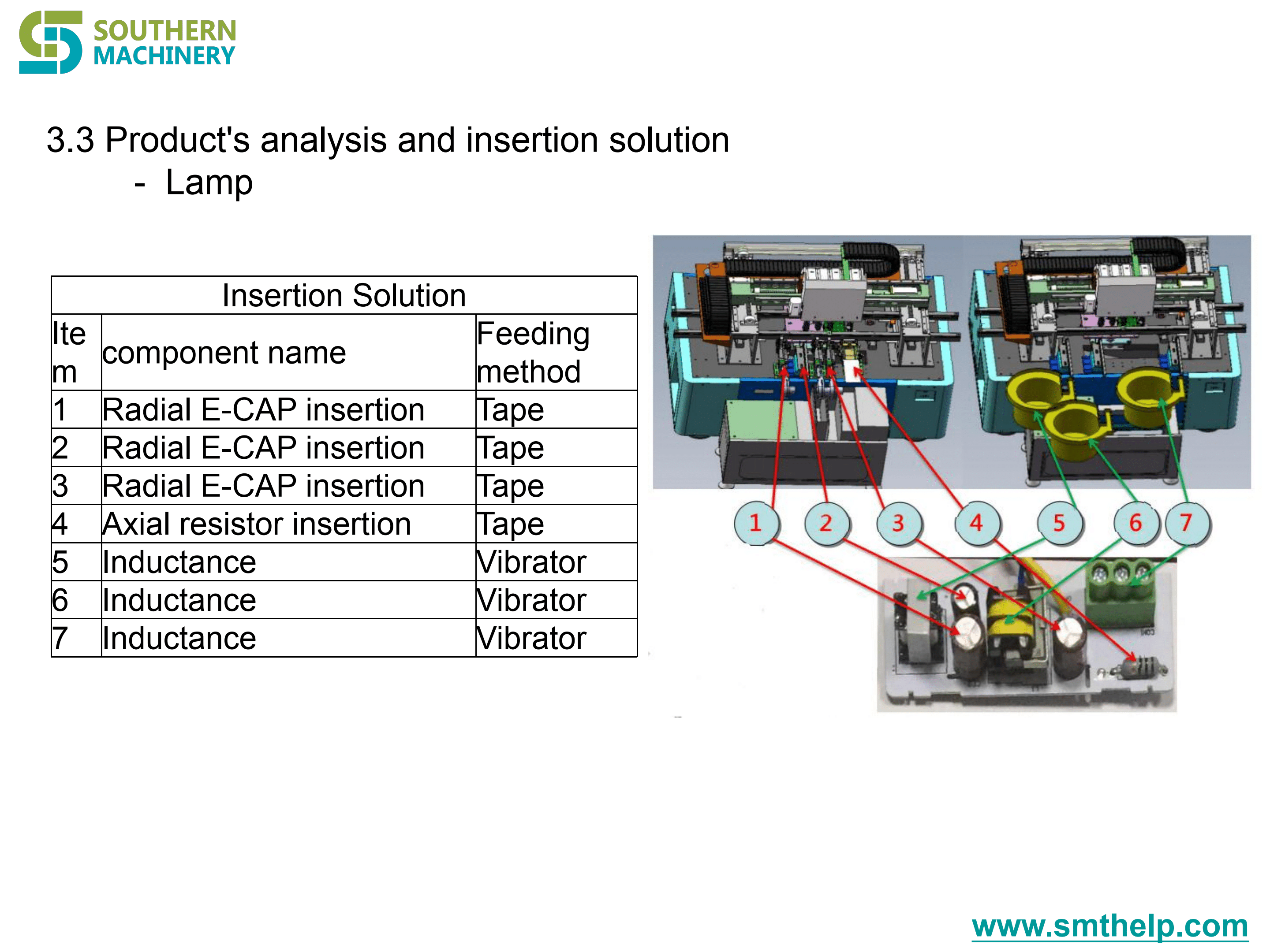
- LED lighting and power supplies — drivers, lamp boards, and ballast PCBs mixing radial parts with odd form capacitors and connectors.
- Home appliances — air conditioner, TV, microwave, induction cooker, and washing machine control boards, where labor turnover on manual DIP lines is a chronic problem.
How an Odd Form Inserter Fits Into a Complete PCB Assembly Line
Odd form insertion is one station in the THT side of a mixed-technology line. A typical flow:
- SMT side: solder paste printing → SMT pick and place → reflow oven → AOI/SPI inspection.
- THT side: radial and axial auto insertion (taped parts) → odd form insertion (non-standard parts) → wave soldering → post-wave lead cutting and cleaning.
- Back end: AOI after wave, ICT/functional test, conformal coating if required.
For inline operation, the odd form machine communicates with the neighboring conveyors and machines via SMEMA handshakes, and PCB loaders/unloaders and buffer conveyors keep the line flowing. Programs are prepared on the machine's teaching software, and repeat orders simply reload the saved program — which is why a well-organized program library is a real asset for EMS lines running the same boards on a cycle.
Key Selection Parameters to Confirm Before Buying
Because every PCB mix is different, an odd form insertion machine should be selected around your actual components, not a generic brochure. Confirm these points with the supplier:
- Component types and body sizes — the range of odd form parts you need to handle, including lead pitch and lead length after clinching.
- Feeding methods — which tube, tray, bowl, or customized feeders the machine supports for your parts.
- Vision and mark point capability — how the machine aligns the board and verifies the component before insertion.
- Teaching and programming modes — insert point teaching, pickup position setting, array/auto-learning, and whether the software is practical for your operators to learn.
- Program storage and changeover — how programs are saved, named, and reloaded for repeat orders.
- Line integration — SMEMA interface, board width range, and conveyor height to match your existing SMT/THT line.
- Training and documentation — operator training, manuals, and spare parts support after installation.
Southern Machinery can recommend a configuration for your specific boards — no two odd form lines are the same.
ROI, Quality & Throughput Perspective
The business case for odd form insertion automation rests on three pillars:
- Labor: one machine replaces several manual insertion stations and removes dependence on hard-to-keep DIP line operators. Output no longer depends on shift staffing or overtime.
- Quality: vision-guided placement eliminates the classic manual defects — missing parts, reversed polarity, mis-insertion, and floating leads — cutting rework and field failures.
- Changeover and consistency: with saved programs, the same board can be reproduced identically weeks later; setup knowledge lives in the program library, not in one senior operator's head.
Southern Machinery's own marketing material frames the S-70LD around exactly these problems: unstable labor, training cost, quality defects, and output that manual insertion cannot scale.
FAQ
Q: What components can an odd form insertion machine handle?
A: Non-standard through-hole parts such as transformers, relays, connectors, switches, large electrolytic capacitors, pin headers, eyelets, and jumper wires — components that do not come on uniform tape and are difficult for radial or axial inserters.
Q: How long does it take to program a new PCB on an odd form insertion machine?
A: It depends on the number of different components and insert points on the board. Southern Machinery's training series shows a structured workflow — nozzle data, component data, mark points, insert point teaching, pickup positions, and material settings — that keeps first-time setup predictable and makes repeat changeovers fast.
Q: Does an operator need programming experience to run the machine?
A: No. The teaching workflow is designed for line technicians, and Southern Machinery provides operator training with its machines. Its public lesson series lets your team preview the software logic before purchase.
Q: Can programs be reused for repeat orders?
A: Yes. Programs are saved on the machine and can be reloaded for repeat orders, which is how EMS factories keep changeover time low when the same boards return on a production cycle.
Q: Which industries use odd form insertion machines?
A: EMS/ODM contract manufacturers, automotive electronics, industrial control, LED lighting and power supplies, and home appliance makers — anywhere PCBs mix SMD parts with substantial through-hole components.
Q: Where can I see Southern Machinery's machines and training content?
A: Product videos and the programming lessons are on Southern Machinery's YouTube channel; machine photos are on ph.smthelp.com and the full catalog is available at file.autoinsertion.com.
Contact Southern Machinery for Configuration Advice
Tell us which boards you assemble and which components you currently insert by hand. We will recommend an odd form insertion configuration, programming workflow, and training plan for your line.
- Jason Wu — jasonwu@smthelp.com
- Website: www.smthelp.com
- Catalogs: file.autoinsertion.com
- Machine photos: ph.smthelp.com
Southern Machinery Sales And Service Co., Ltd — SMT/THT PCB assembly automation equipment from Shenzhen, China, serving 237+ customers worldwide with high-efficiency, cost-effective machines, global support, spare parts, and training.
Comments