
No-Clean Flux Residue Removal: In-Line PCBA Cleaning by Southern Machinery
No-clean flux still leaves a residue, and that film decides whether a board survives humidity, bias voltage, and conformal coating. The SME-6300 in-line PCBA cleaning machine removes rosin, no-clean, and water-soluble fl
Oct 8, 2026 · Updated Oct 8, 2026 · Southern Machinery
No-clean flux is still flux, and the film it leaves behind is harmless only while it stays dry and un-biased. Under humidity and applied voltage, that same residue supports corrosion and electrochemical migration — and coating applied over ionic residue will delaminate against the pad. The SME-6300 is a fully automatic in-line PCBA cleaning machine from Southern Machinery that removes rosin, no-clean, and water-soluble flux residues, solder paste bleed, solder balls, and dust in a single conveyor pass, with a final DI rinse monitored live at 10 MΩ or better. This guide answers the question process engineers actually ask: if the flux is labelled no-clean, why does the board still need cleaning — and how do you verify the result?
Why does no-clean flux residue still have to come off?
"No-clean" describes the flux chemistry, not the board
No-clean was formulated so a normal product can pass without washing — a claim about the flux, not a promise that the residue stays inert once it lands on your board. What remains after reflow, wave soldering, or hand soldering is a film, and films do not announce themselves.
Where the residue does its damage
Rosin and no-clean residues are hygroscopic. Under humidity and bias, they support electrochemical migration — dendrites that short adjacent pads long after the board has shipped. The same film degrades probe contact in ICT, and coating bonded over ionic residue traps the chemistry against the laminate instead of sealing it.
A brush and solvent at a bench remove only what the operator had time to reach, with no logged temperature, no controlled pressure, and no repeatable rinse — two shifts, two cleanliness levels, one part number. In-line cleaning replaces that judgement call with a setting that repeats.
What does the SME-6300 remove from a no-clean board?
The 2021 operation manual names the materials the machine is specified to remove: rosin flux, no-clean flux residues, water-soluble flux, solder paste bleed, solder balls, and other organic and inorganic contaminated material on the board.
How does in-line cleaning remove it in one pass?
Nine sections, one direction
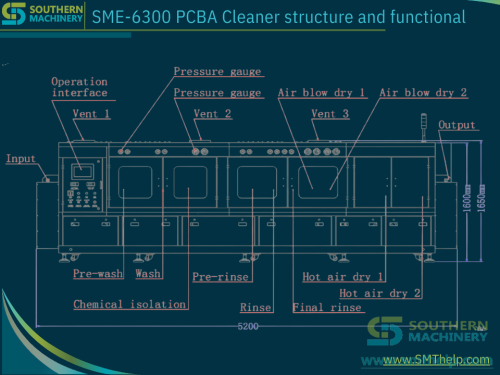
Boards ride a SUS304 mesh conveyor through nine sections in one left-to-right pass: pre-wash, wash, chemical isolation, pre-rinse, rinse, final rinse, air-blow dry, and two hot-air dry stages. The manual publishes the lengths — pre-wash 380 mm, wash 560 mm, chemical isolation 360 mm, pre-rinse 400 mm, rinse 240 mm.
Chemistry where it works, rinses where it must
The pre-wash sprays water-based cleaning liquid top and bottom through 2 + 2 bars from the shared 240 L tank. The wash is the heavy stage: 6 upper and 6 lower bars with 72 nozzles at 2–8 bar, plus a 36 kW SUS316 heater that takes the liquid to as much as 80 °C. Three air knives on a 10 HP blower then blow wash liquid back into the tank — the section that keeps chemistry out of the rinse train. Three rinse stages follow: a 60 L pre-rinse at 2–5 bar, a 40 L heated rinse at up to 60 °C, and a final rinse on fresh DI water.
The rinse that decides the result, and the dry before handoff
The manual specifies the final rinse: fresh DI at 10 MΩ or better, 6–15 L/min, with resistivity and flow monitored live on the panel. Staged overflow reuse refreshes the rinse tanks from the final rinse, and the optional 1000 L/h DI processor covers a plant without a DI supply. Two blow-dry stages at 7.5 HP with 6 + 6 air knives then feed hot air at up to 100 °C (7.5 + 7.5 kW): water carried out of the machine is a second contamination route into the next process.
How do you verify that the board is actually clean?
Final-rinse DI resistivity is monitored on the panel (0–18 MΩ·cm) and the machine alarms if quality drops — a parameter you can log, which a manual bench cannot offer. Filtration is doubled on the wash circuits: steel filter nets plus 1 µm filter barrels. The cleaning liquid is dosed automatically, so bath strength does not drift between manual top-ups. Speed, spray pressures, liquid and rinse temperatures, and hot-air temperature are saved per product on a 10-inch Mitsubishi PLC panel. An optional MES interface logs every cleaned board — recipe, temperatures held, alarms raised — for automotive and medical customers who must prove the step happened.
Typical application scenarios
The line makes sense wherever a board will meet humidity, voltage, or a coating: automotive electronics, medical devices, industrial control and instrumentation, and telecoms hardware — after wave soldering, reflow, or hand soldering, and before conformal coating, test, or final assembly.
How does it fit a complete PCB assembly line?
The SME-6300 is an in-line machine, not a batch basket: boards transfer from the soldering process on a 500 mm wide SUS304 mesh conveyor at 900 ± 25 mm conveyor height, left to right, so it drops into standard line height. Board envelope is up to 500 mm wide by a recommended 400 mm long and 100 mm high including components. The cleaner follows your slowest upstream process rather than setting the pace: capacity is speed divided by pitch, and the manual's worked figures are 40 boards per hour at 0.3 m/min with a 450 mm pitch, and 100 boards per hour at 0.5 m/min with a 300 mm pitch. Downstream, cleaned and dried boards are ready for coating, test, or assembly, and the machine pairs with board handling equipment where the line needs buffering.
Key selection parameters for a no-clean cleaning project
- Board envelope: up to 500 mm wide, recommended 400 mm long, 100 mm high including components.
- Throughput: conveyor 0.1–1.5 m/min adjustable, 0.2–0.4 m/min recommended; capacity = speed ÷ pitch.
- Wash chemistry: water-based cleaning liquid, dosed automatically; 240 L wash tank with a 36 kW SUS316 heater up to 80 °C.
- Rinse: fresh DI at 10 MΩ or better, 6–15 L/min at a 1-inch female inlet, monitored live; three rinse stages.
- Power: AC 380 V, 50/60 Hz, 3P + N + E, total load about 110 kW; 250 A distribution box, 70 mm² phase conductors.
- Air: 0.5–0.7 MPa dry clean compressed air at 200–400 L/min on a Φ12 mm main.
- Drains and exhaust: two 2-inch drains and about 36 m³/min through three Φ250 mm vents with a volume damper.
- Floor: machine L 5200 × W 1650 × H 1650 mm at about 2.8–3.0 t; reserve L 8000 × W 4000 × H 2500 mm for service access.
- Environment: hard industrial floor, 0–30 °C, humidity below 85% with no condensation, away from heat and vibration.
- Decide before ordering: 1000 L/h DI water processor, BGA water knives, MES interface, English operator interface.
What does no-clean residue removal cost, and how do you model it?
The product document carries no prices and no labour rates, so every input below is yours. A cleaning machine is bought against two costs: the labour of the scrubbing bench it replaces, and the rework and field failures the residue it removes would have caused.
annual value = (boards per year x (scrap rate + rework rate) x cost per board)
             + (operators released x loaded annual cost per operator)

payback (months) = machine and installation cost / annual value x 12
Worked example — example only, depends on configuration, subject to final technical confirmation. A line cleaning 150,000 boards a year at an illustrative 2% combined scrap-and-rework rate on a 30 USD board carries 90,000 USD of annual board loss before labour enters the model. Add one operator per shift released from a manual bench and the arithmetic starts to look like a capital case.
FAQ
We use no-clean flux. Do we really need to clean?
Ask whether the residues are activated. No-clean flux leaves a film that is harmless only while it stays dry and un-biased; under humidity it supports corrosion and electrochemical migration, and coating over ionic residue delaminates. If your product sees humidity, voltage, or a coating, cleaning is still a reliability step.
What throughput should I plan for?
Conveyor 0.1–1.5 m/min, recommended 0.2–0.4 m/min; capacity is speed divided by pitch — 40 boards per hour at 0.3 m/min with a 450 mm pitch, and 100 at 0.5 m/min with a 300 mm pitch.
What water and chemistry does it need?
One 1-inch female DI inlet at 0.3 MPa or more delivering 10–15 L/min at 10 MΩ or better, monitored live, plus a water-based cleaning liquid dosed automatically. Wash consumption depends on flux load and throughput — not specified in the source document, so we model it with your numbers.
Will it fit my line, and what happens if power drops?
Machine L 5200 × W 1650 × H 1650 mm, conveyor height 900 ± 25 mm, boards left to right, about 2.8–3.0 t; plan L 8000 × W 4000 × H 2500 mm of floor for service access. If power drops with boards inside, a UPS keeps the mesh conveyor running so they exit the heated sections.
What does the SME-6300 remove in practice?
Rosin flux, no-clean flux residues, water-soluble flux, solder paste bleed, solder balls, and dust from post-solder PCBA, in the manual's own words.
Next step: send a dirty board
Send a photograph of a post-solder board, your flux type, board dimensions, and takt time, and we will come back with a cleaning evaluation: section settings, throughput maths, and a configuration to price. Factory acceptance runs wash, rinse, and dry cycles on a sample of your own boards before shipping, and commissioning plus operator training are part of the handover.
Start with a quote request, review the FAQ, or contact the team. Catalogues: file.autoinsertion.com; photographs: ph.smthelp.com. Email info@smthelp.com or WhatsApp +86 13602562576.
Comments