
NG/OK Unloader After AOI: SBH Series PCB Sorting Guide by Southern Machinery
An NG/OK unloader sits directly behind AOI and decides what happens to every board: good boards to one magazine, rejected boards to another. This guide from Southern Machinery explains what an NG/OK unloader is used for, how the SBH Series — SBH250, SBH330, SBH390 and SBH460 — sorts OK and NG boards into separate magazines over an SMEMA interface, how to size the right model against your PCB envelope, and which parameters to confirm (transport height, pitch, magazine count, belt speed and change-over time) before requesting a quotation.
Sep 24, 2026 · Updated Sep 24, 2026 · Southern Machinery

NG/OK Unloader After AOI: SBH Series PCB Sorting Guide by Southern Machinery
Every PCB that leaves an AOI station already carries a verdict: OK or NG. What usually happens next is a person reading that verdict and putting the board in the right stack. An NG/OK unloader takes that decision away from the operator and gives it to the line.
This guide covers Southern Machinery's SBH Series NG/OK unloader — what the machine is used for, where it sits in a PCB assembly line, how the documented SBH250, SBH330, SBH390 and SBH460 models differ, and which parameters an EMS or OEM engineering team should confirm before requesting a quotation.
What is an NG/OK unloader used for?
An NG/OK unloader is a board-handling machine installed behind an AOI station. It receives inspected PCBs and routes OK boards and NG boards into separate magazines automatically, so that good product and rejected product never share the same storage.
Southern Machinery's published product description is direct about the function: the unit unloads PCBs from the production line and is suitable for receiving both NG boards and OK boards after the AOI process, sending them to different storage. It is deliberately described as a machine that sits behind the AOI and performs the separation itself.
That distinction matters. A standard magazine unloader moves boards. An NG/OK unloader moves boards and classifies them. Its output is not "boards transferred" but "boards sorted into the correct magazine".
A short demo of the machine is published on Southern Machinery's YouTube channel under the title SBH460460 NG OK unloader after AOI — unloader machine for Smart PCB assembly manufacturing:
Watch the SBH NG/OK unloader after AOI demo

Why post-AOI disposition is the quiet bottleneck
Most PCB assembly lines are instrumented up to the AOI station and then go blind. The inspection machine produces a verdict at full line rate. The handling step downstream of it frequently does not — it depends on an operator, a manual push, or a colour-coded sticker.
Three costs follow from that gap:
- Escapes. If an NG board is placed in the OK magazine, a rejected assembly continues down the line and can reach a customer. Post-AOI disposition is one of the last points where a defect can be stopped for free.
- False scrap. If an OK board is placed in the NG magazine, good product enters the rework loop or the scrap bin. Both outcomes inflate cost without improving quality.
- Unstable cycle time. A human sorting step runs at human speed. If the AOI and the printer are matched to each other but the unloader is not, the bottleneck simply moves to the end of the line.
An NG/OK unloader closes that loop mechanically. The verdict still comes from the AOI, but the physical separation becomes part of the equipment instead of part of the operator's memory.
How the SBH NG/OK unloader works
Southern Machinery documents the SBH Series as a PLC-controlled magazine unloader with a shuttle conveyor and a pneumatic pusher. The routing logic is executed by the machine; the board simply has to arrive with a verdict attached.
Documented operating sequence
- The AOI station releases an inspected PCB.
- The PCB transfers into the unloader over the SMEMA interface at the standard line transport height.
- A shuttle conveyor positions the board. Positioning is driven by a ball screw.
- A pneumatic pusher transfers the board into the correct magazine. Pusher pressure is regulated, and the pusher position is adjustable to the centre of the magazine.
- The magazine platform is aligned automatically by upper and lower pneumatic clamping, and the board is indexed at the set pitch.
Documented features
- "Soft touch" LED membrane control panel
- Flexible platform designed to suit standard magazines
- Regulated pressure on the pneumatic pusher
- Pusher position adjustable to the centre of the magazine
- PLC program control
- Ball-screw-driven shuttle conveyor positioning
- Automatic magazine alignment by upper and lower pneumatic clamping
- SMEMA compatible
What the machine does not decide
An unloader cannot invent a verdict. The OK/NG decision has to reach it. In practice this signal comes from the AOI station, either over the SMEMA handshake sequence or over a separate I/O or MES-level link. Which path is used depends on the AOI brand and on how the line controller is configured — it is one of the first interface questions to settle during line engineering, and one of the items to confirm with the supplier rather than assume.
SBH Series model sizing: SBH250, SBH330, SBH390, SBH460
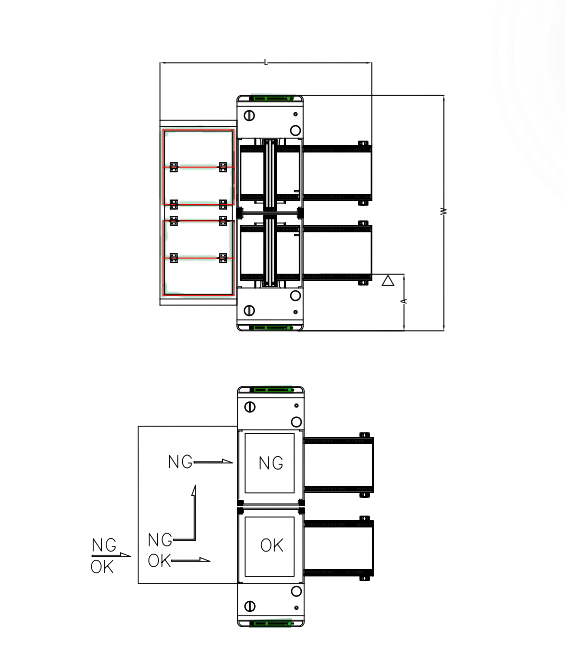
The SBH family is sized by the PCB envelope it can accept. The published model table is below. Dimensions are given in millimetres; the rack size column is the magazine format the platform is built to suit.
| Model | Machine dimensions L×W×H (mm) | PCB size (mm) | Weight (kg) | Rack size L×W×H (mm) |
|---|---|---|---|---|
| SBH250 | 1510 × 1530 × 1250 | 50 × 50 – 350 × 250 | 320 | 355 × 320 × 563 |
| SBH330 | 1910 × 1630 × 1250 | 50 × 50 – 460 × 330 | 350 | 460 × 400 × 563 |
| SBH390 | 2160 × 1760 × 1250 | 50 × 50 – 535 × 390 | 380 | 535 × 460 × 563 |
| SBH460 | 2160 × 1900 × 1250 | 50 × 50 – 535 × 460 | 460 | 535 × 530 × 563 |
The practical reading of this table is that the footprint grows with the widest board you expect to run, not with your average board. A line that will only ever process 250 mm-wide panels does not need to reserve floor space for the 460 mm chassis — but a line that plans to add a larger panel later should size for the envelope it intends to reach, because the magazine rack format changes with the model.
Typical application scenarios
EMS and contract manufacturing
High-mix contract manufacturers change product every few shifts. Every changeover means a new magazine set-up, a new pitch setting and a new board size. The documented magazine change-over time of approximately 30 seconds and the adjustable pitch positions — 10, 20, 30 or 40 mm, or specified to order — are the features that determine whether that changeover happens inside a break or inside a production hour.
Automotive electronics
Automotive board flow is defined by traceability. Once an AOI verdict exists, physically mixing OK and NG boards in the same magazine destroys the audit trail at the point where it matters most. Separating them at the machine level keeps the physical disposition aligned with the recorded disposition.
Power supply, LED lighting and appliance boards
These product families mix SMT and THT content, and they are usually inspected after the soldering steps. An NG/OK unloader fits the same way after AOI on a mixed-technology line as it does on a pure SMT line, provided the board can be pushed into a magazine.
Industrial control and instrumentation
Low-to-medium volume, wide board variety, frequent engineering changes. The same model that handles 50 × 50 mm boards up to the top of the envelope handles the whole product range without a second machine.
How it integrates into a complete PCB assembly line
An NG/OK unloader is the final handling module on the SMT chain, and it is the disposition module on a THT or mixed-technology chain.
Typical SMT assembly flow
- Loader (magazine or compact mini loader)
- Stencil printer, with SPI where paste deposition is monitored
- Pick and Place placement
- Reflow Oven
- AOI
- NG/OK unloader — sorts OK and NG boards into separate magazines
- Rework, repair or packing
Typical THT and mixed-technology flow
- Loader
- Radial, axial or odd-form insertion
- Wave Soldering or selective soldering
- AOI
- NG/OK unloader
- Lead cutting, PCBA cleaning, depanelization or packing
Interface considerations
- SMEMA compatibility is documented on the SBH Series, so it can be placed downstream of equipment from other vendors rather than only behind a Southern Machinery AOI.
- Transport height is documented at 900 mm ± 20 mm, which matches the common inline conveyor reference height.
- Transfer direction is documented as left to right, or right to left if specified.
- Buffer and transfer modules are commonly placed alongside the unloader to decouple it from the AOI cycle. Southern Machinery lists companion handling modules for this purpose, including the SBN250 NG buffer conveyor / SPI vertical buffer, the S-350C PCB buffer conveyor, the SPD330 shuttle conveyor and the S-460 90-degree turning conveyor.
Southern Machinery supplies insertion machines, Wave Soldering systems, Reflow Ovens, board handling, inspection, cleaning and depanelization equipment, so the unloader can be specified as part of a matched line rather than as a single component negotiated against a separate vendor's layout.
Key selection parameters to confirm before requesting a quotation
The values below are the documented parameters for the SBH Series. Anything outside them requires engineering confirmation for the specific configuration.
| Parameter | Documented value | What to confirm for your line |
|---|---|---|
| Transport height | 900 mm ± 20 mm | Match against the AOI outfeed and every conveyor between it and the next station |
| Transfer direction | L to R, or R to L if specified | State it explicitly; do not assume it is reversible on site |
| Belt speed | 16 m/min | Confirm it exceeds the AOI output rate for your board pitch |
| PCB loading time | ± 15 seconds | Compare against your AOI cycle time, board by board |
| Magazine capacity | 4 magazines total, 50 PCBs per magazine | Confirm how long one OK magazine lasts at your NG rate before an operator intervention |
| Pitch distance | 10, 20, 30, 40 mm, or specified to order | Confirm the pitch your board thickness and component height actually require |
| Maximum total magazine weight | 50 kg each, or specified | Confirm with the magazines you already own, not only with a catalogue |
| Magazine change-over time | ± 30 seconds | Multiply by changeovers per shift to get the real labour figure |
| Air supply | ≥ 6 bar, 10 l/min maximum consumption | Confirm plant air is available at the installation point |
| Power supply | 110 VAC or 220 VAC / 50 Hz / 1 Ph | Confirm voltage and phase at the point of installation |
| Power consumption | 300 VA maximum | Include it in the line's electrical loading calculation |
| PCB size | 50 × 50 mm up to the model envelope | Confirm panel edge clearance and board thickness range for your product mix |
Also confirm, with the supplier, the interface path for the AOI verdict (SMEMA sequence versus a separate I/O or MES link), spare parts availability, operator training and service coverage in your region.
ROI, quality and throughput considerations
Quality
The measurable quality effect of an NG/OK unloader is not a soldering improvement — it is a containment improvement. Sorting at the machine removes the two failure modes that manual disposition creates: NG boards released into finished goods, and OK boards destroyed or reworked unnecessarily. In a plant tracking first-pass yield and scrap cost, both show up on the same report.
Labour
An NG/OK unloader does not remove the operator from the line. It removes the operator's unpredictable tasks — reading verdicts, picking boards, choosing a stack — and leaves only predictable ones: load a magazine, unload a magazine. The documented magazine change-over time of approximately 30 seconds and the 4-magazine capacity are what let those interventions be scheduled instead of continuous.
Throughput
Throughput on this machine is bounded by two numbers that are easy to check before purchase: the AOI cycle time and the ± 15 second PCB loading time. If board loading cannot keep up with the AOI, the unloader becomes the line constraint. Because the SBH Series is a magazine machine with an automatic pusher rather than a hand-pack station, the removing and stacking of boards happens inside the machine cycle rather than inside the operator's.
Capital efficiency
The largest chassis in the family occupies 2160 × 1900 mm. On a floor where square metres are budgeted, that is a real cost. Sizing the model to the PCB envelope the line will actually run — rather than to the largest panel anyone has ever mentioned — is the single most effective way to keep this investment proportional.
Frequently asked questions
What is an NG/OK unloader?
An NG/OK unloader is a board-handling machine that sits behind an AOI station. It receives inspected PCBs and automatically places OK boards and NG boards into separate magazines, so good product and rejected product are never stored together.
Where does an NG/OK unloader sit in a PCB assembly line?
It is placed immediately downstream of the AOI station, at the end of an SMT line or after inspection on a THT or mixed-technology line. Its infeed connects to the AOI outfeed over the standard SMEMA interface at a documented transport height of 900 mm ± 20 mm.
How does the machine know which boards are NG?
The verdict comes from the AOI station, not from the unloader. It reaches the machine either through the SMEMA interface sequence or through a separate I/O or MES-level link, depending on the AOI brand and the line controller configuration. Confirm the exact interface path with the supplier during line engineering.
How many magazines does an SBH NG/OK unloader hold?
The documented configuration holds 4 magazines in total, with 50 PCBs per magazine. Pitch distance is documented as 10, 20, 30 or 40 mm, or specified to order, and the maximum total magazine weight is documented at 50 kg each unless otherwise specified.
How do I choose between the SBH250, SBH330, SBH390 and SBH460?
Size by PCB envelope. The SBH250 accepts boards from 50 × 50 mm up to 350 × 250 mm, the SBH330 up to 460 × 330 mm, the SBH390 up to 535 × 390 mm and the SBH460 up to 535 × 460 mm. Machine footprint and weight grow with the model, so the correct choice is the smallest chassis that covers your largest panel plus planned growth.
Is the SBH Series compatible with equipment from other vendors?
SMEMA compatibility is documented, and the transport height matches the common inline reference height, so the unloader can be installed downstream of a printer, AOI or conveyor from another supplier. Voltage, direction and handshake details should still be confirmed against your specific line layout.
Does it suit lead-free and wave soldered boards?
Nothing in the documented handling method depends on the solder alloy. The constraint is mechanical: the board must fit the model envelope and be transferable by the pneumatic pusher into a standard magazine. Boards processed through Wave Soldering are frequently heavier and may carry tall THT components, so board weight and component height are the parameters to check.
Next step: get a configuration recommendation
Board disposition is a line-layout decision, not a catalogue purchase. Send Southern Machinery your PCB size range, panel thickness, AOI throughput, existing magazine format and available floor space, and the engineering team will confirm which SBH model fits and whether a buffer or shuttle module should sit alongside it.
- Contact: Jason Wu — jasonwu@smthelp.com | +86 13602562576
- Equipment catalogue and PDFs: https://file.autoinsertion.com
- Machine photos and real installations: https://ph.smthelp.com
- Company and product pages: https://www.smthelp.com
About Southern Machinery
Southern Machinery Sales And Service Co., Ltd was established in March 2011 in Shenzhen, Guangdong province, China. The company designs and manufactures SMT and THT PCB assembly automation equipment — auto insertion machines, Wave Soldering systems, Reflow Ovens, board handling systems, inspection equipment, cleaning machines and depaneling equipment — and supports PCB assembly manufacturers worldwide with spare parts, training, retrofit kits and field service. Southern Machinery serves 237+ customers globally across power supply, LED lighting, automotive electronics, home appliance and general electronics manufacturing.
Specifications quoted in this article are taken from Southern Machinery's published product documentation and are provided for evaluation purposes. Final configuration, capacity and interface details are subject to technical confirmation for your specific application.
Comments