
NBHZ Series Soldering Robot by Southern Machinery: Automate Manual THT Soldering for High-Mix EMS Lines
Southern Machinery's NBHZ Series soldering robot automates manual THT soldering — repeatable quality, lower labor cost, one operator runs multiple machines.
Aug 16, 2026 · Updated Aug 16, 2026 · Southern Machinery
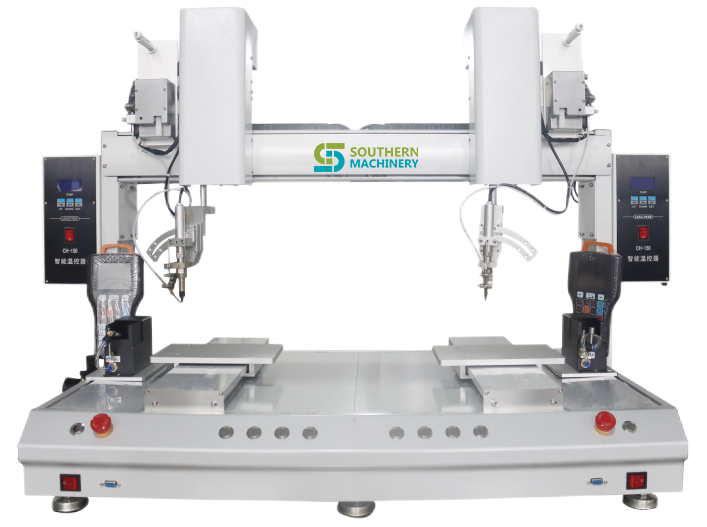
NBHZ Series Soldering Robot by Southern Machinery: Automate Manual THT Soldering for High-Mix EMS Lines
Southern Machinery's NBHZ Series soldering robot automates manual THT iron-tip soldering — repeatable quality, lower labor cost, one operator runs multiple machines.
For every SMT line that runs smoothly, there is usually a THT soldering bench running less smoothly. After pick and place, Reflow Oven, and inline inspection, someone still has to solder connectors, relays, transformers, and other through-hole parts by hand. That bench is where quality becomes operator-dependent, and where labor cost keeps climbing.
Southern Machinery's NBHZ Series automatic soldering machine (also called a desktop soldering robot) replaces that manual iron-tip work with a programmable, repeatable soldering process — designed for the high-mix, low-to-medium volume environment that most EMS and ODM factories actually operate in.
What is this machine used for?
The NBHZ Series is an automatic iron-tip soldering machine: a desktop or cabinet-style robot that moves a soldering iron along a programmed path and feeds solder wire automatically to each joint. It is used for THT soldering tasks that are normally done by hand — the same connectors, coils, switches, and wire-to-board joints that occupy manual soldering stations today.
In practice, Southern Machinery documents the NBHZ family across three configurations:
- NBHZ-5331 — double-head, double-station soldering machine for higher throughput
- NBHZ-331-2 — double-splicing configuration for multi-point or multi-station work
- NBHZ-331-3 — cabinet-type visual soldering machine with vision-assisted positioning
Because the machine is programmed rather than tooled, changing product means changing the program — not rebuilding a fixture. That makes it a fit for high-mix production where dedicated special-purpose machines cannot pay back.

Why manual soldering is the hidden bottleneck
Manual iron-tip soldering is one of the least controlled processes in PCB assembly:
- Quality varies by operator and by hour of the shift — joint temperature, dwell time, and solder volume drift.
- Skilled labor is expensive and scarce — good soldering operators take months to train.
- Defects are expensive — cold joints, bridges, and oxidation typically show up at test or at the customer, driving rework and field returns.
- Output is hard to scale — adding volume means adding benches and people.
Southern Machinery's NBHZ product page states the machine's core benefits directly: high welding quality that prevents oxidation and virtual welding (cold joint) problems; low labor cost with no professional skills required — one person can operate multiple machines; high production efficiency with fast welding speed and 24-hour continuous production; and low energy consumption — no flux, gas, or bulk solder required, only a small amount of tin wire.
Typical application scenarios
The NBHZ Series fits wherever through-hole joints are still soldered by hand:
- Power supply and charger PCBA — connectors, transformers, and pin headers
- Home appliance control boards — relays, terminal blocks, and wire-to-board joints
- Automotive electronics — connectors and sensors that require consistent joint quality
- Industrial control modules — terminal blocks, fuses, and board-to-board connectors
- Medical electronics — low-volume, high-reliability boards where joint consistency matters
- Prototype and pilot lines — programming-based changeover suits short runs
For each of these, the buyer should compare the NBHZ approach against two alternatives: manual soldering (low CapEx, high ongoing labor and defect cost) and selective wave soldering (higher throughput but higher CapEx and fixture cost). The soldering robot sits in between — it suits the mixed, mid-volume THT workload that is too small for a selective wave line but too expensive to keep manual.
How it fits into a complete PCB assembly line
A full THT soldering process does not have to be one machine. Southern Machinery supplies whole SMT/THT PCB assembly automation lines, so the NBHZ robot is normally positioned as a flexible soldering cell, integrated with:
SMT line (printing → placement → Reflow Oven → AOI)
        ↓
THT insertion (axial / radial / odd-form inserters)
        ↓
NBHZ soldering robot (programmed iron-tip soldering)
        ↓
Cleaning / inspection / depaneling
        ↓
Test & pack
The robot can be placed directly at the soldering stage, next to a wave soldering line for post-solder touch-up, or as a standalone cell with a fixture and a tray of boards. For high-mix lines, Southern Machinery can also pair the soldering robot with its board handling equipment (loaders, unloaders, conveyors) so the cell runs with minimal operator attention — consistent with the one-operator-multiple-machines model.
Key selection parameters — what to confirm before you buy
Southern Machinery publishes the NBHZ Series with the following parameters to confirm per application. Exact values depend on your board set, so ask for the configuration sheet:
- Number of soldering heads and stations — single-head, double-head double-station (NBHZ-5331), or cabinet-type (NBHZ-331-3)
- Board / fixture size and working area — must match your largest PCB and fixture
- Iron tip selection — tip geometry should match pad and joint types (Southern Machinery's training video covers how to select an iron tip soldering robot)
- Solder wire feeding — wire diameter and feeding method must suit the joints you solder
- Programming and vision — teach-mode programming, visual positioning, and program storage for changeover
- Throughput expectation — joints per board and cycle time target
- Integration — conveyor height, SMEMA-style handshake, or standalone cell layout
- Utilities — power supply, compressed air, and fume extraction requirements
Southern Machinery does not publish generic CPH claims for the NBHZ Series; throughput is validated against your board layout and joint count during the quotation process.
ROI, quality, and throughput
Quality. A programmed robot applies the same temperature profile, solder volume, and dwell time to every joint — removing the human variables that cause oxidation and cold joints. The NBHZ product page lists this as the machine's primary benefit.
Labor. Because the process is automated, operators do not need advanced soldering skills; one person can supervise multiple machines. This changes the labor economics of THT soldering even at modest volumes.
Throughput. The machine can run continuously — including across shifts — without the quality drift of manual work. Throughput per machine depends on joint count and board handling, so the practical ROI calculation is: (manual labor cost saved + rework/defect cost saved) versus machine cost and floor space. Southern Machinery provides ROI modeling with your actual labor rates and board data.
FAQ
Is the NBHZ Series a wave soldering machine? No. The NBHZ Series is an automatic iron-tip soldering robot that solders joints one by one along a programmed path. It complements wave soldering for post-solder touch-up, or replaces manual soldering benches entirely.
What kind of components can it solder? Through-hole and odd-form joints that are normally done by hand: connectors, relays, transformers, terminal blocks, coils, and wire-to-board joints. Suitability depends on joint geometry, access, and tip selection.
Do we need skilled soldering operators? No. The robot is programmed in teach mode, and the manufacturer's stated benefit is that one person can operate multiple machines without professional soldering skills.
How fast is it? There is no universal CPH figure; cycle time depends on board layout, joint count, and configuration (single or double head). Southern Machinery validates speed against your actual PCB during quotation.
Can it handle high-mix production? Yes. The robot is program-based, so product changeover is a program change rather than a tooling rebuild — suited to high-mix EMS and ODM environments.
How do we evaluate the NBHZ Series for our boards? Send your PCB data, BOM, and joint photos to Southern Machinery. They will confirm configuration, iron tip, fixture approach, and throughput expectations before quotation.
Get a configuration recommendation
Every THT soldering line is different, so Southern Machinery recommends starting with your board data rather than a catalog page.
- Email Jason Wu: jasonwu@smthelp.com — Sales & Service Engineer
- WhatsApp / phone: +86 13602562576
- Browse the product catalog: file.autoinsertion.com — PDFs, manuals, and product boards
- See machine photos: ph.smthelp.com — real product photo album
Published by Southern Machinery — SMT/THT PCB assembly automation equipment. Established 2011 in Shenzhen, serving 237+ global customers with SMT, THT, wave soldering, board handling, and inspection solutions for EMS, ODM, automotive, medical, and industrial electronics manufacturing.
Comments