
NBHZ 5-Axis Desktop Soldering Robot by Southern Machinery
The NBHZ 5-axis desktop soldering robot automates the through-hole joints that most SMT lines still solder by hand. Southern Machinery's bench-top machine repeats a taught path at ±0.02 mm, holds the heater within ±2 °C
Sep 28, 2026 · Updated Sep 28, 2026 · Southern Machinery
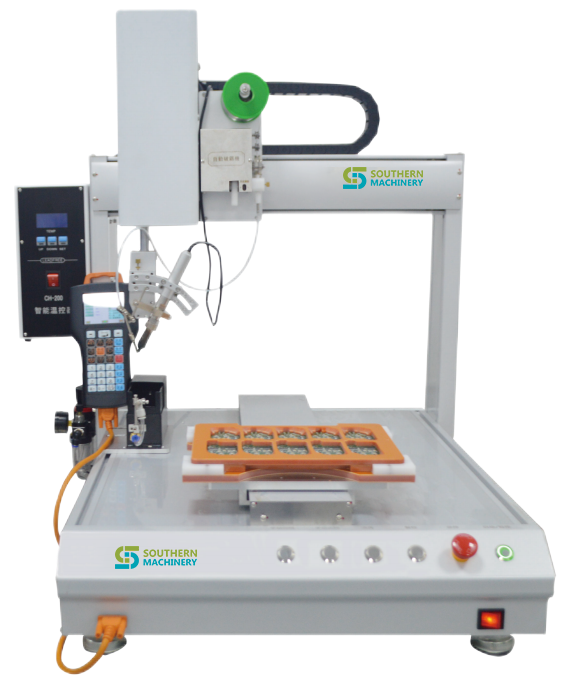
NBHZ 5-Axis Desktop Soldering Robot by Southern Machinery
Direct answer: The NBHZ 5-axis desktop soldering robot is a bench-top machine that automates iron-tip soldering of through-hole joints — connectors, relays, terminal blocks and wire-to-board points that most SMT lines still solder by hand. It reproduces a taught path or DXF-imported coordinates with ±0.02 mm repeat accuracy, holds the heater within ±2 °C up to 480 °C, and supports both spot and drag soldering. Buyers shortlist the NBHZ 5-axis desktop soldering robot when hand soldering has become the yield bottleneck but selective wave soldering cannot be justified for the product mix.
What is a 5-axis desktop soldering robot used for?
The joints that move off the bench
The NBHZ is built for through-hole work that never reaches a wave solder pot: connectors, relays, transformers, switches, terminal blocks and wire-to-board points. These are the joints that sit on a manual bench after pick-and-place and reflow, and they are the reason a line that looks automated still needs three to five trained operators per shift (a figure stated on the NBHZ page — treat it as indicative, not a commitment). Typical homes for the machine in EMS, ODM and OEM plants include power supply and charger PCBA connectors, appliance control board relays, automotive connector and sensor joints, industrial control terminal blocks and fuses, medical boards where joint consistency matters more than volume, and pilot lines where changeover by program beats changeover by fixture.
Spot mode and drag mode solve two different joint shapes
The machine is quoted with both spot (point-to-point) and drag (continuous line) soldering, running within a 300–800 mm/s travel band. Spot mode is the right choice for isolated pads and single pins: the head moves to one coordinate, dwells, feeds wire and moves on. Drag mode suits a connector row, where a straight continuous pass along the pin line is faster and more uniform than ten separate spot cycles. Both modes are programmed the same way, so one machine can handle a mixed product family without a second capex decision.
Where the NBHZ is the wrong machine
Three cases should be ruled out early. If the joint is a large thermal mass with heavy ground planes, a selective wave pot with a wide nozzle will usually hold heat better. If annual volume is high enough to justify hard tooling, a dedicated selective soldering line pays back faster. And if the board has fewer than a handful of hand-soldered joints per unit, the setup time will not amortise. The NBHZ occupies the middle band: too much hand soldering to accept, too little volume for a fixture-based line.
How do you choose the right NBHZ configuration?
1. Axis travels must match your largest board
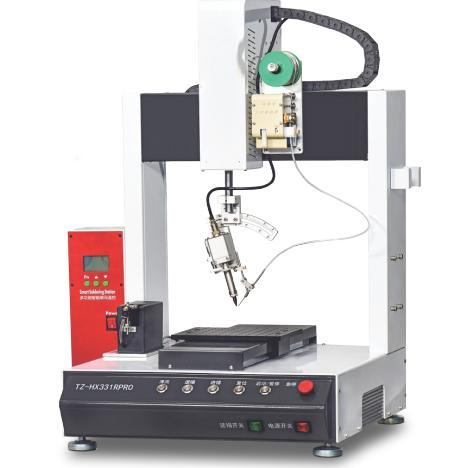
The product sheet quotes X 300 mm, Y 300 mm and Z 100 mm, all marked customizable, plus R 360° rotation and B tilt adjustment. The practical rule is to size the travels against your largest board plus the fixture margin, not your average board. Southern Machinery agrees customized travels per project, so the board drawing should be attached to the enquiry rather than assumed from the catalogue value.
2. Programming route: teaching box or DXF import
Programs are created either with the handheld teaching box or by importing DXF coordinates. The controller stores 100 programs. If your CAD department already issues joint coordinates, DXF import removes most of the teach-in labour and makes changeover essentially a file selection. If not, the teaching box is sufficient for stable, repetitive product families — but budget the first-article programming time honestly.
3. Heater, solder feed and power supply
The heater is quoted as RT to 480 °C with ±2 °C accuracy under high-frequency constant temperature control, and a heating power of 150–300 W on an AC 220 V single-phase supply. That combination means a standard bench circuit rather than a dedicated three-phase feed — relevant if you are dropping the machine into an existing THT cell. The ±2 °C figure is the direct counter-argument to manual irons, which the NBHZ page describes as drifting up to ±15 °C from setpoint and creating cold joints and thermal damage.
NBHZ selection checklist
| Parameter | What the NBHZ product sheet states | What to confirm before ordering |
|---|---|---|
| Axes | X 300, Y 300, Z 100 mm, R 360°, B tilt | Largest board size; customized travels are agreed per project |
| Repeat accuracy | ±0.02 mm | Position tolerance of your tightest joint |
| Moving speed | 300–800 mm/s | Drag-soldering row length per board |
| Temperature | RT – 480 °C | Your lead-free alloy and its working window |
| Heater accuracy | ±2 °C | Joints sensitive to thermal damage |
| Heating power | 150–300 W | Whether a 220 V bench circuit is free |
| Programming | Handheld teaching box + DXF import | Whether CAD can export joint coordinates |
| Program storage | 100 sets | Product mix per changeover cycle |
| Power supply | AC 220 V full voltage, single phase | Local mains and plug standard |
How does the NBHZ fit into a complete PCB assembly line?
Position in the THT flow
The natural sequence is SMT printing, placement, reflow and AOI, then through-hole insertion, then soldering, then cleaning, inspection and depanel. The NBHZ sits at the soldering step of that second half — after axial, radial or odd-form insertion and before inspection. Because it moves by program rather than by fixture, it can be placed directly at the bench position it replaces, with the same board handling and the same operators feeding it.
Running alongside wave soldering rather than instead of it
Many plants keep the wave or selective soldering line for the bulk through-hole joints and use the NBHZ for post-solder touch-up, rework and the small mixed batches that would otherwise disrupt a running wave. That is a capacity decision, not a compromise: the robot absorbs the variable work, while the wave pot keeps running at its stable recipe. Southern Machinery supplies the surrounding modules — THT and auto insertion equipment, insertion machines and soldering machines — so the soldering step can be planned as part of a line rather than as a standalone bench.
What is the payback on a desktop soldering robot?
The payback formula
Manual bench hours per month
  = boards per day × hand-soldered joints per board × seconds per joint ÷ 3600
    × production days per month

Bench hours freed per month
  = manual bench hours per month × cycle-time reduction

Annual labour saved (USD)
  = bench hours freed per month × loaded operator cost per hour × 12

Simple payback (months)
  = machine price ÷ (annual labour saved ÷ 12)
Example calculation (indicative only)
Assume 300 boards per day, 10 hand-soldered joints per board and 22 seconds per joint — the NBHZ page's own illustration of a relay joint — over 22 production days. Manual bench time is 300 × 10 × 22 ÷ 3600 × 22 ≈ 403 hours per month. The page states that the robot cuts that cycle by about 60%, which frees roughly 242 hours per month, or about 2,900 hours per year. At a loaded operator cost of USD 6 per hour, the arithmetic gives about USD 17,400 per year of bench labour. Every input above is an example: boards, joints, cycle time, wage and the reduction itself depend on your configuration and part, and the result is subject to final technical confirmation. Southern Machinery quotes a project-specific figure against your joint list rather than publishing a guaranteed ROI.
What does ownership look like after installation?
Installation, training and spare parts
The machine ships with on-site installation and training for one operator and one host engineer, 7×24 remote support by phone, WhatsApp or remote session, CE marking, an ISO 9001 quality system and ISO 14001 environmental management. Spare-part dispatch from Shenzhen is quoted at one day.
Consumables and day-to-day upkeep
The robot consumes solder wire and iron tips rather than flux or bulk solder. The recurring tasks are tip condition, program backup and joint inspection after a program change — all of which belong to the process engineer, not to a soldering specialist, which is the whole point of moving the joint off the manual bench.
FAQ
What is the repeat accuracy of the NBHZ soldering robot?
±0.02 mm, quoted from the NBHZ product sheet. The heater holds ±2 °C with high-frequency constant temperature control.
Can the NBHZ do both spot and drag soldering?
Yes. Spot (point-to-point) and drag (continuous line) are both supported, at 300–800 mm/s travel speed.
How are soldering programs created?
With a handheld teaching box, or by importing DXF coordinates. The controller stores 100 programs.
What power supply does the robot need?
AC 220 V full voltage, single phase. Heating power is 150–300 W, so a standard 220 V bench circuit is enough.
What are the axes and travels?
X 300 mm, Y 300 mm, Z 100 mm (all customizable), R 360° rotation and B tilt adjustment.
Does Southern Machinery support installation and training?
On-site installation and training for one operator and one host engineer are included, with 7×24 remote support and 1-day spare-part dispatch from Shenzhen.
Next step
Send Southern Machinery your joint list — joint type, pitch, board size and daily volume — and we will return a configuration and a payback estimate within one working day. Southern Machinery has designed and manufactured SMT and THT PCB assembly equipment in Shenzhen since 2011, serving EMS, ODM, automotive, medical and industrial electronics plants worldwide. Email info@smthelp.com, message WhatsApp +86 136 0256 2576, or start from the NBHZ series product page and the wider Southern Machinery catalogue.
Comments