
Mixed-Technology Radial Insertion by Southern Machinery
Mixed-technology radial insertion for high-mix PCB assembly: S-3010A programming in minutes, 2.5-10 mm spans, 22 mm parts, one-operator inline cell.
Oct 7, 2026 · Updated Oct 7, 2026 · Southern Machinery
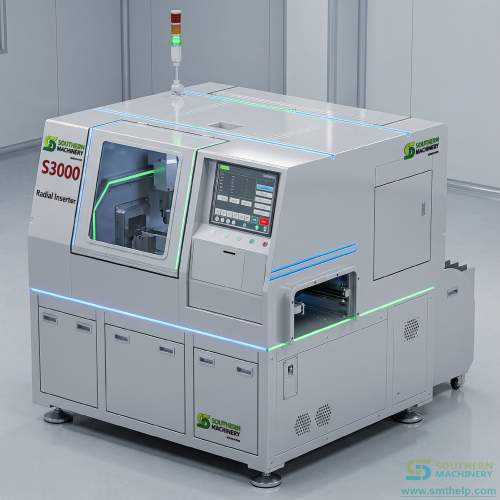
Direct answer. A mixed-technology radial inserter sequences and inserts tape-packed radial-lead components — capacitors, transistors, LEDs and key switches — onto boards that also carry SMT and odd-form content. The Southern Machinery S-3010A is a radial insertion machine rated at 12,000 CPH (actual speed 10,000 CPH) with a camera-visual operating system, built for high-mix, low-volume and NPI boards where a new program is finished in minutes instead of taught by hand.
Why do mixed-technology boards cost more than their placement time?
Setup, not placement, is the bottleneck. A mixed-technology board carries SMT parts, tape-packed radial-lead parts and a few odd-form components. Placement is fast; the changeover is not. Teaching a new board manually can take hours, and in high-mix production that cost is paid again at every change.
Radial content arrives in many spans. Electrolytic and film capacitors, transistors, LEDs and key switches arrive in radial tape across a wide range of lead spans and body heights. A machine built for one span pushes the remainder back onto a hand-insertion bench.
A miss is most expensive at the end. A reversed electrolytic capacitor or a wrong-value part that survives a visual check fails at test — the most expensive stage to catch it.
What does high-mix mean in practice?
Boards that change every shift. Setup time repeats with every changeover, not once per order.
2.5 mm and 10 mm spans in one program. Span diversity decides whether the line can insert the whole population or only part of it.
Parts up to 22 mm tall. Anything taller has to run without derating, or it goes back to manual.
Loaders and magazine racks. On many inserters, connecting to a loader and an unloader is a project rather than a plug-in.
Documented repeatability. A customer asking for an audit trail needs the insertion step recorded, not implied.
What does mixed-technology radial insertion change on the floor?
The S-3010A is a 1,000 ppm reliability class machine aimed at two bottlenecks: programming time and insertion throughput.
A new board is programmed in minutes
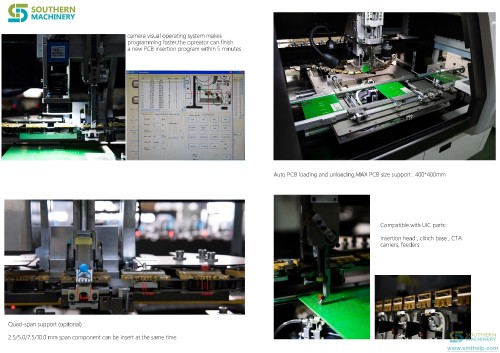
Camera-visual programming. The camera visual operating system identifies board coordinates automatically, so an operator finishes a new PCB insertion program in under five minutes with no manual teaching. Machine-vision coordinate correction and machine-vision calibration systems hold those positions across the run.
Why that matters at NPI. A first-article build and a low-volume run are the same activity; the difference is how long the line stands still while the program is created.
One machine covers the radial span range
Insertion spans. Single, dual, triple and quad-span tooling covers 2.5 mm to 10.0 mm, including 3.5 mm, with a standard triple span of 2.5/5.0 mm.
Component height. Parts up to 22 mm tall are inserted without derating.
Insertion head. Servo-motor driven, 13.0 mm, with an N-type clinch base; insert direction runs 0° to 360° in 1° increments.
Clinch. 1.5 mm to 2.2 mm at 10 to 35 degrees.
Throughput. 12,000 CPH rated, 10,000 CPH actual.
Components. Capacitors, transistors, LED lights, key switches and standard tape-packed radial-lead parts.
How does the inserter connect to a PCB assembly line?
The S-3010A is supplied as a supervised cell rather than a stand-alone machine: a loader feeds boards in, the inserter completes them, and an unloader returns finished boards to a magazine rack.
Inside the cell
Loader — sends boards to the inserter; track height and width are matched to the machine and adjustable.
Magazine rack — holds up to 50 boards; full racks feed automatically and empty racks exit for reload.
S-3010A — the insertion core, with 10 feeders as standard and In-Line or Straight-Back layouts from 10 to 100 feeder inputs.
Unloader — finished boards enter an empty rack; at 50 boards the rack leaves for the next process.
Supervision — one operator manages the cell in place of several hand-insertion stations.
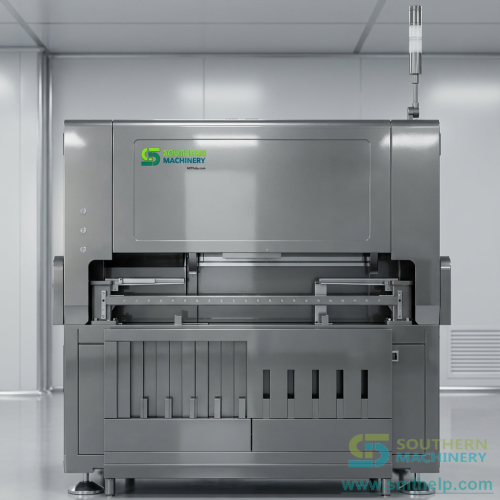
The cell sits between the SMT line and the wave-soldering and board-handling stages. Compare the THT machine range, the feeder range, a complete PCB DIP assembly line and the wider one-stop PCB assembly solutions for EMS, and read the S3010A Radial Inserter datasheet (PDF) before you configure.
Which parameters decide a mixed-technology radial insertion configuration?
Documented specification
Model — S-3010A radial insertion machine.
PCB envelope — minimum 50 × 50 mm, maximum 400 × 400 mm; thickness 0.79 mm to 2.36 mm.
Insertion spans — 2.5 mm to 10.0 mm, including 3.5 mm; single, dual, triple and quad-span tooling.
Insertion head — servo-motor driven, 13.0 mm, with N-type clinch base; 0° to 360° in 1° increments.
Clinch — 1.5 mm to 2.2 mm, 10 to 35 degrees.
Speed — 12,000 CPH rated, 10,000 CPH actual.
Feeders — 10 as standard; 10 to 100 feeder inputs in In-Line or Straight-Back layouts.
Control — Southern Machinery platform software on an industrial-control computer with an LCD monitor; English or Chinese interface.
Utilities — 220 V AC single phase, 50/60 Hz; air at 0.6 MPa / 0.3 m³/min; ambient 10 °C to 35 °C.
Footprint — 1800 × 1600 × 1800 mm; 1,000 kg.
Parts service — UIC-compatible insertion heads, clinch bases, CTA carriers and feeders, with spares held on a 1-day lead time.
Applications listed — LED signage and illumination, LED drivers and ballasts, set-top boxes, appliances, power conversion and high-mix environments.
Anything your board mix needs that the datasheet does not cover is not specified in source — contact Southern Machinery to confirm it against your actual panel.
What is the payback on a mixed-technology radial cell?
The arithmetic is throughput against required volume. Take a board carrying 24 radial inserts and a cell running at the actual 10,000 CPH insertion speed.
insertion time per board = 24 inserts / 10,000 CPH = 0.0024 h = 8.64 s
at 80% availability      = 8.64 s / 0.80       = 10.8 s of machine time per board
machine-limited output   = 3,600 s / 10.8 s    = 333 boards per hour
a 20,000-board order     = 20,000 / 333        = 60 h = about 7.5 single-shift days
Example only — depends on configuration and is subject to final technical confirmation. The insert count, the CPH your own mix achieves, availability and batch size are inputs you control; the calculation shows the method, not a guaranteed output.
Where the saving comes from
Setup. Camera-visual programming replaces manual teaching on every new board, so a high-mix schedule stops the line less often.
Consolidation. One machine handles 2.5 mm through 10.0 mm spans and parts up to 22 mm tall.
Labour. One operator supervises the loader, inserter and unloader as a single cell.
Parts availability. UIC-compatible heads, clinch bases, CTA carriers and feeders, with spares on a 1-day lead time.
Questions buyers ask before specifying
What is a mixed-technology board?
A mixed-technology board carries surface-mount parts alongside through-hole components — here, tape-packed radial-lead capacitors, transistors, LEDs and key switches — so the line has to handle SMT placement and radial insertion in the same product.
Can one machine handle 2.5 mm and 10 mm spans?
Yes. The S-3010A takes single, dual, triple and quad-span tooling from 2.5 mm to 10.0 mm, including 3.5 mm, with a standard triple span of 2.5/5.0 mm, and inserts components up to 22 mm tall without derating.
How long does it take to program a new board?
The camera visual operating system identifies board coordinates automatically, so an operator can finish a new PCB insertion program in under five minutes; teaching a new board manually can take hours.
Can it run inline with loaders and unloaders?
Yes. The machine supports automatic PCB loading and unloading with 50-board magazine racks in In-Line or Straight-Back layouts, from 10 to 100 feeder inputs, with one operator supervising the whole cell.
What utilities does the machine need?
220 V AC single-phase power at 50/60 Hz, compressed air at 0.6 MPa / 0.3 m³/min, and an ambient temperature between 10 °C and 35 °C.
How do I get a configuration and a quotation?
Send board sizes, component mix, monthly volume and line layout to info@smthelp.com. Southern Machinery replies with a model and automation recommendation within 24 hours, and quotation and delivery are confirmed after technical review.
Next step
Southern Machinery has built SMT and THT PCB assembly automation from Shenzhen since 2011 and serves more than 237 customers worldwide. Send your panel sizes, radial component list and monthly volume, and the engineering team will confirm span tooling, feeder count and the loader/unloader layout for your mixed-technology boards.
Contact — info@smthelp.com · +86 136 0256 2576 (WhatsApp).
Comments