
SMT Nozzle Supplier for Mixed-Line EMS by Southern Machinery
A mixed-brand EMS line buys a JUKI, a Yamaha and an ASM Siplace for good reasons, and then inherits three nozzle accounts, three part-number languages and three lead times. This guide is about consolidating that: which mounter brands one SMT nozzle supplier can cover, how to match a pickup nozzle to the head model and machine part number, how to build a spares kit from placement history rather than a price list, how to audit the nozzle shelf, and a staged switchover that proves each brand on a sample pick before an old account is retired. It also sets out the recovery-time arithmetic behind mis-pick handling, a selection checklist, and the open points Southern Machinery states rather than averages.
Oct 8, 2026 · Updated Oct 8, 2026 · Southern Machinery
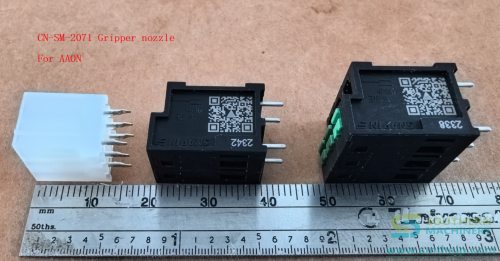
An SMT nozzle supplier who covers every mounter brand on your line turns six nozzle accounts into one reorder list. A mixed EMS line usually runs a JUKI, a Yamaha and an ASM Siplace because each machine was bought for a different job — and each arrived with its own numbering, wear parts and lead time. Southern Machinery designs and manufactures pickup nozzles for JUKI, Yamaha, Siemens / ASM, FUJI, Panasonic and Samsung / Hanhwa heads in vacuum, slot, gripper and pipe types, matched to the head model and machine part number rather than to a visible tip shape.
Why does a mixed-brand mounter line need one SMT nozzle supplier?
The cost of a split shelf is coordination, not unit price
Three machines mean three nozzle accounts, three part-number languages, three lead times and three people who each know one brand's numbering. The reorder cycles never line up, and a line stops because one vendor's tip is on backorder. When a mis-pick appears, nobody can say which account owns it.
Fragmentation shows up as an event, not a trend
Each brand's mis-picks are logged, if at all, in a different place by a different person, so nozzle wear arrives as a stop rather than a slope: a head starts mis-picking, someone blames the feeder, then the program, then the machine, and only after the line is down does anyone look at the tip.
Treat the nozzle shelf as one inventory problem instead of five purchasing problems — one list keyed by head model and part number, one owner, one reorder cadence, one place where wear is logged. The brands stay different; the management becomes one system.
What does one SMT nozzle supplier have to cover?
Six mounter brands, four tip families. Start with the brand on your line:
- JUKI — 500 and 700 series pickup nozzles plus slot, gripper and pipe types, tip bores published from 0.4 mm to 9.5 mm in the JUKI application catalogue, matched to KE-2010 to KE-2060, FX-1 and 730 to 760 heads
- Yamaha — pickup nozzles for YSM, YV and YG mounters, matched by head and part number
- Siemens / ASM — Siplace and X-series pickup nozzles, supplied against the machine part number
- FUJI — NXT, CP and AIM pickup nozzles, matched by head and feeder platform
- Panasonic — NPM and CM pickup nozzles, matched to the head and model
- Samsung / Hanhwa — CP45 and CP40 series nozzles, matched to head and revision
- Gripper and custom — gripper nozzles for bulky and polarised odd-form parts, plus custom design when no standard tip fits
How do you match a nozzle to a head across brands?
A four-question decision order
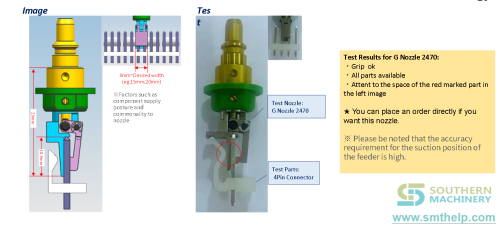
Work the standard families before you commission a custom tool. Does a standard vacuum tip bore fit the component width? If the part has leads, does a slot nozzle straddle them? If it is bulky or polarised, does a gripper hold it? If it is a large body, socket or shield, does a pipe tip carry it? Only when all four fail is it a custom project — skipping straight there adds cost and lead time.
Record three facts per nozzle
Record the brand, the exact head model and firmware, and the part number the catalogue maps to that head. Cross-brand part numbers are not interchangeable, and inside one brand a single type can carry two numbers that fit different machines. The JUKI 500 series is the worked example: the original reference E36xx7290A0 and the newer 40011046 are different orders.
What should a nozzle spares kit be built from?
Build it from placement history, not from the price list. Pull the last quarter of board programs from every head, extract the distinct component widths, map each to the tip family and bore that fits it, then add the odd-form layer — the slot, gripper and pipe tips for parts that never fit a vacuum tip. Built across brands, that list is one reorder instead of six, and a quarterly review keeps retired machines and dead stock out of it.
What does a nozzle shelf audit show?
Sort the drawer into three columns: how often each tip is used, how long it lasts, and how long it takes to replace. Anything rarely used and fast to replace does not need stocking; anything used daily and slow to replace needs a floor. The hidden costs never appear next to the unit price: dead stock, emergency couriers, and the line waiting on a vendor's lead. One supplier with one published lead time makes thin stocking viable instead of risky.
How do you work out the payback?
Recovery time is the measurable part. A correctly matched nozzle recovers from a mis-pick faster than a worn or wrong-bore one, and that difference is arithmetic, not a claim.
Formula
Recovery seconds per board = mis-picks per board × recovery seconds per mis-pick
Handling hours released per month = (worn-nozzle seconds per board − matched-nozzle seconds per board) × boards per day × production days per month ÷ 3600
Example — illustrative inputs, not Southern Machinery data
- Mis-picks per board: 0.4
- Recovery per mis-pick, worn nozzle: 75 seconds
- Recovery per mis-pick, matched nozzle: 25 seconds
- Boards per day: 400
- Production days per month: 22
Worn: 0.4 × 75 = 30 seconds per board. Matched: 0.4 × 25 = 10 seconds per board. Difference: 20 seconds × 400 boards = 8,000 seconds, about 2.2 hours per day, or roughly 49 handling hours released per month.
This is example / depends on configuration / subject to final technical confirmation. The inputs are illustrative values chosen to show the arithmetic; Southern Machinery publishes no recovery-time figure, and the model ignores nozzle purchase price, cleaning consumables and yield loss. Multiply the hours by your own loaded labour rate.
How do you consolidate without stopping the line?
Stage it. A single-source line with a hole in it is worse than a multi-source line, because there is no fallback vendor.
- Map every head and part number and have the new supplier quote the whole list — do not buy yet.
- Run a parallel period where new nozzles arrive alongside old stock, so there is never a gap.
- Prove each brand with a sample pick on your own component before retiring the old account.
- Retire brand by brand, not all at once, and keep a head-and-number register the supplier also holds.
How does a nozzle programme connect to the rest of the line?
Nozzles are one shelf in an SMT and THT build — the same supplier covers the rest:
- Nozzle spares and feeder range
- Board handling systems and PCB assembly equipment
- Brand spare-parts pages — JUKI, Yamaha, Siplace / Siemens, FUJI, Panasonic, Samsung
- Machine catalogue and photo library — file.autoinsertion.com, ph.smthelp.com
Key selection parameters to confirm before you order
- Mounter brand, head model and firmware for every machine on the line
- The distinct components you place, with widths and weights
- Tip family per part: standard vacuum, slot, gripper or pipe
- Bore or slot width, read from the catalogue where published and from your drawing where it is not
- Material, named per brand and per part and never assumed
- Shaft and Automatic Tool Changer fit
- Lead time for the specific part, not the family
- Pick-test result on your own component, per brand
FAQ
Which mounter brands can one SMT nozzle supplier cover?
JUKI, Yamaha, Siemens / ASM, FUJI, Panasonic and Samsung / Hanhwa, in vacuum, slot, gripper and pipe types, standard or custom, each with its own series page.
Are nozzle part numbers interchangeable between mounter brands?
No. Each brand has its own numbering and revisions, and within one brand a single type can carry two part numbers that fit different machines.
What pickup rate and nozzle life should you expect?
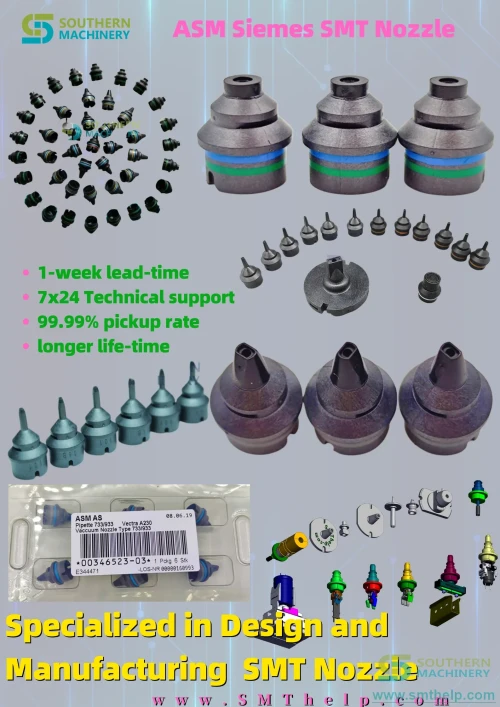
The decks quote a 99.99 percent pickup rate and a service life of more than 24 months. Those are manufacturer's claims, not OEM catalogue figures; real life depends on duty cycle and abrasion, so treat them as targets and confirm on your component.
What is the lead time for standard and custom nozzles?
One week is quoted on standard types, with sea freight and customs-clearance delivery offered. Custom types and non-stock brands are quoted per drawing.
Can a mixed line be consolidated without stopping production?
Yes, if the switch is staged: quote the whole list, run a parallel stock period, prove each brand on a sample pick, then retire the old accounts one brand at a time.
Send the head list, not just a part number
Tell Southern Machinery the mounter brands and the components you place and you will get the nozzles that cover every mounter on the line — plus an honest answer where a brand is not a fit. Founded in Shenzhen in 2011 and serving 237+ customers worldwide, Southern Machinery designs and manufactures SMT and THT equipment and spare parts. Email info@smthelp.com, message WhatsApp +86 13602562576, or request a quote.
Comments