
Medical Device PCB Depaneling by Southern Machinery
Depanel medical device PCBs without micro-cracks: S380A router specs, the V-score versus router rule, dust extraction and the separation payback math.
Oct 7, 2026 · Updated Oct 7, 2026 · Southern Machinery
Medical Device PCB Depaneling by Southern Machinery
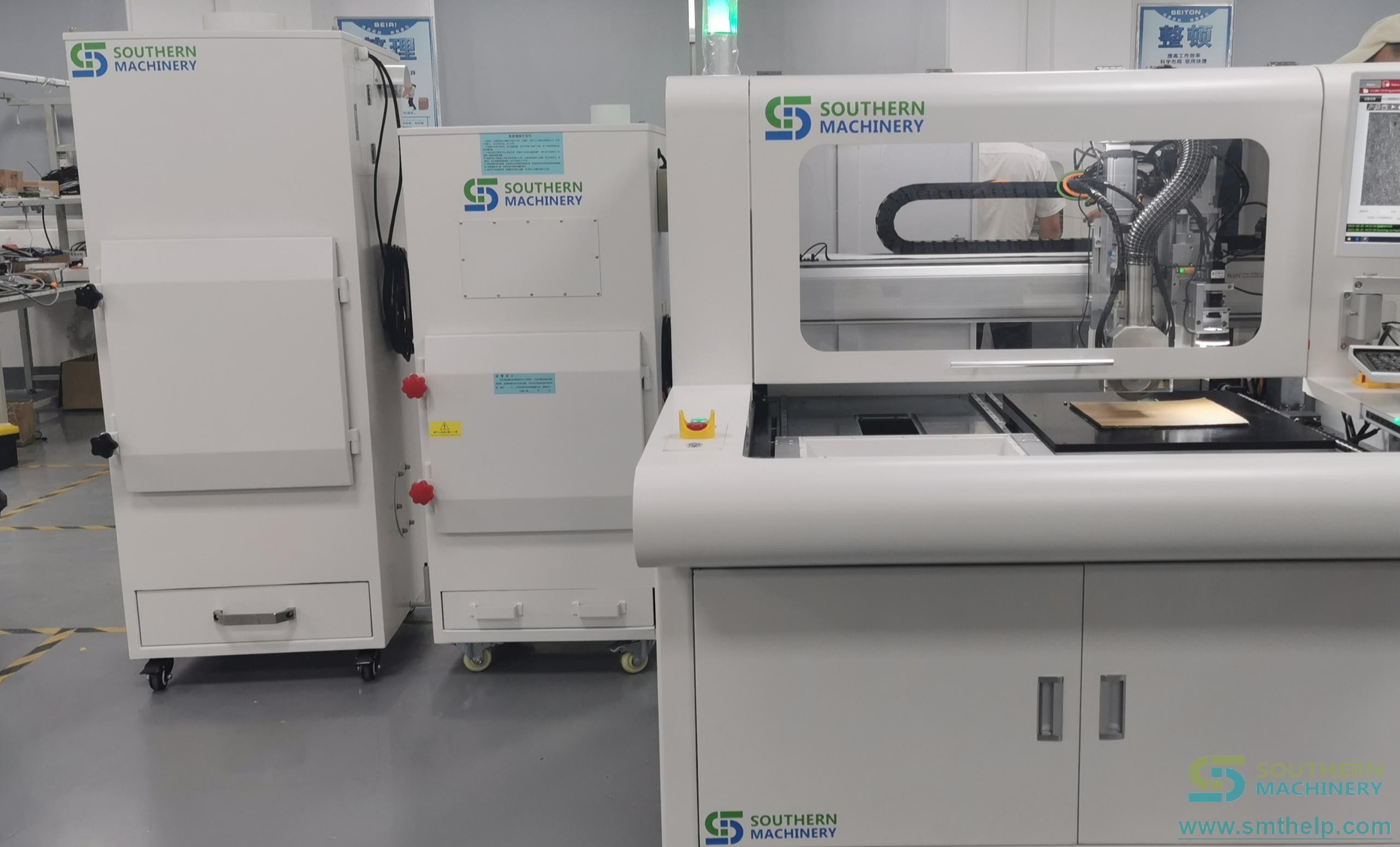
Medical device PCB depaneling is the separation step that turns an assembled multi-up panel into finished boards, and on diagnostic, monitoring and handheld medical electronics it is usually the operation nobody specified. The S380A from Southern Machinery is a vision-guided router separator: it mills the panel contour with a 0.8-3.0 mm bit at up to 60,000 rpm instead of pressing a straight blade through a V-score, so circular sensor boards, curved housings, L-shaped cut-outs and stamp-hole panels are separated in the line rather than broken by hand.
What is medical device PCB depaneling used for?
Depaneling is the last operation before a board is packed. On medical electronics it produces the outline the housing was designed around without damaging components and joints that SMT and THT placement already created — so a round sensor board, a curved-handle board or a panel with a closed connector cut-out stays in the line instead of going back to a hand tool.
The outline, not the volume, decides the method
Volume decides cycle time; the outline decides the process. A blade separator is fast and cheap to run, and it is right for panels whose cuts are all straight, parallel and open at the edge. The moment a cut is an arc, a circle or a closed contour inside the board, a blade cannot produce it at any price — which is why medical and instrument panels are usually routing jobs.
Manual separation is a defect that fails later
Hand-breaking a scored panel sends a shock wave along the board. Micro-cracks in ceramic capacitors and hairline fractures in solder joints do not announce themselves at the bench: they fail at temperature cycling in the field months later, and the cost lands in returns rather than in the separation cost centre.
V-score blade or router: which method fits a medical board?
A V-cut separator wedges a straight blade into a scored line until the remaining material fractures along it; a router removes material with a spinning bit. Blade separation optimises speed on straight, open, parallel cuts. Router separation optimises any outline at all, at a slower feed.
Three questions that sort a product list in five minutes
Ask three questions of every product. One: is every cut line straight and parallel? Two: is every cut open at the panel edge, or is any cut a closed contour inside the board? Three: how close is the nearest component to a cut? If the answer to one or two is no, blade separation is off the table, and if the nearest component sits within roughly 5 mm the shock argument applies even on straight lines.
What a milled contour changes about stress and edge quality
Milling keeps cutting stress low because material is removed rather than fractured, and it leaves an edge that fits a housing without a finishing operation. The published capacity list is your checklist: straight lines, arcs, circles, L-shaped and U-shaped panels, stamp-hole and V-slot models, with the machinable working area covering V groove, stamp hole, bridge and circle.
Which published S380A values decide whether your panel fits?
Quoted from the S380A specification sheet and the 2023 operation manual; disagreements between the two are listed rather than resolved.
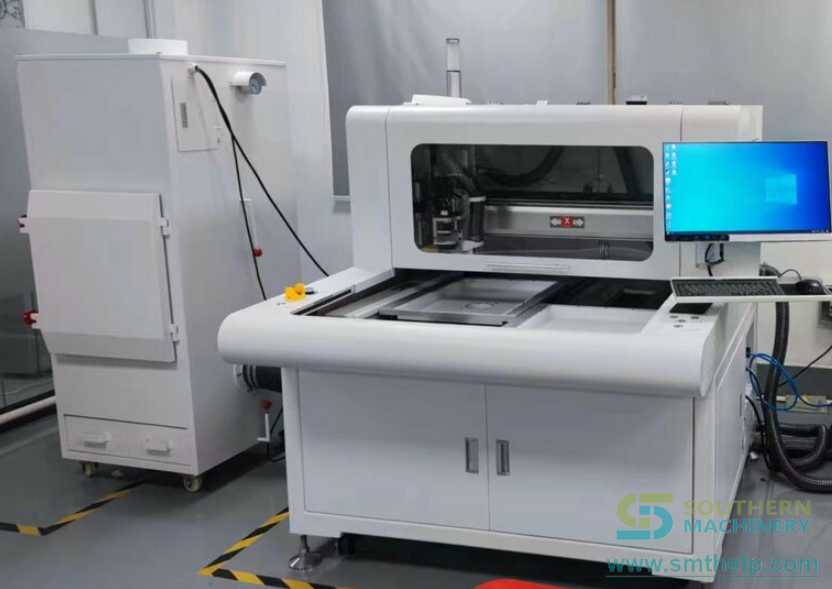
- Type and envelope — S380A vision-guided curved and V-cut router separator; effective cutting size 350 × 550 mm (the manual quotes L350 × W330 mm, which appears to describe one table)
- Cutting thickness and accuracy — 0.3-3 mm; repeat positioning ±0.01 mm, with the manual additionally quoting ±0.02 mm cutting accuracy
- Cutting speed and spindle — 5-100 mm/s adjustable; spindle maximum 60,000 rpm (manual range 20,000-60,000); cutter 0.8-3.0 mm
- Work table and drive — dual table on independent Y1 and Y2 axes, cutting and loading overlapping, with Panasonic A6 series servo drives on X, Y1, Y2 and Z
- Tool monitoring — automatic tool sinking, tool breaking and sliding-tool detection, with Z-axis height correction after a tool change
- Dust collection — bottom extraction standard, top collection optional; matched collector 665 × 635 × 1610 mm, 155 kg, AC380V 3 HP
- Power and footprint — separator 1180 × 1180 × 1350 mm, 800 kg; installation site 2500 × 2500 × 2500 mm; air 4.5 kg/cm²; ambient 10-30 °C
- Not published — machine price, because it depends on cutter package, fixture and board handling
- To confirm — automatic tool change is documented for the Q380A configuration, not listed as standard on the S380A sheet
How does a depaneling cell connect to the rest of the line?
The separator sits after reflow, wave or selective soldering and after inspection, immediately before final assembly or packing, so it has to match board thickness and panel support upstream and panel pitch and magazines downstream. Because both Y tables carry independent programs, a high-mix plant can run a small urgent medical order on one table while a larger batch continues on the other. Routing also produces FR-4 dust — abrasive, and mildly conductive when it holds moisture — so extraction at the cutting point belongs in the process specification: the S380A ships with a matched collector and a documented interlock, so a collector that is not running is reported as a fault.
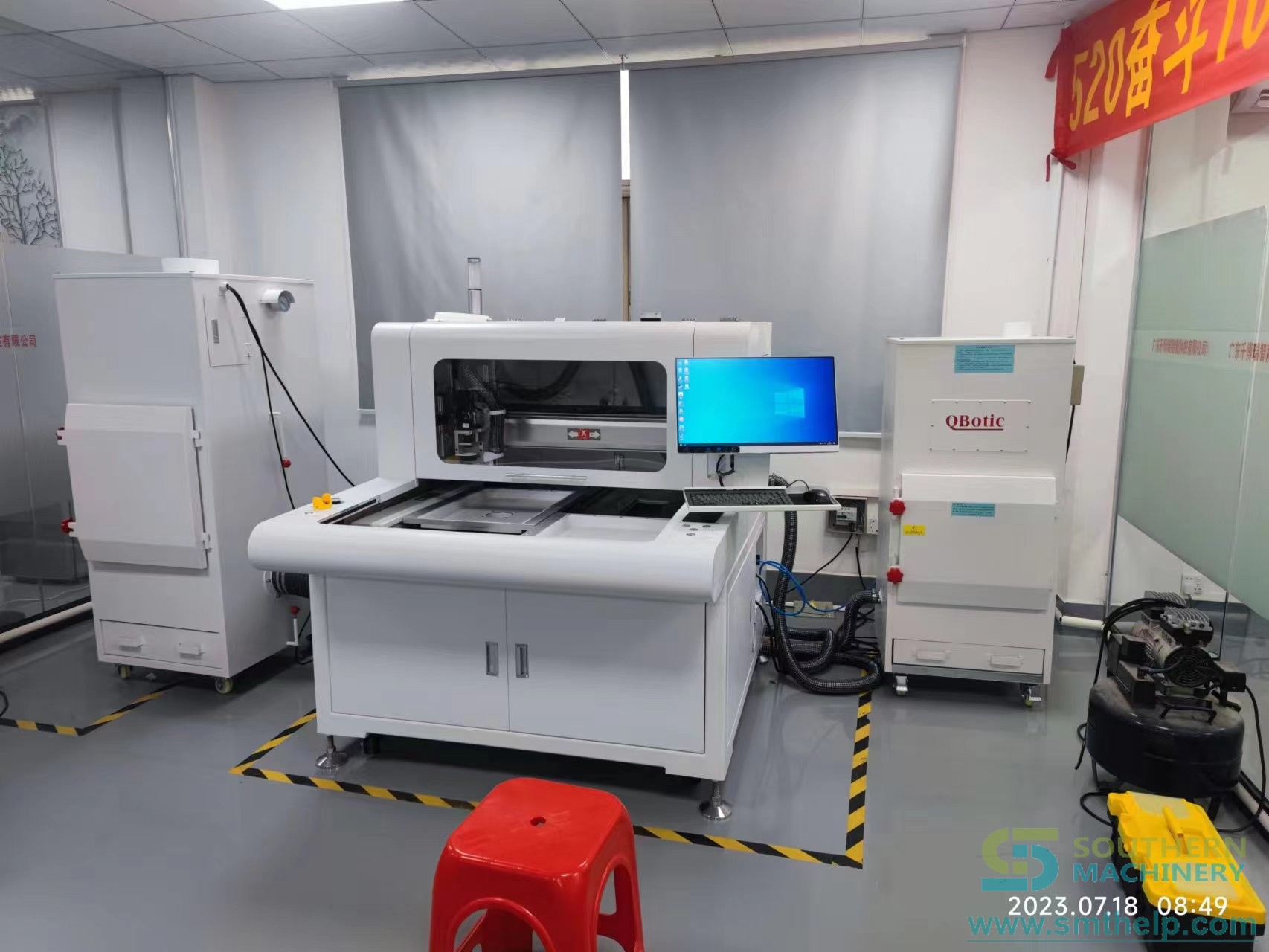
The cell connects to the same equipment as the rest of the line: board handling systems for conveyors and transfer, SMT machines upstream, THT equipment for mixed-technology boards, and the catalogue at file.autoinsertion.com.
What does micro-crack-free separation cost per panel?
No machine price is published, because it depends on the cutter package, the fixture and the board handling you select. What is published is the method and the 5-100 mm/s feed range it needs.
machine cutting time per panel  = total cut length per panel ÷ cutting feed
machine cutting hours per month = cutting time per panel × panels per month
labour replaced per year        = bench operators × fully loaded annual cost per operator
payback period                  = machine investment ÷ (labour replaced per year ÷ 12)
A worked example, with the arithmetic shown
Every money figure below is the buyer's own input; the investment figure is a placeholder for your quotation, not a published price. Example only, depends on configuration, subject to final technical confirmation: 900 mm of contour at 20 mm/s is 45 s per panel, so 3,000 panels a month is 135,000 s ≈ 37.5 machine hours. Two bench operators at 25,000 fully loaded cost each replace 50,000 a year, and an illustrative 40,000 investment returns 40,000 ÷ (50,000 ÷ 12) ≈ 9.6 months.
Where the saving actually accumulates
The labour step change happens once; the quality saving compounds. Every month without separation-induced field failures is a month of avoided returns — the part of the payback that never appears in a spreadsheet prepared at purchase.
What keeps a depaneling cell repeatable and auditable?
Programming is a picture of the board, not a coordinate list
The CCD system images the whole panel and the programmer draws the path — straight lines and arcs — on that image, with line width matched to the cutter diameter. Mark1 and Mark2 are taught from a template and confirmed by a test value, each product gets an arrayable sub-template, and if a board revision shifts the Marks, Mark matching realigns the program while tracks can be dragged, stretched or shortened. Programs persist, so a repeat run is a fixture change and a recall.
The maintenance that actually moves accuracy
Most of the schedule is cleaning rather than parts replacement. The manual's periodic table: wipe the operation table and plate fixture daily, since fixture flatness holds cutting accuracy; lubricate the ball screw and guide sliding quarterly with high-speed bearing grease; clean the electric-box filter quarterly; clear the dust bag monthly and empty the collection box weekly, lifting the drawer fully so the vacuum does not leak; clean the camera yearly with lens paper. A written routine with named frequencies is what lets the separation step be described as a controlled process.
FAQ: medical device PCB depaneling questions buyers ask
What is medical device PCB depaneling used for?
It separates an assembled multi-up panel into finished boards after SMT and THT assembly, and on medical electronics it must also produce non-rectangular outlines — circles, arcs, L-shapes, closed cut-outs — without micro-cracks.
Can a router separator also cut straight V-scored panels?
Yes. V-slot panels are on the published capacity list, alongside straight lines, arcs, circles, L-shaped and U-shaped panels and stamp-hole models, so one machine covers the whole outline.
What PCB thickness and panel size does the S380A handle?
Published cutting thickness is 0.3-3 mm and published effective cutting size is 350 × 550 mm. The 2023 manual quotes L350 × W330 mm — confirm for your configuration.
How accurate is a router depaneling machine?
Published repeat positioning accuracy is ±0.01 mm, with the manual additionally quoting ±0.02 mm cutting accuracy. Repeat positioning is how consistently the machine returns to a commanded position; cutting accuracy is the result on the board.
Does the S380A need a dust collector?
Yes — it is supplied with a matched collector, bottom extraction standard and top extraction optional, with the interlock documented so an extraction failure is reported.
What support comes with the machine?
Free installation and training, one-day spare-part lead time, five-day customised design for a non-standard outline, and 7 × 24 worldwide support.
Next step: send the panel outline
Send the panel outline, board thickness, the distance from the nearest component to a cut and your monthly volume. An application engineer will come back with the cutter diameter, the fixture arrangement, whether both tables can run your products in parallel and a payback calculation on your own labour cost. Southern Machinery has built SMT and THT PCB assembly equipment in Shenzhen since 2011 and serves more than 237 customers worldwide.
Request a depaneling cut study — machine photographs are published at ph.smthelp.com.
Comments