
MBF-2003 Mini Bowl Feeder for SMT Machines: Compact Bulk Component Feeding by Southern Machinery
Loose components that arrive in bags instead of reels are a quiet bottleneck on SMT lines. The MBF-2003 Mini Bowl Feeder from Southern Machinery is a compact vibratory bowl feeder that orients and presents small bulk components - terminals, crystals, ICs, chip diodes, SMD triodes and hardware parts - directly to an SMT placement machine. Published at 200 mm width with 850 x 200 x 930 mm overall dimensions, a reference cycle time of 0.8 second or less and a 110 / 220 V power supply, it is built for machine-side installation where space is tight. This guide covers what the MBF-2003 is used for, how it integrates with Panasonic, JUKI, FUJI, ASM and Universal SMT machines, the selection parameters buyers must confirm, typical applications, and the ROI case for replacing manual placement of bulk components.
Sep 16, 2026 · Updated Sep 16, 2026 · Southern Machinery
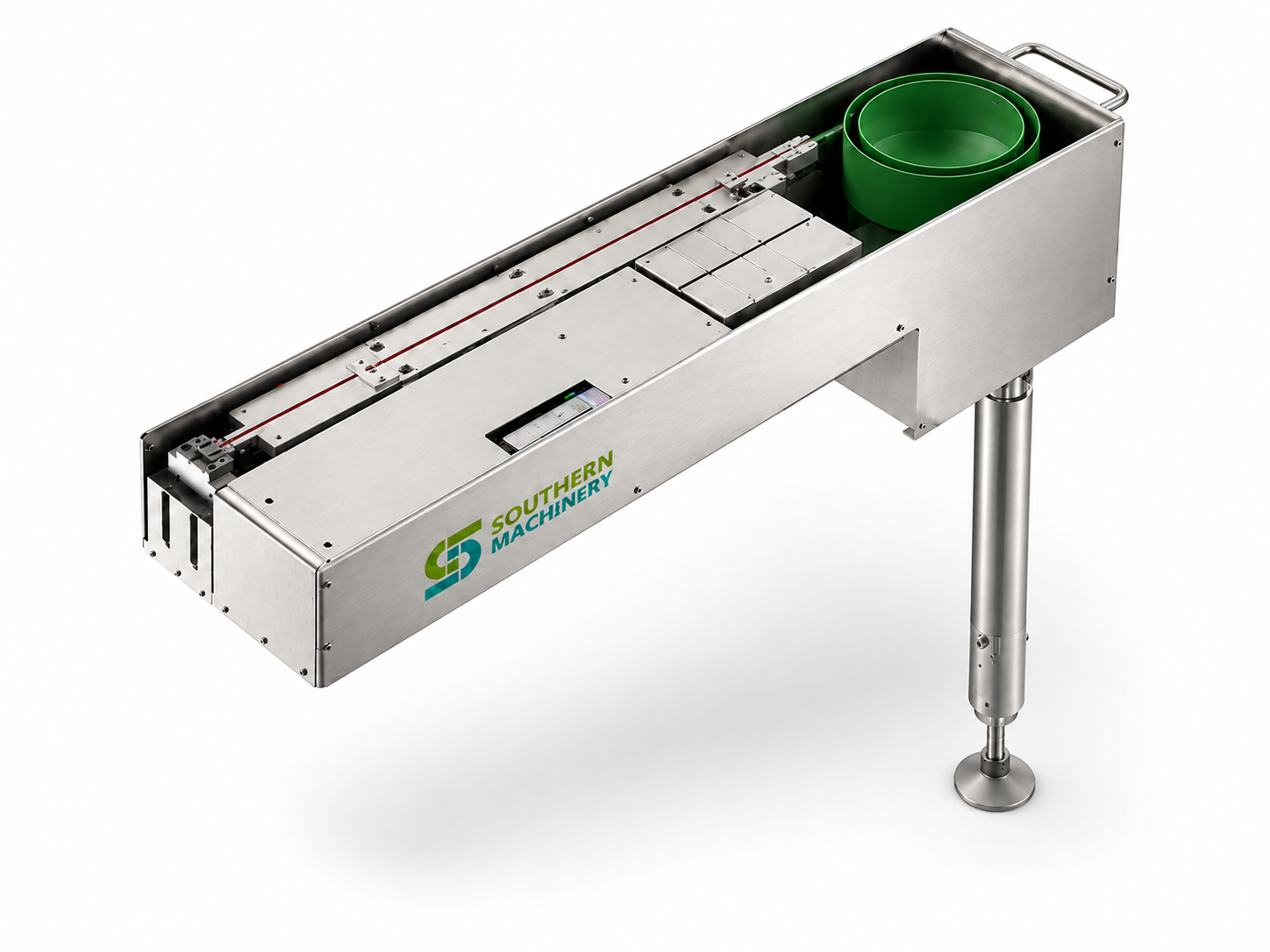
MBF-2003 Mini Bowl Feeder for SMT Machines: Compact Bulk Component Feeding by Southern Machinery
Most SMT lines have a component that refuses to behave like the rest of the BOM. It arrives loose in a bag, it has no tape and no reel, and it has a geometry that a standard tape Feeder cannot present reliably. Terminals, crystals, hardware inserts, chip diodes on odd carriers — the parts that quietly force a factory back to manual placement.
The MBF-2003 Mini Bowl Feeder from Southern Machinery is a vibratory bowl feeding solution built specifically for that gap. It is designed to sit beside an SMT placement machine, orient and present small loose components, and hand them to the mounter's Nozzle in a controlled, repeatable position — inside a machine-side footprint that a typical SMT line can actually spare.
This article covers what the MBF-2003 is used for, where it earns its place on a PCB assembly line, how it integrates with existing SMT equipment, and which parameters a procurement or process engineering team should confirm before specifying one.
What is the MBF-2003 Mini Bowl Feeder used for?
The MBF-2003 is a compact vibratory bowl Feeder used to feed small loose electronic and hardware components into SMT mounting equipment. Instead of presenting components on embossed tape or in tubes, it uses a vibrating bowl to singulate parts, orient them into a track, and deliver them to a fixed pickup position where the SMT machine's head can collect them.
It is intended for components that are supplied in bulk and are difficult or uneconomical to tape. Southern Machinery publishes the following as the applicable component families for the MBF-2003:
- Terminals
- Crystals
- ICs
- Chip diodes
- SMD triodes
- Hardware parts and other compatible components
The feeder is manufactured mainly from steel and aluminum alloy for structural stability and service life. Its documented width is 200 mm, with published overall dimensions of 850 × 200 × 930 mm. Published reference cycle time is ≤0.8 second, and the power supply is specified as 110 / 220 V. Vibration amplitude and frequency are controlled through the Vibration AMP setting, expressed in V (voltage) and Hz (frequency) — which is the primary lever an engineer uses to tune presentation speed and orientation stability for a given component.
In short: if a component is loose, small, and blocking your tape-based material flow, the MBF-2003 is a candidate for automating it at the point of placement rather than at a manual station.
Why machine-side footprint is the hidden constraint
When engineers evaluate a bowl feeder, they usually start with component size and cycle time. The constraint that actually kills projects appears later, during layout review: where does the feeder physically sit, and can the operator still reach the machine?
A vibratory bowl feeder is not a small accessory. A bowl, a drive unit, a linear track and an escapement mechanism all need space at the side of the mounter, and that side of the machine is often already occupied by tape Feeder banks, Feeder carts, operator walkways and material handling routes.
At 200 mm width, the MBF-2003 is deliberately narrow. That design choice is what makes it practical on crowded lines: it can be positioned alongside the SMT machine without forcing a re-layout of the Feeder bank or blocking the operator's access path.
The dimensions that matter for layout planning — all published by Southern Machinery — are:
- Width: 200 mm
- Overall dimensions: 850 × 200 × 930 mm
- Mechanical height: matched to the target SMT machine (confirmed during configuration)
- Main construction: steel and aluminum alloy
Because mechanical height and communication are matched per machine, the feeder is normally quoted against a specific SMT machine model rather than ordered as a standalone, machine-agnostic unit.
Typical application scenarios
Terminals and connector hardware on power and control boards
Terminals, pins and small hardware parts are the classic bulk-feeding problem. They are frequently supplied loose or in bulk packaging, have no standard tape format, and are often inserted or placed near board edges where manual handling causes damage and inconsistency. A bowl feeder presents them in a fixed orientation so the mounter can pick them with a dedicated Nozzle or gripper.
Crystal and IC feeding for high-mix assembly
Crystals and small IC packages can arrive in formats that a tape Feeder handles poorly. Where volume does not justify a custom taped reel, bowl feeding gives a repeatable presentation method for the same part across multiple production runs.
Chip diodes and SMD triodes in bulk packaging
When a component is bought in bulk to reduce material cost, the line needs a way to convert that bulk supply into a machine-presentable stream. The MBF-2003 is documented as applicable to chip diodes and SMD triodes, making it a route to keeping bulk purchasing economics without adding a manual placement station.
LED, appliance, power supply and automotive electronics
These product families commonly combine a taped SMT content with a smaller population of loose odd-form parts. Southern Machinery serves these industries with SMT and THT automation equipment, and the mini bowl feeder is typically specified as a targeted add-on to an existing SMT line rather than as a full line replacement.
Contract manufacturing with frequent changeover
For EMS and ODM factories running multiple customers on shared equipment, the value of the MBF-2003 is not raw speed — the documented cycle time is ≤0.8 second — but the ability to switch a loose component from manual placement to automated placement without building a custom tape reel for each job.
How the MBF-2003 integrates into a complete PCB assembly line
The MBF-2003 is a component supply device, not a standalone production machine. It works as an extension of an SMT placement system, so integration planning follows the same logic as any Feeder selection.
1. Define the component and its packaging first.
Confirm the exact part number, its bulk packaging method, and its physical geometry (body outline, lead or termination form, orientation constraints). Final component compatibility is confirmed against the actual component, not the category.
2. Match the target SMT machine.
Southern Machinery documents that the MBF-2003 can be mechanically matched and configured for communication with Panasonic, JUKI, FUJI, ASM, Universal and other SMT machines according to actual machine requirements. Mechanical height and communication configuration are part of the configuration process. Confirm your machine model and available mounting position before quoting.
3. Confirm the machine-side position and access.
At 200 mm width, the feeder needs a defined machine-side location. Check the Feeder bank arrangement, the operator walkway, and any material handling route (AGV, trolley, cart) that passes the machine.
4. Define the pickup interface.
Decide how the mounter will collect the component — Nozzle type, gripper, or a dedicated pickup head — and confirm that the escape position the feeder presents is compatible with that interface.
5. Tune vibration for the part, not for a specification sheet.
Vibration amplitude and frequency (Vibration AMP, in V and Hz) are set per component. Expect to tune during commissioning: too much vibration causes parts to jump the track or double-feed, too little causes starvation and pickup misses.
6. Plan the line position.
The feeder sits at the SMT placement stage, where the part is placed onto paste before the Reflow Oven. If the component is a THT part, verify whether the placement happens before or after the Wave Soldering stage and whether the board handling direction supports that sequence.
7. Validate upstream and downstream.
Board Handling equipment, SPI at paste printing, and AOI after placement all remain part of the process. Adding a bulk-fed component can change inspection programming, so include inspection in the change plan.
8. Document it in the process, not just in the equipment list.
Record the feeder settings, the component/part number pairing, and the changeover procedure so a shared line can be reconfigured without re-deriving settings from scratch.
Key selection parameters checklist
Use this list when specifying a mini bowl feeder. Parameters marked as published are documented by Southern Machinery for the MBF-2003; the rest are categories your team must confirm for your own application.
- Model: MBF-2003 (published)
- Feeder type: mini vibratory bowl feeder (published)
- Width: 200 mm (published)
- Overall dimensions: 850 × 200 × 930 mm (published)
- Reference cycle time: ≤0.8 second (published)
- Power supply: 110 / 220 V (published)
- Control method: Vibration AMP (V and Hz) (published)
- Main construction: steel and aluminum alloy (published)
- Applicable components: terminals, crystals, ICs, chip diodes, SMD triodes, hardware parts and compatible components (published)
- SMT machine compatibility: mechanically matched and communication configured for Panasonic, JUKI, FUJI, ASM, Universal and other machines (published)
- Component geometry: body outline, terminations and orientation constraints — confirm per part
- Bulk packaging format: bag, tray, box or bulk carton — confirm per part
- Pickup interface: Nozzle, gripper or dedicated head — confirm per machine
- Mechanical height: matched to the target SMT machine — confirm per machine
- Communication configuration: matched to the target SMT machine — confirm per machine
- Available machine-side space: including operator access and material routes — confirm per layout
- Changeover expectation: parts per run, number of distinct bulk components — confirm per production plan
- Inspection impact: whether AOI or SPI programming must change — confirm per process
Because final component compatibility, mechanical height and communication configuration depend on the SMT machine model and the actual component, these are confirmed during configuration rather than assumed from the model number alone.
ROI, quality and throughput perspective
Bulk feeding projects are usually justified on one of three grounds:
Labor displacement at the manual station. Every loose component placed by hand consumes operator time, and that time scales with volume. Automating presentation at the mounter removes the manual placement step from the routing for that component. Southern Machinery's positioning across its automation portfolio is consistent: replace repeatable manual insertion and placement work with equipment that holds a repeatable result.
Material cost. Components bought in bulk are typically cheaper than the same part supplied on custom tape. The MBF-2003 is the mechanism that lets a factory keep that bulk pricing advantage while still placing the part automatically. The trade-off is feeder setup and tuning effort per component, which is why the number of distinct bulk parts is a key input.
Quality consistency and reduced handling damage. Manual handling of small loose components produces bent terminals, dropped parts, and variation between operators. A bowl feeder presents every part in the same orientation at the same position, which makes placement more consistent and makes defects traceable to the process rather than to an individual.
A realistic expectation: the MBF-2003 is documented at ≤0.8 second reference cycle time for the feeding function. Total line impact depends on the host machine's placement rate and on how much manual work the feeder replaces — which is why the ROI case should be built from your own part population, volumes and labor hours, not from a generic benchmark.
Why Southern Machinery
Southern Machinery (Shenzhen Southern Machinery Sales And Service Co., Ltd) was founded in 2011 in Shenzhen, China, and serves 237+ global clients. The company focuses on SMT and THT PCB assembly automation equipment and supports customers with complete line solutions spanning SMT, THT, Wave Soldering, Board Handling and inspection, alongside the Feeder and Nozzle ecosystem that makes a line actually run.
For a mini bowl feeder, that matters for one practical reason: the feeder has to match a machine. Southern Machinery works from the SMT machine model and the component, configures mechanical height and communication accordingly, and supports the installation with spare parts, training and service. The company's documented services include spare parts supply, repair, retrofit, machine upgrading, training and overhaul — which is the relevant support envelope for a feeding device that will be tuned and re-tuned as the product mix changes.
FAQ
What is the MBF-2003 Mini Bowl Feeder?
The MBF-2003 is a compact vibratory bowl Feeder from Southern Machinery designed to feed small loose components into SMT mounting equipment. It is documented at 200 mm width, 850 × 200 × 930 mm overall dimensions, ≤0.8 second reference cycle time, 110 / 220 V power supply, with vibration amplitude and frequency controlled via the Vibration AMP (V and Hz) setting.
Which components can the MBF-2003 feed?
Southern Machinery documents terminals, crystals, ICs, chip diodes, SMD triodes, hardware parts and other compatible components as applicable. Final component compatibility is confirmed against the actual component during configuration, because part geometry and bulk packaging affect how the bowl orients and presents parts.
Does the MBF-2003 work with my SMT machine brand?
Southern Machinery states that the MBF-2003 can be mechanically matched and configured for communication with Panasonic, JUKI, FUJI, ASM, Universal and other SMT machines according to the actual machine requirements. Both mechanical height and communication configuration are part of the matching process, so provide your machine model when requesting a configuration.
How much space does it need beside the machine?
The published width is 200 mm, making it one of the narrower bowl feeding options for machine-side installation, with published overall dimensions of 850 × 200 × 930 mm. Actual layout planning also has to account for operator access and material handling routes, so the position should be verified against your machine layout.
Is a bowl feeder or a tape Feeder the better choice?
It depends on the component. Taped components are designed for tape Feeders and should generally stay there. A bowl feeder such as the MBF-2003 is for components supplied loose in bulk, or supplied in formats that a standard Feeder cannot present reliably. For belt-type bulk feeding of larger or more delicate parts, Southern Machinery also documents the S-MVF01 belt bulk Feeder as a different feeding approach.
Does Southern Machinery provide support after installation?
Yes. Southern Machinery provides configuration advice, spare parts, training, retrofit and repair services. Because feeder settings depend on the component, expect to tune vibration parameters during commissioning and to document settings for each part number so changeover stays repeatable.
Get configuration advice from Southern Machinery
If you have a component that keeps forcing manual placement, send the part number, its bulk packaging format, and the SMT machine model you intend to use. Southern Machinery will advise on whether a mini bowl feeder is the right approach, whether the MBF-2003 fits your machine-side space, and what else the configuration requires.
- Browse product catalogs and documentation: file.autoinsertion.com
- See machine photos and product albums: ph.smthelp.com
- Review the company's equipment range: www.smthelp.com
- Contact: jasonwu@smthelp.com
Southern Machinery — your smart EMS factory partner since 2011, Shenzhen.
Comments