
Manual Stencil Printer for SMT Solder Paste Printing | Southern Machinery
Print 0402 and fine-pitch PCBA with a manual SMT stencil printer from Southern Machinery — repeatable paste printing for prototypes, NPI and small batches.
Sep 3, 2026 · Updated Sep 3, 2026 · Southern Machinery
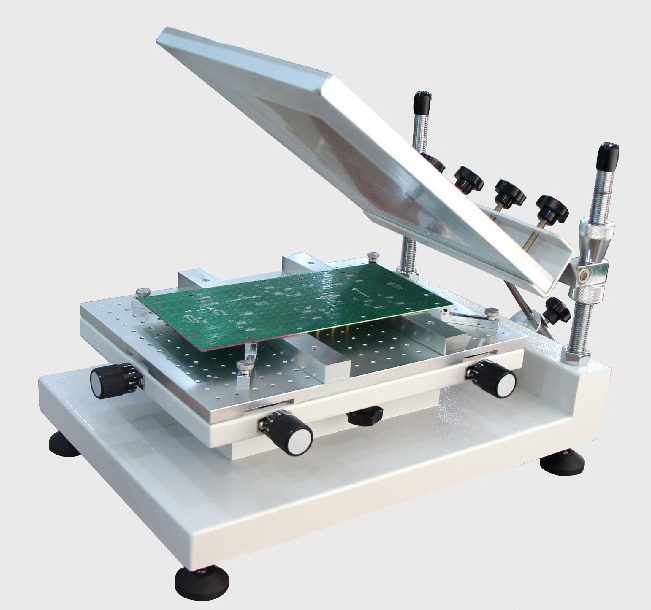
Manual Stencil Printer for SMT Solder Paste Printing | Southern Machinery
A manual stencil printer is the lowest-cost way to deposit solder paste with a controlled, repeatable print — instead of hand-soldering or squeezing paste from a syringe. It is the machine an SMT line uses for prototype boards, small batches, and new-product introductions, and it is often the first paste-printing step a factory buys before it justifies a semi-automatic or automatic printer.
Southern Machinery supplies a high-precision manual SMT PCB stencil printer positioned for fine-pitch work — 0402 passives and 0.4 mm pitch ICs — alongside its SP family of semi-automatic and automatic stencil printers. The video below shows the manual stencil printer and the solder-paste process in action.
Watch: Manual Stencil Machine SMT Soldering Printer
What is this machine used for?
A manual stencil printer (manual solder paste printer) applies solder paste to a bare PCB through a laser-cut stencil by hand. The operator loads the PCB onto the tooling fixture, positions the stencil over the board, places solder paste along the stencil, and draws a squeegee across it. Paste is forced through the stencil apertures and deposited exactly on the pads that will receive SMD components.
It does the same printing job as an automatic stencil printer — paste volume control, aperture-to-pad alignment, clean aperture fill — but with the operator controlling squeegee speed and pressure instead of a pneumatic or servo system. That makes it ideal for:
- Prototype and NPI runs where board designs change frequently and a production printer cannot be spared.
- Small-batch, high-mix EMS jobs that do not justify the capital of an automated printer.
- First-article paste checks — Southern Machinery's demo positions the manual stencil printer as a way to verify solder-paste printing options before placement-quality problems appear downstream.
- R&D labs, universities, and repair stations that assemble SMT boards in low volume.
Southern Machinery's manual PCB stencil printer is documented on smthelp.com as a high-precision unit for SMT 0402 and 0.4 mm chip components — the fine-pitch classes where alignment and paste volume decide print quality.
Typical Application Scenarios
- EMS / ODM factories — NPI lines and quick-turn prototypes alongside high-volume SMT lines.
- Electronics R&D and product development — engineering samples and pilot builds before mass production.
- Automotive and industrial electronics suppliers — small qualification batches of control boards, sensor boards, and driver boards.
- Medical electronics — low-volume, high-traceability assemblies that run in controlled batches.
- LED lighting and power electronics — mixed boards where paste printing small runs beats manual soldering throughput and consistency.
- Service and repair operations — board-level rework and short replacement runs.
For any of these, a manual stencil printer removes the two classic failure modes of hand-applied solder: too much paste (bridging, solder balls) and too little paste (voids, opens).
How It Integrates into a Complete PCB Assembly Line
A complete SMT line runs solder paste printing → pick and place → reflow soldering → inspection. The manual stencil printer covers the printing stage in specific situations:
- Off-line NPI / sample printing — the process engineer prints a few boards with the manual printer to validate aperture design, paste type, and squeegee settings before the automatic printer takes over.
- Low-volume production cell — a manual printer, a compact pick-and-place machine, and a reflow oven form a small complete SMT line for batches that are too small for the main line.
- Complement to an automated line — the manual printer stays loaded with a second paste or stencil for pilot runs while the automatic printer runs production.
Southern Machinery supplies the whole chain — stencil printers (manual, semi-automatic, automatic), pick-and-place machines, reflow ovens, wave soldering machines, board handling conveyors, and inspection equipment — so a manual stencil printer can be specified as the entry step of a line that grows into full automation later.
Key Selection Parameters
Confirm these with Southern Machinery when matching a manual stencil printer to your boards:
- Fine-pitch capability — the smthelp.com product page positions this printer for 0402 components and 0.4 mm pitch ICs; confirm your smallest package and pitch against the machine's alignment resolution.
- PCB size range — maximum and minimum board dimensions the fixture can hold.
- Stencil frame compatibility — standard frame sizes the printer accepts, and whether your existing stencils fit.
- Board registration method — tooling pins, adjustable stops, or other fixturing for repeatable board placement.
- Alignment mechanism — X/Y and rotational (theta) adjustment for aligning stencil apertures to pads; the finer the pitch, the more important precise adjustment.
- Squeegee type — metal or polyurethane blades, and the squeegee width relative to your board width.
- Board support — how the PCB is supported under the stencil during printing to avoid flex and paste smearing.
- Throughput expectations — a manual printer is operator-paced; size staffing for the batch volume you plan to run.
ROI, Quality & Throughput Perspective
- Capital cost: a manual stencil printer is the smallest paste-printing investment in the SMT world — the entry point before semi-automatic (SP-300 / SP-1200 class) or automatic (SP-1008 / SP-830-A class) printers.
- Quality: controlled paste deposits reduce the opens, bridges, and rework that manual soldering or syringe paste application produce on fine-pitch boards.
- Throughput: limited by the operator, which is exactly right for prototypes and small batches — the machine pays for itself by not occupying a production printer for short runs.
- Rework savings: correct paste volume from the first board cuts downstream placement and reflow defects; the demo positions the machine as a check-before-placement tool that prevents quality problems appearing later in the line.
- Training value: operators and process engineers learn aperture fill, squeegee angle, and paste behavior on a manual machine before moving to automated printing.
FAQ
Q: What is a manual stencil printer used for in SMT assembly?
A: It deposits solder paste on a PCB through a stencil by hand, using a squeegee drawn across the stencil. It is used for prototypes, small batches, NPI runs, and as a low-cost entry to controlled solder paste printing.
Q: Can a manual stencil printer handle 0402 components and fine-pitch ICs?
A: Southern Machinery's manual SMT PCB stencil printer is documented on smthelp.com as a high-precision unit for 0402 and 0.4 mm chip components. Confirm your smallest package and pitch with Southern Machinery before ordering.
Q: Manual, semi-automatic, or automatic stencil printer — which do I need?
A: Manual printers suit low volumes and prototypes with the lowest capital cost; semi-automatic printers (SP-300 / SP-1200 class) add controlled squeegee actuation; automatic printers (SP-1008 / SP-830-A class) add program-controlled print cycles for high-volume production. Southern Machinery supplies all three classes.
Q: Does a manual stencil printer fit into a full SMT production line?
A: Yes — as an off-line NPI and sample printer, as the printing stage of a compact low-volume SMT cell, or as a complement that keeps pilot runs off the automatic printer.
Q: What support does Southern Machinery provide with this equipment?
A: Southern Machinery provides configuration advice, training, spare parts, and global after-sales support from its Shenzhen base, which has served 237+ customers since 2011.
Q: Can I see the manual stencil printer in operation?
A: Yes — the video above shows the manual stencil machine and solder-paste printing process. Southern Machinery can also arrange a demonstration and machine photos on request.
Contact Southern Machinery for Configuration Advice
Southern Machinery Sales and Service Co., Ltd — founded 2011 in Shenzhen, China, serving 237+ customers worldwide with SMT/THT PCB assembly automation equipment and full-line solutions (SMT, THT, wave soldering, board handling, inspection).
Get a configuration and quotation for your stencil printing step:
- Contact: Jason Wu — jasonwu@smthelp.com
- Catalogs & documentation: file.autoinsertion.com
- Machine photos: ph.smthelp.com
- Website: www.smthelp.com
High-efficiency, cost-effective PCB assembly automation with global support, spare parts, and training — from a single accountable supplier.
Comments