
LED Bulb Assembly Line: Conveyor-Paced DIP & Manual Insertion for LED Bulb PCBA | Southern Machinery
Assemble LED bulb PCBA on a conveyor-paced DIP line with anti-static benches. Southern Machinery builds LED bulb assembly lines for lighting EMS.
Sep 3, 2026 · Updated Sep 3, 2026 · Southern Machinery
LED Bulb Assembly Line: Conveyor-Paced DIP & Manual Insertion for LED Bulb PCBA | Southern Machinery
Assembling an LED bulb PCB — driver circuit, LED matrix, through-hole capacitors and connectors — is a mix of SMT work and DIP insertion that most lighting factories still run across benches, with boards carried by hand between stations. A conveyor-paced LED bulb assembly line changes that: the PCB travels on a motor-driven belt while operators at fixed stations insert components, and the same line feeds straight into wave soldering or manual soldering stations.
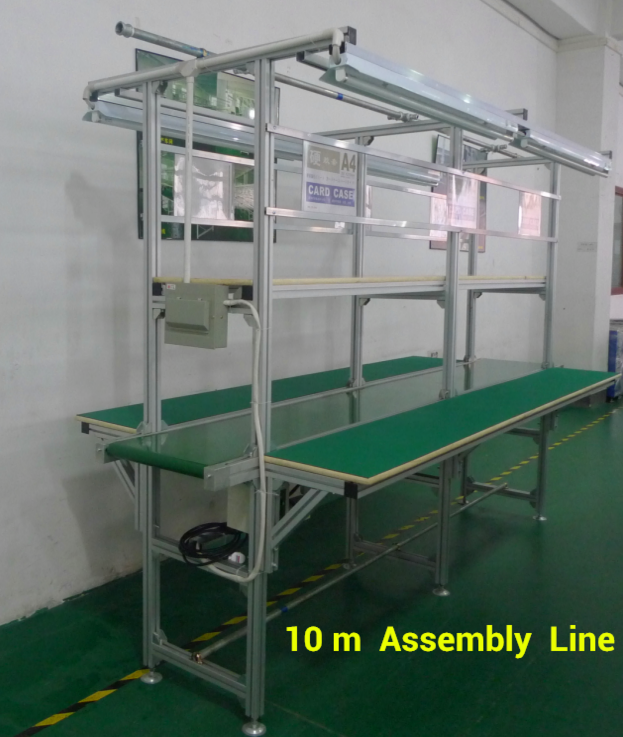
Southern Machinery builds this type of LED bulb assembly line — a modular DIP / manual-insertion PCB assembly line designed around LED bulb and lighting PCBA production. The machine shown in the video below is a 10-meter configuration with anti-static workbenches, an adjustable-speed middle belt, station lighting and power outlets along the line.
Watch: LED Bulb lamp automatic assembly machine — Made in China | Deep dive: 5 Min show you how to assembly LED bulk lamp
What is this machine used for?
The LED bulb assembly line is a DIP (Dual In-line Package) / manual insertion PCB assembly production line for LED bulb and LED lamp boards. Its job is to pace through-hole assembly of LED bulb PCBA: the assembled PCB (often an SMT-processed LED board plus a driver board) is placed on the moving belt and carried past insertion stations where operators fit radial and axial components — electrolytic capacitors, resistors, connectors, and bulk LED components — before the board moves to soldering, testing, and final bulb assembly.
Because it is a line rather than individual benches, work-in-progress moves continuously instead of waiting in piles, and each operator owns one repeatable task instead of assembling a whole board. That is the standard fix for the two biggest costs in DIP assembly: idle motion and defect rework.
Typical Application Scenarios
- LED bulb & retrofit lamp manufacturers — A-line, globe, and reflector lamp PCBA where driver electronics and LED loading dominate the bill of materials.
- LED lighting EMS / ODM factories — mixed-model DIP lines for lighting customers who need traceable, repeatable manual insertion before wave soldering.
- LED driver board assembly — through-hole electrolytic capacitors, bridge rectifiers, and connectors that are impractical to place by SMT alone.
- General lighting and control board assembly — the same conveyor line logic applies to ballast, driver, and lighting-control PCBA.
Southern Machinery also demonstrates the automation layers around this line: bulk LED lamp inserters and bulk LED feeders for the repetitive LED loading step, radial/axial insertion machines for LED board through-hole work, and full SMT lines (pick & place, reflow oven, wave soldering) that feed or follow the DIP stage.
How It Integrates into a Complete PCB Assembly Line
An LED bulb PCBA usually crosses both SMT and THT domains. A typical flow around this line:
- SMT stage — solder paste printing, LED placement (e.g., on aluminum MCPCB), reflow soldering.
- DIP / insertion stage — this line — boards index down the belt to manual or semi-automatic insertion stations for through-hole parts and bulk LEDs.
- Soldering stage — wave soldering for the through-hole joints, or selective/manual touch-up for mixed boards.
- Post-solder — cleaning, inspection, and functional test, then mechanical assembly into the bulb housing.
Because Southern Machinery supplies the surrounding equipment as well — stencil printers, pick & place machines, reflow ovens, wave soldering machines, board handling conveyors, and inspection tools — the LED bulb assembly line can be specified as part of one accountable line, not a collection of mismatched vendors.
Verified Configuration of the 10 m Assembly Line
From the Southern Machinery product page for the LED bulbs assembly line:
- Line length: 10 meters (workstations distributed along the conveyor)
- Driving system: DPG motor speed governor; gear box 120 W / 1:20
- Conveying belt (middle moving belt): green, seamless PVC belt, δ2 × 350 mm; conveying speed 1.0–6 m/min, adjustable via the speed governor; low-noise conveying
- Workbench height: 720 ± 20 mm
- Frame: 38 × 38 mm iron square tube, standard-screw assembly (easy to assemble and disassemble, solid and stable); the middle belt frame uses 40 × 60 mm aluminum alloy square tube to avoid contamination of the electronics
- Anti-static work surface: δ18 mm wood board covered with green anti-static belt, 350 mm wide, running beside the conveying belt
- Station power: square multi-socket outlet at each working position (one outlet per meter)
- Station lighting: energy-saving T5 28 W lights, each with independent control
These figures are the documented configuration of the 10 m line shown on smthelp.com. Your board size, station count, and automation level may differ — Southern Machinery confirms the exact specification against your product mix before building.
Key Selection Parameters
Confirm these with Southern Machinery when quoting an LED bulb assembly line:
- PCB size and belt width — the standard belt is 350 mm wide; conveyor width and board carrier must suit your largest board.
- Station count and line length — number of insertion positions determines staffing and throughput; the line is modular.
- Conveying speed range — 1.0–6 m/min adjustable is the documented standard; the correct pace depends on operator skill and cycle time per board.
- Manual vs automated insertion — decide which steps stay manual (bulk LED loading, odd parts, connectors) and which move to bulk LED feeders or radial/axial insertion machines.
- Soldering hand-off — whether the line feeds a wave soldering machine inline or boards are batched to soldering stations.
- ESD and housekeeping requirements — anti-static bench tops are standard on the documented line; confirm wrist-strap grounding and flooring needs.
ROI, Quality & Throughput Perspective
The business case for a conveyor-paced DIP line is straightforward:
- Throughput: continuous belt transport removes the walk-and-carry cycle between benches. Operators stay at their stations; boards move at a speed set to the line's slowest task.
- Consistency: each operator repeats one operation, so skill requirements drop and defect patterns become visible per station rather than per person.
- Quality: anti-static work surfaces and belt frame materials reduce ESD and contamination risk on sensitive lighting PCBA; low-noise conveying supports a stable production environment.
- Rework savings: defects found at the station where they are made are cheaper to correct than after soldering or final test.
- Scalability: the screw-assembled frame and per-meter power outlets make line extension straightforward when volumes grow — you add stations, not a new line.
When paired with automation (bulk LED inserters, radial/axial insertion, wave soldering), the same line removes the highest-labor through-hole steps, which is where LED bulb manufacturing cost concentrates.
FAQ
Q: What is an LED bulb assembly line used for?
A: It assembles LED bulb and lighting PCBA through a conveyor-paced DIP / manual insertion process: boards travel on a moving belt while operators at fixed stations insert through-hole components before soldering and testing.
Q: Can this line handle both SMT and through-hole LED boards?
A: The line itself is a DIP / manual insertion line for through-hole work. LED bulb PCBA typically runs SMT first (LED placement and reflow), then through-hole insertion on this line, then wave soldering. Southern Machinery supplies all of those stages.
Q: Is LED bulb loading automated?
A: Southern Machinery demonstrates bulk LED feeders and bulk LED lamp inserters for the repetitive LED loading step, alongside radial and axial insertion machines for other through-hole parts. The level of automation is selected per product mix.
Q: What industries use this equipment?
A: LED bulb and retrofit lamp manufacturers, LED lighting EMS/ODM factories, LED driver board producers, and general lighting electronics assembly.
Q: How does automation improve quality versus manual assembly?
A: Automation removes the repetitive, fatigue-prone steps (bulk LED insertion, high-count radial parts), giving consistent placement and polarity while operators focus on the parts that genuinely need human judgment.
Q: Can I see the machine in operation?
A: Yes — the video above shows the LED bulb assembly line running, and Southern Machinery can arrange a working demonstration or customer references on request.
Contact Southern Machinery for Configuration Advice
Southern Machinery Sales and Service Co., Ltd — founded 2011 in Shenzhen, China, serving 237+ customers worldwide with SMT/THT PCB assembly automation equipment and full-line solutions (SMT, THT, wave soldering, board handling, inspection).
Get a configuration and quotation for your LED bulb assembly line:
- Contact: Jason Wu — jasonwu@smthelp.com
- Catalogs & documentation: file.autoinsertion.com
- Machine photos: ph.smthelp.com
- Website: www.smthelp.com
High-efficiency, cost-effective PCB assembly automation with global support, spare parts, and training — from a single accountable supplier.
Comments