
K-Leg Forming for Bulk Capacitors by Southern Machinery
K-leg forming decides whether THT bulk capacitors sit flat through wave soldering. See the die, the tolerance band and the cost per formed part.
Oct 7, 2026 · Updated Oct 7, 2026 · Southern Machinery
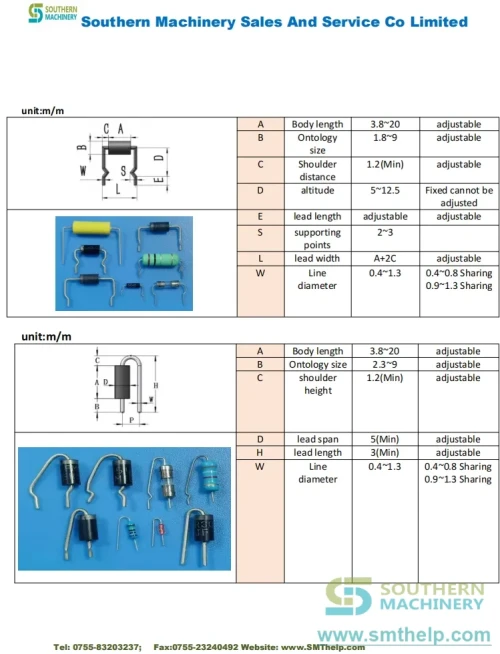
K-leg forming is the fourth forming dimension on a capacitor lead, and on a through-hole line it decides whether the part sits flat on the pad or proud of it. A K-leg is the kinked bend pressed into the lead after the X-direction and Y-direction 90° forms, so the finished leg carries three reference points instead of one. Southern Machinery builds K-leg forming as a dedicated station on the S-EPCOS bulk capacitor lead cutting and forming machine, where the kink comes from a die cut to your capacitor drawing rather than from an operator's wrist.
What is a K-leg on a bulk capacitor lead?
A K-leg is a lead form in which the lead is bent back on itself, so the finished leg carries a kink rather than a straight run to the pad. It is the bend that follows both 90° forms and gives the part its final seated shape.
The documented sequence on the S-EPCOS project machine runs: bulk capacitors loaded into the rail, travel along the vibratory rail, stopper pre-locates the part, manipulator picks the part, part located, lead cutting, X-direction 90° forming, Y-direction 90° forming, K-leg forming, secondary reshaping, discharge to conveyor. The K-leg is step nine of eleven, and the reshaping pass after it removes spring-back from the finished shape.
Why the K-leg has to be its own station
The machine separates front and rear bending, a dedicated K-leg station and a reshaping station. Splitting the bends across stations keeps each dimension independent: the X bend holds only its angle, the Y bend only its own, and the K-leg only its depth. Forming all three in one pass would couple them, so a correction to one dimension moves the other two.
K-leg formed in a die vs a K-leg formed by hand
- Reference surfaces. A K shape has three reference points; a hand jig typically constrains only one.
- Repeatability. One lever in two pairs of hands gives two interleaved populations. The averages agree; the parts do not.
- What you see. Hand-formed parts pass incoming inspection on average and are rejected one at a time at the insertion machine.
- Where tolerance lives. In a die it is a property of geometry. On a lever jig it is a property of attention.
The defect a wrong K-leg produces
The published comparison is blunt: get the K-leg slightly wrong and the part sits proud of the board, and the wave solder bridges it.
How do you measure a K-leg and hold its tolerance?
Five minutes at the start of a shift, one formed part, five measurements on a card that lives on the machine: cut length, bend-to-bend distance, leg angle, K-leg depth and overall envelope. If any figure has moved by more than a third of its tolerance, stop and look before running the batch.
On the S-EPCOS customer drawing the figures the die has to hold are:
- Bend radius (2×) — R 1.3 mm
- Outer radius — R 0.5 mm max
- Leg angle — 10° ±0.5°
- Formed height — 12.11 ±0.2 mm
- Formed offset — 5.82 ±0.2 mm
- Body envelope — Ø 18.5 mm max
These come from the capacitor drawing supplied with the enquiry, not a catalogue shape, which is why a drawing change is a die change and nothing else. To settle a drift argument, measure the same dimension on twenty parts from each operator and plot two groups: separated groups mean the fixture is the cause, and an overlapping pair with too wide a spread means the fixture still is.
Where does K-leg forming sit in a PCB assembly line?
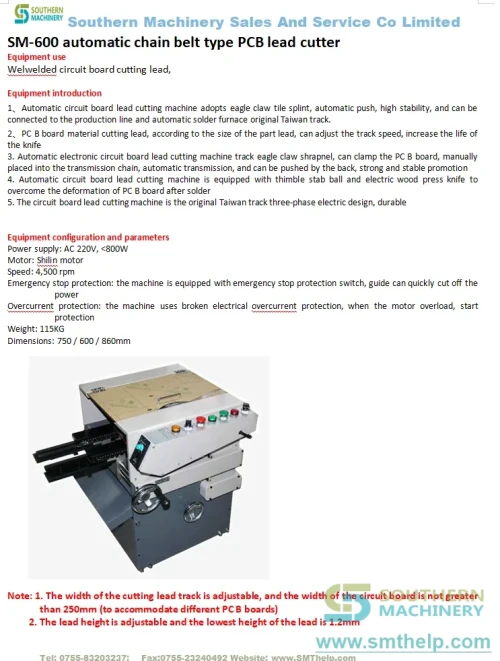
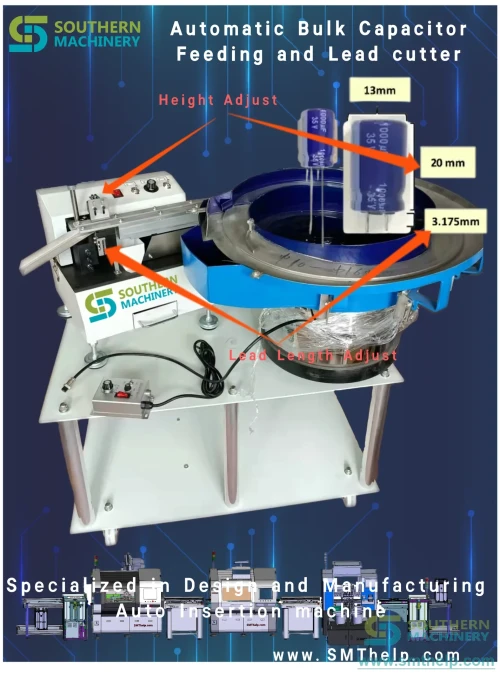
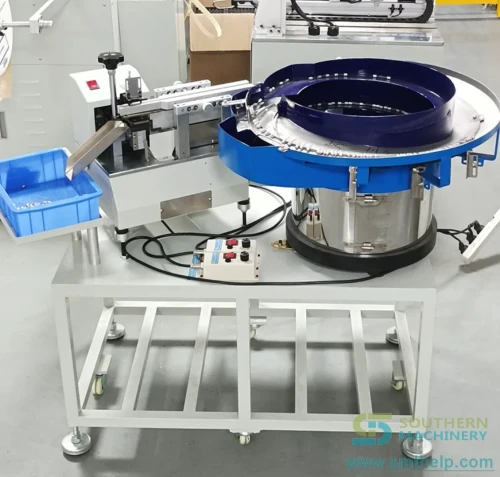
The machine is a rotary-disc indexer assembled from four parts — main machine, vibratory feed rail, cabinet and control system — running as one pass with no re-handling. The loading structure feeds a vibratory bowl with automatic alignment and a material sensor; a cutting station with upper and lower dies and a scrap chute cuts the lead as a discrete step; the forming station carries front and rear bending, the K-leg station and the reshaping station; and a feed conveyor takes finished parts to a tray, so the operator who keeps the bowl supplied is not also sorting output.
Formed parts then feed the through-hole insertion and soldering stages. Southern Machinery supplies the wider line too — axial and radial insertion, odd-form placement and the wave soldering stage — so a forming machine can be specified against the stations on either side of it. The full range is listed under THT machines.
What should you specify in an RFQ for K-leg forming?
- The forming drawing — K-leg depth, leg angle, formed height, formed offset.
- The body envelope — the S-EPCOS project drawing caps it at Ø 18.5 mm.
- Packaging — this family is specified for loose bulk capacitors; taped radial parts use a different machine.
- Monthly quantity and shift pattern, so the rate becomes a shift plan rather than a brochure figure.
- Site conditions — AC 220 V ±10% at 50 Hz, compressed air, and floor space for roughly 1,800 × 1,200 mm at about 1,900 mm high.
One caution: the technical agreement states an air supply of 5–7 MPa, far outside normal workshop practice for this class. Southern Machinery publishes it as to be confirmed and will not ship against a guess.
What does a formed-in-die K-leg change in cost and yield?
The honest comparison is cost per finished part, not cost per capacitor:
forming labour / piece   = loaded hourly wage ÷ parts finished per operator per hour
rejection cost / piece   = material cost per piece × reject rate ÷ yield
cost per finished part   = material + forming labour + rejection cost
payback (simplified)     = machine price ÷ annual freed bench labour
The simplified payback ignores the rejection cost the die removes, the rework a lever bench causes and the value of the extra capacity, so treat it as a floor rather than a forecast.
The one published planning datum is the machine rate of about 1,000 pieces an hour from the S-EPCOS technical agreement: about 8,000 parts for one attended 8-hour shift, about 16,000 for two, about 416,000 in a 26-day two-shift month before derating, and about 312,000 with a 75% derating applied. That derating is an illustration, not a promise, and the rate is a machine rate while the machine is running — derive your own factor from bowl refill, die change and board supply, then keep it constant. Example only, depends on configuration and subject to final technical confirmation: a bench finishing a few hundred large capacitors per operator-shift is exactly the case where the labour term starts to dominate.
Is a machine or a bench the right answer?
Below a few thousand pieces a month the manual bench is genuinely cheaper, and the S-EPCOS documentation says so. Above it, the labour term dominates and the arithmetic flips. The useful threshold is your volume, your loaded wage and your reject rate.
Founded in Shenzhen in 2011, Southern Machinery designs and manufactures SMT and THT automated assembly equipment and supports lines worldwide with spare parts, retrofit, training and overhaul. Machine data here comes from the S-EPCOS technical agreement and part dimensions from the customer's capacitor drawing, with disagreements between the two published rather than averaged away.
FAQ
What exactly is a K-leg on a capacitor lead?
A kinked lead form — a bend pressed back on itself so the finished leg has three reference points, formed at a dedicated station after the X and Y 90° forms and before the secondary reshaping pass.
Which station forms the K-leg on the S-EPCOS machine?
Step nine of the eleven-step documented sequence, at its own station inside the eight-station indexer. The reshaping station that follows removes spring-back from the finished shape.
Is the K-leg tolerance a guaranteed figure?
The bend radius, outer radius, leg angle, formed height, formed offset and body envelope here are read from one customer's capacitor drawing. They are the reference the die is cut to, not a catalogue tolerance.
How fast does it run, and how many operators does it take?
The agreement quotes about 1,000 pieces an hour with manual bowl loading and a material sensor, so one operator keeps the bowl supplied while the indexer cuts and forms. Confirm the rate against your own board supply.
Can the machine form a different capacitor later?
Yes, with its own die set and bowl tooling. The die and the bowl are the two items that touch the capacitor, and both are made to your drawing and body envelope.
What does the machine need on site?
AC 220 V ±10% at 50 Hz, compressed air, roughly 1,800 × 1,200 mm of floor and about 1,900 mm of height for a machine of about 190 kg, with access to the bowl, the tooling and the scrap chute.
Send a drawing and twenty formed parts
If a K-leg is drifting on your bench, the fix is a measurement before it is a machine. Send a photograph of your forming drawing and twenty formed capacitors to info@smthelp.com: Southern Machinery will measure the spread across the five critical dimensions and tell you which one is most likely to move first on your part. Feasibility runs, die design from your drawing, installation and commissioning, and replacement die sets cut to the same drawing are all part of the service.
Comments