
JUKI SMT Pickup Nozzle Selection Guide by Southern Machinery
JUKI pickup nozzle selection by bore, part revision and wear trend: match the tip to your component width and cut mis-pick recovery time on the line.
Oct 7, 2026 · Updated Oct 7, 2026 · Southern Machinery
JUKI SMT Pickup Nozzle Selection Guide by Southern Machinery
JUKI SMT pickup nozzles are the vacuum, slot, gripper and pipe tips that let a JUKI mounter pick a component and carry it to the board. The tip is the only part of the placement cycle that touches the part, so its bore, material and wear set pick quality before any machine parameter does. Southern Machinery designs and manufactures them in Shenzhen — standard 500 and 700 series tips plus odd-form slot, gripper and pipe types — matched to the component you actually place.
Why is the nozzle the first thing to check on a JUKI mis-pick?
The tip decides, not the machine
Two boards can come off the same feeder, the same program and the same head, and one skips 0402s while the other runs clean. The variable is almost always the tip: the wrong bore for the component width, a worn edge, or a nozzle that was never meant for that part. Work the failure from the tip outward — confirm the nozzle against the component width band, inspect the tip edge under magnification, then check vacuum level and pickup height. Only after those three steps does a machine vendor visit make sense.
Wear is a throughput number, not a spare-parts number
A worn tip does not stop the machine; it makes the machine retry. Each retry costs a fraction of a second, and a rising mis-pick rate across thousands of picks a shift is line rate you have already sold as delivered capacity — invisible until someone asks why the line is slow.
How do you select a JUKI nozzle from the bore table?
Outer bore, inner bore and applicable width do three different jobs
Outer bore is the contact diameter that sits on the part. Inner bore is the vacuum opening that seals against the body. Applicable component width is the catalogue's own answer to "what part is this tip for" — the column to select from when you have a component drawing. A buyer who matches only the outer bore picks a tip that covers the part but cannot hold it.
The published JUKI bore bands
Reproduced from the JUKI Nozzle Application Catalogue (Rev C) as printed, subject to final technical confirmation against your component and head:
- 501 — outer 0.7 mm, inner 0.4 mm, width under 0.45 mm
- 502 — outer 0.7 mm, inner 0.4 mm, width 0.45 to 0.75 mm
- 503 — outer 1.0 mm, inner 0.6 mm, width 0.75 to 1.45 mm
- 504 — outer 1.5 mm, inner 1.0 mm, width 1.1 to 2.5 mm
- 505 — outer 3.5 mm, inner 1.7 mm, width 2.5 to 4.0 mm
- 506 — outer 5.0 mm, inner 3.2 mm, width 4.0 to 7.0 mm
- 507 — outer 8.5 mm, inner 5.0 mm, width 7.0 to 10.0 mm
- 508 — outer 9.5 mm, inner 8.0 mm, width 10.0 mm and up
- 101 (700 laser) — outer 1.0 mm, inner 0.4 mm, width under 1.1 mm
- 106 (700 laser) — outer 9.5 mm, inner 8.0 mm, width 10.0 mm and up
- Gripper nozzles — gripping range 0.8 to 5.2 mm, arm 2.8 to 5.8 mm, for bulky or polarised parts
Across the published families, standard tip outer bores run from 0.7 mm to 9.5 mm and inner bores from 0.2 mm to 8.0 mm. One disclosed conflict is worth carrying: Rev C prints a 1.5 mm outer bore for nozzle 504 while some Southern Machinery reference tables list 1.6 mm for the same tip, a 0.1 mm difference that changes the seal on a small body.
Which JUKI mounters do these nozzles fit?
500 series on the 2000 and FX-1 heads
The 501 to 508 tips serve the KE-2010, KE-2020, KE-2030, KE-2040, KE-2050, KE-2060 and FX-1 heads, published from 0.7 mm to 9.5 mm outer bore.
1xx and 2xx on the 700 series
On the 700 series (730, 740, 750, 760), the 101 to 106 tips run laser-alignment heads and 201 to 204 the vision-alignment heads, sized 1.0 mm to 9.5 mm outer. The catalogue states applicable component width for the 1xx family but marks it "not stated" for the 2xx vision rows, so those widths need confirming against your part.
The two 500-series revisions
The same nozzle type number can be two different parts. The catalogue lists an original E36xx7290A0 revision and a new 40011046 / 40001339 revision: the original fits the whole KE-2010 to KE-2060 and FX-1 range, while the new revision fits KE-2050, KE-2060 and FX-1 and is not compatible with the earlier KE-2010 to KE-2040. Specify by part revision, not by type number. Southern Machinery also lists a RES-1 serial nozzle family, types 7501 to 7508 — a Southern Machinery family label, so confirm the machine mapping.
When should a vacuum tip become a slot, gripper or pipe nozzle?
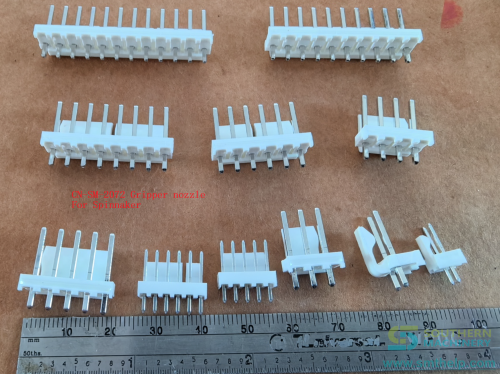
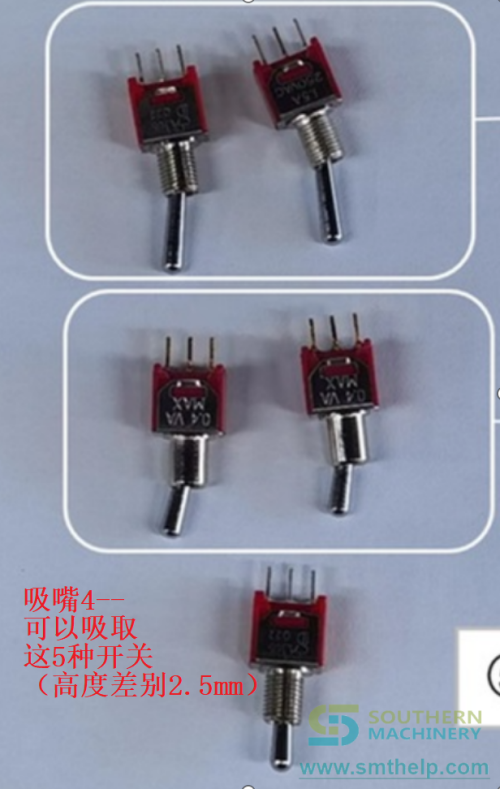
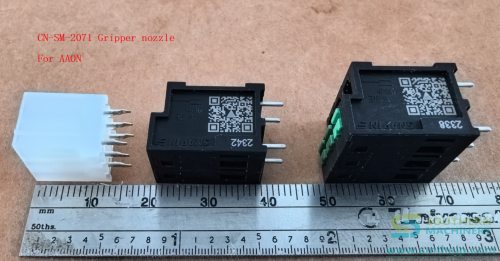
Answer four questions in order. Can a vacuum seal form on a flat face? If yes, stay on a vacuum tip. Does the part have leads you can straddle and a body the slot walls can grip? Then it is a slot nozzle. Is it bulky or polarised and does it need clamping rather than suction? Then it is a gripper, checked against the published 0.8 to 5.2 mm range. Is it a large body, socket or shield lifted without a reliable seal? Then it is a pipe nozzle with interchangeable rubber tips. Slot, gripper and pipe families are catalogued for both the 700 and 2000 groups, so the choice is a lookup against part geometry. Where no standard tip fits, Southern Machinery machines a custom nozzle to your drawing, built to the standard slider shaft and Automatic Tool Changer.
What does nozzle wear cost a line?
Wear shows up as recovery time, not as a spare-part invoice. A simple model, worked from your own numbers:
recovery seconds per board = mis-picks per board x recovery seconds per mis-pick
handling hours released per month = (worn-nozzle recovery - matched-nozzle recovery) x boards per day x production days / 3600
labour released per year = handling hours released per month x 12 x wage per operator
Example — depends on configuration, subject to final technical confirmation: a plant running 2,000 boards a day over 22 days, where clearing a mis-pick falls from 90 seconds on a worn nozzle to 30 seconds on a matched one, at two mis-picks per board, releases roughly 733 handling hours a month, about 24 operator hours per working day. Enter your own numbers first; if the matched-nozzle recovery is not shorter, the model returns nothing rather than a saving. The Southern Machinery decks quote a 99.99 percent pickup rate and a service life of more than 24 months — manufacturer claims, not catalogue figures, to be treated as targets.
How do these nozzles fit into a complete PCB assembly line?
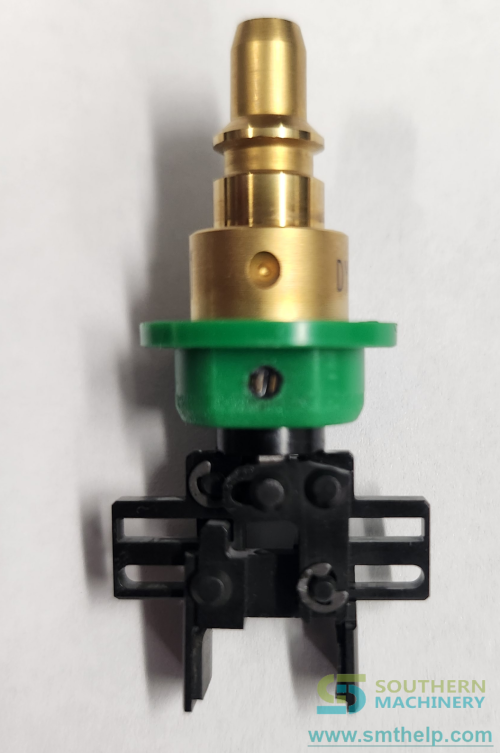
Nozzles are a consumable in the SMT placement stage, specified alongside the rest of the line: SMT placement and printing equipment, the THT insertion machines that place odd-form parts a mounter cannot touch, board handling between stations, and PCB depanelizing after assembly. Build the spares kit from your last quarter of board programs — the component widths you actually place, mapped to catalogue bands — then add the odd-form layer and log each tip against its part number. Southern Machinery, founded in Shenzhen in 2011 and serving 237+ global customers, supplies nozzles, feeders and insertion equipment from one shop. Machine and photo libraries: file.autoinsertion.com and ph.smthelp.com.
Which JUKI machines do these nozzles fit?
The 500 series is mapped to the KE-2010, 2020, 2030, 2040, 2050, 2060 and FX-1 heads, and the 1xx and 2xx families to the 700 series. Confirm your exact head and firmware before ordering.
What tip sizes are available?
Standard outer bores run from 0.7 mm (501 and 502) to 9.5 mm (508 and 106), with inner bores from 0.2 mm to 8.0 mm.
What are the nozzles made of?
The catalogue states a copper-alloy body and tip, polyurethane cups on fine-pitch tips and interchangeable rubber tips on pipe nozzles.
Is the 500-series part number interchangeable with an older machine?
Not always. The original E36xx7290A0 fits KE-2010 to KE-2060 and FX-1; the new 40011046 / 40001339 revision fits KE-2050, KE-2060 and FX-1 only.
Can Southern Machinery make a custom JUKI nozzle?
Yes — including slot, gripper and pipe types and a JUKI CN-SM-2713 custom part, built to the standard slider shaft and Automatic Tool Changer.
What lead time and pickup rate can I expect?
The decks quote one week for standard types and 99.99 percent pickup; a design note separately states two to four weeks for custom builds. Treat both as targets and confirm on your component.
Send the component, not just the part number
Tell Southern Machinery the part, the machine and the monthly volume, and you will get the nozzle that fits — including when the honest answer is a custom tip. Ask for a pick test on your own part and for the drawing the bore is quoted against. Send your nozzle list or component drawing to info@smthelp.com or WhatsApp +86 13602562576 to start a component trial.
Comments