
In-Line PCBA Cleaner TCO: SME-6300 by Southern Machinery
In-line PCBA cleaner total cost of ownership: SME-6300 utility load, DI water and throughput data, plus a payback method using your own numbers.
Oct 7, 2026 · Updated Oct 7, 2026 · Southern Machinery
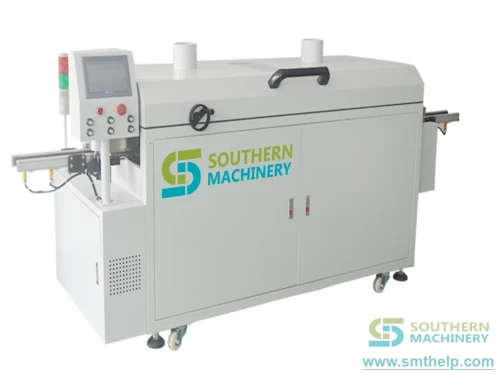
An in-line PCBA cleaner is bought for repeatable cleanliness after soldering, but it is paid for every month in electricity, compressed air, DI water and chemistry. The Southern Machinery SME-6300 is a nine-section, one-pass spray cleaner for boards up to 500 × 400 mm, and its 2021 manual and installation layout document publish the figures a plant engineer needs for a total cost of ownership model: about 110 kW connected load, 200–400 L/min of compressed air, 10–15 L/min of ≥ 10 MΩ rinse water, and 40 to 100 boards per hour by speed and pitch.
What does an in-line PCBA cleaner cost to own before labour?
Total cost of ownership for an in-line PCBA cleaner splits into four lines: the machine itself, the utility load it draws, the consumables it consumes, and the bench labour it removes. The SME-6300 documents the first three in its installation layout guide and lets you model the fourth with your own wage figures — the product document states it supplies a method, not a quotation.
The utility load you must plan for
The installation layout document defines six items your floor must supply before commissioning, and three of them are recurring cost:
- Power — AC 380 V / 50 Hz, three-phase five-wire, 70 mm² phase conductors, a 250 A distribution box beside the machine, and a total connected load of about 110 kW.
- Compressed air — 0.5–0.7 MPa of dry clean air at 200–400 L/min on a Φ12 mm main line; the air knives and the blow-dry sections run on it continuously.
- DI water — one 1-inch inlet at ≥ 0.3 MPa delivering 10–15 L/min of ≥ 10 MΩ water, with an optional 1000 L/h DI processor if you do not already make DI water.
The document names the main consumers inside that figure: a 36 kW wash heater, a 5.5 kW SUS304 wash pump, a 10 HP chemical-isolation blower driving three air knives, and a 7.5 HP class blow-dry blower. Connected load is not the running figure, so build each utility line as a formula rather than a single number:
Annual energy cost (example method) = connected load in kW × load factor × operating hours per year × your electricity tariff in $/kWh
Annual compressed-air cost (example method) = air drawn in m³/min × operating hours per year × your compressor specific power in kW per m³/min × your electricity tariff
Annual DI water cost (example method) = litres per hour drawn × operating hours per year × your cost per litre of DI water
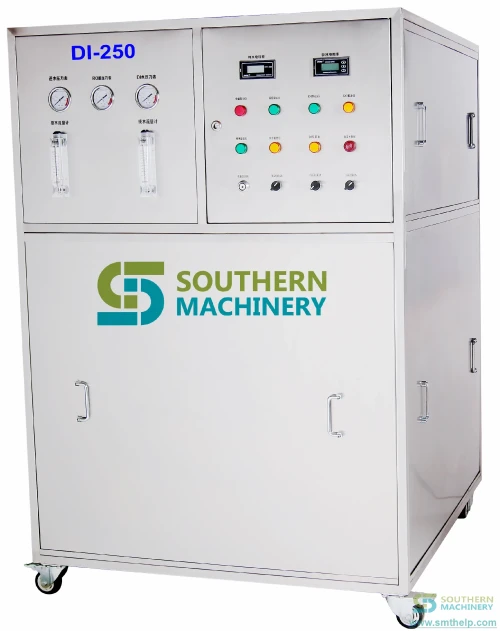
The load factor is the variable a quotation cannot give you, because it depends on how long your heater, pumps and blowers actually run against your board mix. Treat every figure above as example / depends on configuration / subject to final technical confirmation.
DI water and chemistry: the recurring consumables
Two design choices in the SME-6300 exist specifically to stretch consumable life, and both are quoted from the 2021 manual:
- The 240 L wash tank recirculates through steel filter nets plus a 1 µm filter barrel, so solder balls and particles stay out of the spray rather than shortening nozzle life.
- The chemical-isolation air knives return wash liquid from the board back into the tank instead of letting it leave on the board.
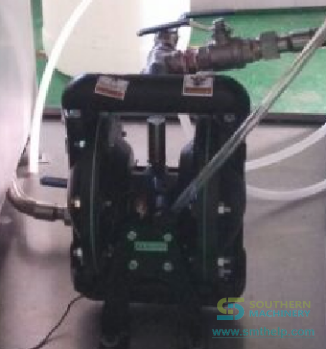
Cleaning liquid is dosed automatically at set intervals by a standard diaphragm-pump system, and the rinse tanks are refreshed by staged overflow from the final rinse rather than by raw consumption. Chemistry consumption depends on flux load and board throughput — it is not specified in the source document, so contact Southern Machinery to confirm a figure for your product mix.
What throughput can an in-line PCBA cleaner actually deliver?
Capacity is a division, not a promise
An in-line cleaner is paced by its conveyor, so capacity is machine speed divided by the pitch you keep between boards. Pitch is board length plus a safe gap. The SME-6300 document supplies this comparison, calculated from the manual at recommended speeds:
- 0.2 m/min — 40 boards/hour at 300 mm pitch, 27 at 450 mm, 20 at 600 mm
- 0.3 m/min — 60 boards/hour at 300 mm pitch, 40 at 450 mm, 30 at 600 mm
- 0.4 m/min — 80 boards/hour at 300 mm pitch, 53 at 450 mm, 40 at 600 mm
- 0.5 m/min — 100 boards/hour at 300 mm pitch, 67 at 450 mm, 50 at 600 mm
The conveyor spans 0.1–1.5 m/min with 0.2–0.4 m/min recommended, and the wash, rinse and dry sections hold full dwell time anywhere in that range. Your real number comes from the slowest upstream process — the cleaner follows the line, it does not set it.
How do you calculate payback on an in-line PCBA cleaner?
The payback formula the machine documents
The product document gives one deliberately simple method:
Simple payback in years = machine price ÷ annual freed bench labour
Annual freed bench labour = operators released × loaded wage in $/h × working hours per day × working days per month × 12
A worked example
Example only — depends on configuration and subject to final technical confirmation. The document supplies no prices; every input below is yours to replace:
- Operators the line frees up — 3
- Loaded wage per operator — $9/h example
- Working pattern — 8 h/day, 22 days/month
- Annual freed bench labour — 3 × 9 × 8 × 22 × 12 = $57,024
- Machine price used for illustration — $60,000 example
- Simple payback — 60,000 ÷ 57,024 ≈ 1.05 years
That result sits close to the document's own statement that factories with two or three bench operators usually find the machine pays back inside the first year on labour alone.
What the simple formula leaves out
The document is explicit that its calculator handles only the labour half. Simple payback ignores rework savings, scrap savings and the cost of line stoppage while boards queue for a bench — all of which shorten the real number. Use it as a floor, not a forecast.
How does an in-line cleaner fit a complete PCB assembly line?
The SME-6300 is designed to sit on the conveyor between soldering and test rather than as a standalone station.
- Footprint — L 5200 × W 1650 × H 1650 mm, with a conveyor height of 900 ± 25 mm to match standard line height, and a recommended floor plan of L 8000 × W 4000 × H 2500 mm for service access.
- Direction and handling — boards travel left to right on a SUS304 net conveyor with EMG stops and board-detection sensors, so loaded boards index predictably into the wash sections.
- Power-loss behaviour — a UPS keeps the net conveyor running so loaded boards exit the heated sections safely if power drops.
- Line partners — the cleaning step normally follows a wave soldering machine and feeds test through board handling systems; Southern Machinery configures the whole PCB assembly line, and the wider PCB cleaning machine range covers batch, stencil and fixture cleaning.
- Traceability — an optional MES interface logs each cleaned board with recipe, temperatures and alarms, which matters for automotive and medical EMS customers who must prove the process step happened.
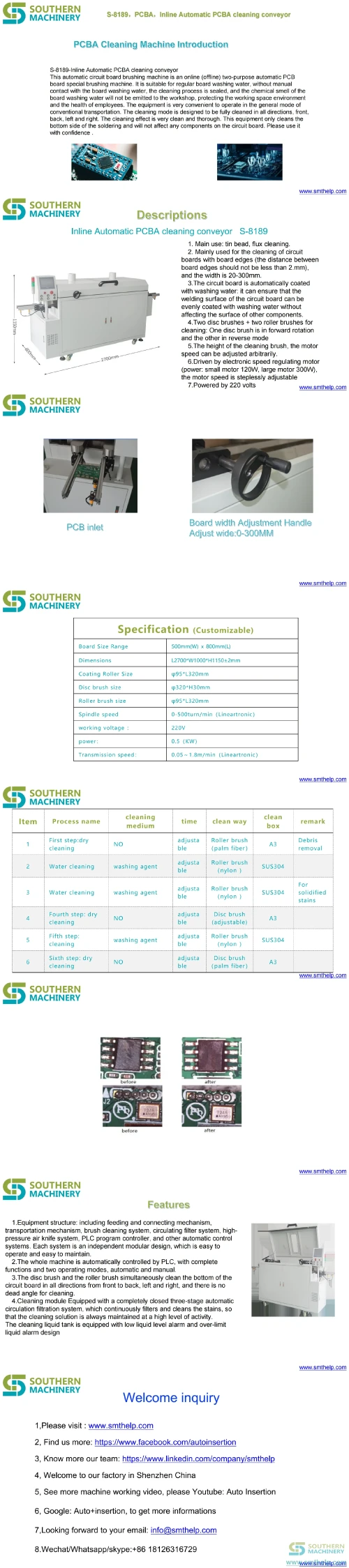
Machine specifications, layout drawings and the manual are published in the Southern Machinery machine catalogue.
FAQ: in-line PCBA cleaner cost and specification questions
How much electricity does an in-line PCBA cleaner need?
About 110 kW total connected load on AC 380 V / 50 Hz three-phase five-wire, with a 250 A distribution box and 70 mm² phase conductors, per the installation document. That is the connected figure; running consumption depends on duty cycle and must be confirmed against your board mix.
How much DI water does it consume?
One 1-inch connection at ≥ 0.3 MPa delivering 10–15 L/min of ≥ 10 MΩ water. The machine monitors incoming resistivity live on a 0–18 MΩ·cm meter and alarms if quality drops, and staged overflow reuse refreshes the rinse tanks rather than using raw water.
What does the cleaning chemistry cost per board?
Not specified in the source document — contact Southern Machinery to confirm. The manual states water-based cleaning liquid is dosed automatically at set intervals and that consumption depends on flux load and board throughput, so the number has to be modelled with your products.
Does an in-line cleaner remove an operator?
The document states one person loads the line at the start of the shift and the machine completes the chemistry unattended. The scrubbing benches whose operators must reach every shadow zone are the labour the payback formula credits.
What board sizes can the SME-6300 clean?
Boards up to 500 × 400 mm measured as width × recommended length, across the nine documented sections from pre-wash to hot-air dry.
Can cleaning be logged as a production record?
Yes — an optional MES interface logs every cleaned board with the recipe used, temperatures held and alarms raised. The English operator interface is also a factory option.
Next step: model your own numbers
Send board dimensions, component height, flux type, takt time, utility tariffs and your line layout to info@smthelp.com or WhatsApp +86 13602562576. Southern Machinery returns a configuration sheet with conveyor speed, tank and heater settings sized to your products — usually within one working day, with sample cleaning available before you commit. Shenzhen Southern Machinery Sales and Service Co., Ltd. has supplied SMT and THT assembly and cleaning equipment to EMS factories on six continents since 2011, backed by spare parts, retrofit, training and overhaul for 237+ global customers.
Comments