
In-Line Circuit Board Test Machine: Automated Component Verification for SMT PCB Assembly
Automate in-line impedance measurement and visual mounting verification of chip resistors and capacitors, catching wrong-value and mis-mounted parts.
Sep 22, 2026 · Updated Sep 22, 2026 · Southern Machinery
In-Line Circuit Board Test Machine: Automated Component Verification for SMT PCB Assembly
A printed circuit board can pass paste inspection, survive reflow and still be wrong. A 10 kΩ resistor can be loaded where the bill of materials calls for 1 kΩ. A chip capacitor can be rotated 180°, placed on the wrong pads, or drawn from a reel that was mislabelled at incoming inspection. Optical systems see a component sitting in the right place; they cannot tell you whether its value is correct.
The High Speed In-line Circuit Board Test Machine from Southern Machinery closes that gap. It combines automatic impedance measurement of chip components with a visual mounting check, so the electrical identity and the physical placement of every chip resistor and capacitor are verified together — inside the line, not in a separate laboratory.
What is an in-line circuit board test machine used for?
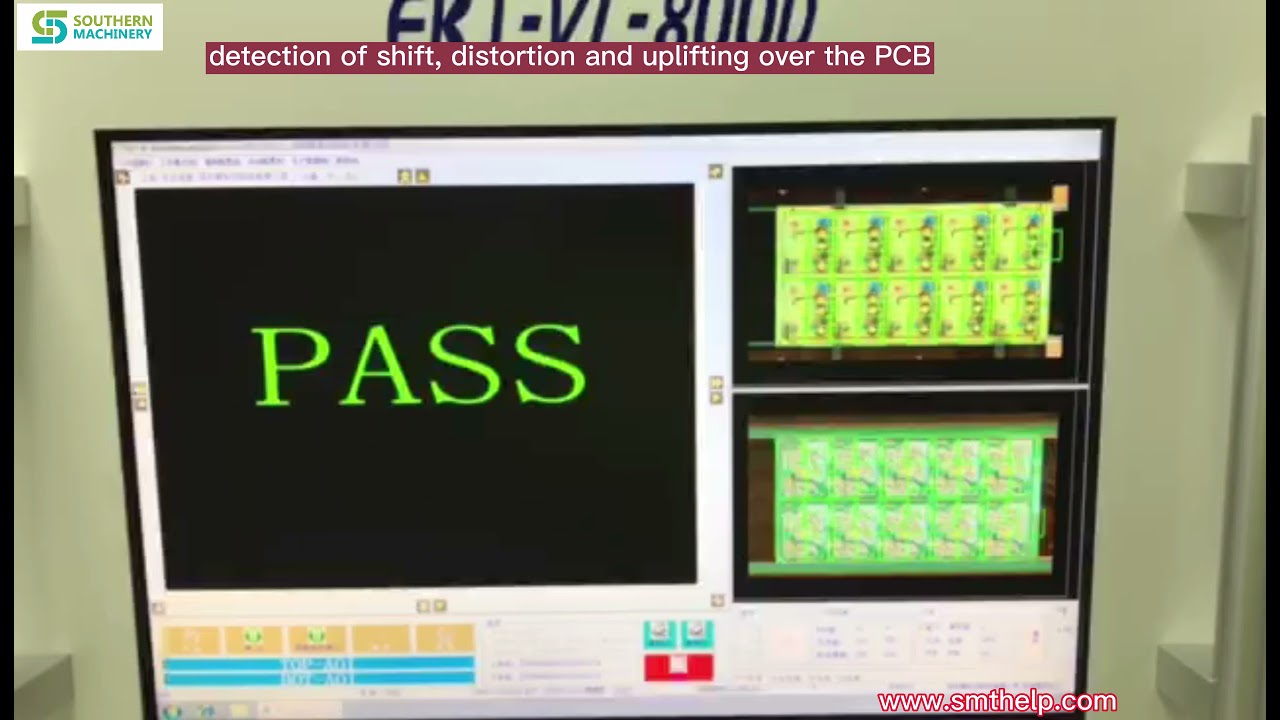
It is used to verify that the chip resistors and capacitors actually mounted on a PCB match the board's mounting data and component list. The machine performs automatic impedance measurement and judgment on each chip component, and at the same time presents a visual inspection view of the mounted board on the operator monitor so that mounting status can be confirmed component by component — including orientation, size, and alphanumeric characters such as part markings and typo descriptions.
The output is both a pass/fail judgment and a stored test record: the machine automatically generates test data from the mounting data and component list, and automatically records test results for data management and quality reference.
In practice, an EMS or OEM factory uses it in two places:
- Pilot run and production setup — detecting mounting faults on the pilot run PCB within a short period, so the line can be released with confidence and the changeover completed faster.
- Volume production — preventing defective boards from being produced and passed downstream, which is how it contributes to productivity improvement on the PCB mounting line.
How the machine verifies components
Automatic impedance measurement and judgment
The machine measures the impedance of mounted chip resistors and capacitors and judges each reading automatically. This is an electrical check on the component that is physically on the board — the only way to confirm that the value loaded matches the value required.
Visual mounting status verification
Alongside the measurement, the machine incorporates a visual inspection function that allows mounting status checks on each component on the operator monitor. That view is used to confirm placement characteristics such as alphanumeric character descriptions, orientation and size — the failure modes that impedance measurement alone cannot describe, and that a purely optical system cannot judge electrically.
Automatic test data generation and recording
Test data is generated from the mounting data and component list rather than being keyed in by hand, and test results are recorded automatically. Those records support data management and act as quality references — useful evidence when a customer asks how a specific lot was verified, and useful input when a line is being re-qualified.
Board test-area sizes
The desktop model is offered in three test areas, so the right format can be matched to the panel sizes a factory actually runs:
| Model variant | Test area |
|---|---|
| Medium size | 330 mm x 250 mm |
| Large size | 510 mm x 380 mm |
| Extra Large size | 530 mm x 460 mm |
Both English and Chinese versions of the machine software are available.
Where it fits in a complete SMT/THT assembly line
The machine is an in-line station, so it sits in the flow rather than beside it. A typical Southern Machinery line runs:
Stencil printing → SPI → SMT pick and place → Reflow oven → AOI → THT auto insertion (radial, axial, odd-form, terminal) → Wave or selective soldering → PCBA cleaning → in-line circuit board test → depaneling → board handling and magazine unloading.
Positioning the test station in-line means a board that fails component verification stops there, before it consumes wave soldering time, cleaning chemistry, depaneling capacity or manual rework. In a mixed-technology factory, that matters most on boards where THT insertion follows SMT reflow and a single wrong chip value is expensive to find late.
For factories building a full line from one supplier, Southern Machinery covers the rest of the sequence as well — stencil printing, wave and selective soldering, auto insertion, board handling, cleaning and inspection — plus spare parts, retrofit kits, training and overhaul support.
Typical application scenarios
- EMS / contract manufacturing — high-mix, high-changeover production, where the pilot run has to be verified quickly before a line is committed to volume.
- Automotive electronics — assemblies where an incorrect passive value is a functional-safety and warranty exposure, not just a rework cost.
- Medical electronics — low-volume, high-criticality boards where traceable test records carry weight with auditors and customers.
- Industrial control and power electronics — dense mixed-technology boards combining SMT passives with THT components, where mistakes surface late in the process.
- Consumer and appliance electronics — high-volume boards where a small reduction in downstream rework pays back quickly.
How it differs from AOI, SPI and X-ray counters
These are complementary tools, and confusing them leads factories to buy the wrong one.
- SPI (solder paste inspection) checks the paste deposit before components are placed.
- AOI (automated optical inspection) checks appearance — presence, position, solder joint shape — but judges components optically, not electrically.
- X-ray component counters verify the quantity of parts on a reel, for inventory and kitting accuracy.
- An in-line circuit board test machine verifies the electrical value and mounting status of the components that are already on the board.
A factory running AOI may still ship a board with a correct-looking but wrong-value resistor. That is the specific gap this machine is built to close.
Key selection parameters to confirm before quotation
Because board sizes, component mix and line interfaces vary widely between factories, configuration is confirmed per project. The parameters worth settling early:
- Board and test-area size — which of the three test areas matches your panel dimensions, or whether a custom area is needed.
- Component coverage — the chip resistor and capacitor sizes and values present on your boards.
- Line position and interface — where the station will sit, and how it connects to the upstream and downstream conveyors.
- Production volume and changeover frequency — how often programs are switched, which determines how much the automatic test-data generation is worth to you.
- Data and traceability requirements — what test records need to be retained, and in what format.
- Software language — English, Chinese, or both.
Southern Machinery confirms the final configuration against your actual boards and process rather than quoting a generic unit.
ROI: quality, throughput and traceability
Three levers drive the payback:
- Rework and scrap avoided. Catching a wrong-value or mis-mounted passive at the test station removes it from the wave soldering, cleaning and depaneling queues — and removes the far more expensive case where it reaches a customer.
- Faster production setup. Detecting mounting faults on the pilot run PCB within a short period compresses changeover, which is where high-mix factories lose the most capacity.
- Quality records. Automatically recorded results replace a manual log, giving quality and engineering teams traceable evidence instead of a signature on a clipboard.
For a line already running wave soldering and inspection equipment, this station is usually the missing electrical check between "the board looks right" and "the board is right."
Frequently asked questions
What does an in-line circuit board test machine measure?
It performs automatic impedance measurement and judgment of mounted chip resistors and capacitors, and combines that with a visual inspection function for mounting status checks on each component.
Can it replace AOI?
No. AOI inspects appearance optically; this machine verifies component values electrically and confirms mounting status. Most factories run both, because the failure modes they catch are different.
Where in the SMT line should it be installed?
It is an in-line station, typically placed after soldering and cleaning and before depaneling, so that failed boards are removed before they consume further process time.
What board sizes are supported?
The desktop model offers three test areas: 330 mm x 250 mm, 510 mm x 380 mm, and 530 mm x 460 mm. Southern Machinery confirms the right format against your panel dimensions.
How is test data set up?
Test data is generated automatically from the mounting data and component list, and results are recorded automatically for data management and quality reference.
Is the software available in English?
Yes — both English and Chinese versions are available.
Next step
If your line already has SPI and AOI but you still find wrong-value passives downstream, an in-line circuit board test station is the missing electrical check.
Contact Southern Machinery (Shenzhen, China — founded 2011, serving 237+ global customers) for configuration advice based on your boards and process. We cover SMT and THT PCB assembly automation end to end: insertion machines, wave and selective soldering, board handling, cleaning, inspection, spare parts, retrofit kits, training and overhaul.
- Browse the machine catalog at file.autoinsertion.com
- See machine photos at ph.smthelp.com
- Email jasonwu@smthelp.com or call +86 13602562576 — Jason Wu
Comments