
How to Size an SMT/THT Line Before Requesting a Quotation
A practical checklist for EMS and OEM teams to estimate PCB assembly line capacity before buying SMT/THT automation equipment.
Jun 30, 2026 · Updated Jun 30, 2026 · Southern Machinery
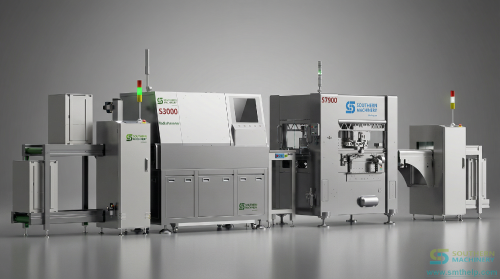
How to Size an SMT/THT Line Before Requesting a Quotation
A good quotation starts with a clear production target. Before selecting machines, Southern Machinery normally confirms four points: product type, output target, PCB size and component class, then automation and budget level.
1. Start With the Output Target
Convert monthly demand into boards per hour. For example, 60,000 boards per month at 22 working days and 2 shifts means roughly 170 boards per hour before adding line balance and changeover margin.
2. Separate SMT and THT Work
A complete line usually includes stencil printing, pick-and-place, reflow, optional SPI/AOI, then THT insertion and wave or selective soldering. Treat each process as a capacity gate, not as isolated machines.
3. Match Equipment Class to Product Mix
For high-mix products, flexibility and changeover speed matter more than headline CPH. For high-volume stable products, placement speed, board handling, inspection, and soldering capacity become the main ROI drivers.
4. Prepare These Details for RFQ
- Product type and target volume
- PCB size range, thickness, and panelization
- Smallest passive package and fine-pitch IC requirements
- THT parts such as connectors, transformers, relays, and heatsinks
- Required inspection level such as SPI, AOI, ICT, or FCT
- Budget range and automation preference
With these inputs, Southern Machinery can match a cost-effective full-line configuration from SMT to THT, wave soldering, board handling, and inspection.
Comments
Southern Machinery Test Reader
Jun 30, 2026Test comment for Southern Machinery launch verification.
jasonwu
Jun 30, 2026Great practical guide! As an EMS provider, line balancing and estimating the actual UPH (Units Per Hour) is always the trickiest part before an RFQ.Many teams often overlook the THT automation phase or treat it separately, which creates a huge bottleneck right after a high-speed SMT reflow oven. Integrating SMT, THT, and wave soldering into a unified, balanced line plan from the start is the real key to maximizing factory ROI and saving labor costs.Looking forward to more detailed guides on balancing high-mix vs. high-volume line configurations!
jasonwu
Jun 30, 2026Great practical guide! As an EMS provider, line balancing and estimating the actual UPH (Units Per Hour) is always the trickiest part before an RFQ.Many teams often overlook the THT automation phase or treat it separately, which creates a huge bottleneck right after a high-speed SMT reflow oven. Integrating SMT, THT, and wave soldering into a unified, balanced line plan from the start is the real key to maximizing factory ROI and saving labor costs.Looking forward to more detailed guides on balancing high-mix vs. high-volume line configurations!