
SME800 Auto Stencil Cleaning Machine: Southern Machinery's Solution for SMT Yield Control
The SME800 electric stencil cleaner from Southern Machinery removes paste, adhesive, and mask residues from stencils and misprinted PCBs for higher SMT yield.
Aug 8, 2026 · Updated Aug 8, 2026 · Southern Machinery
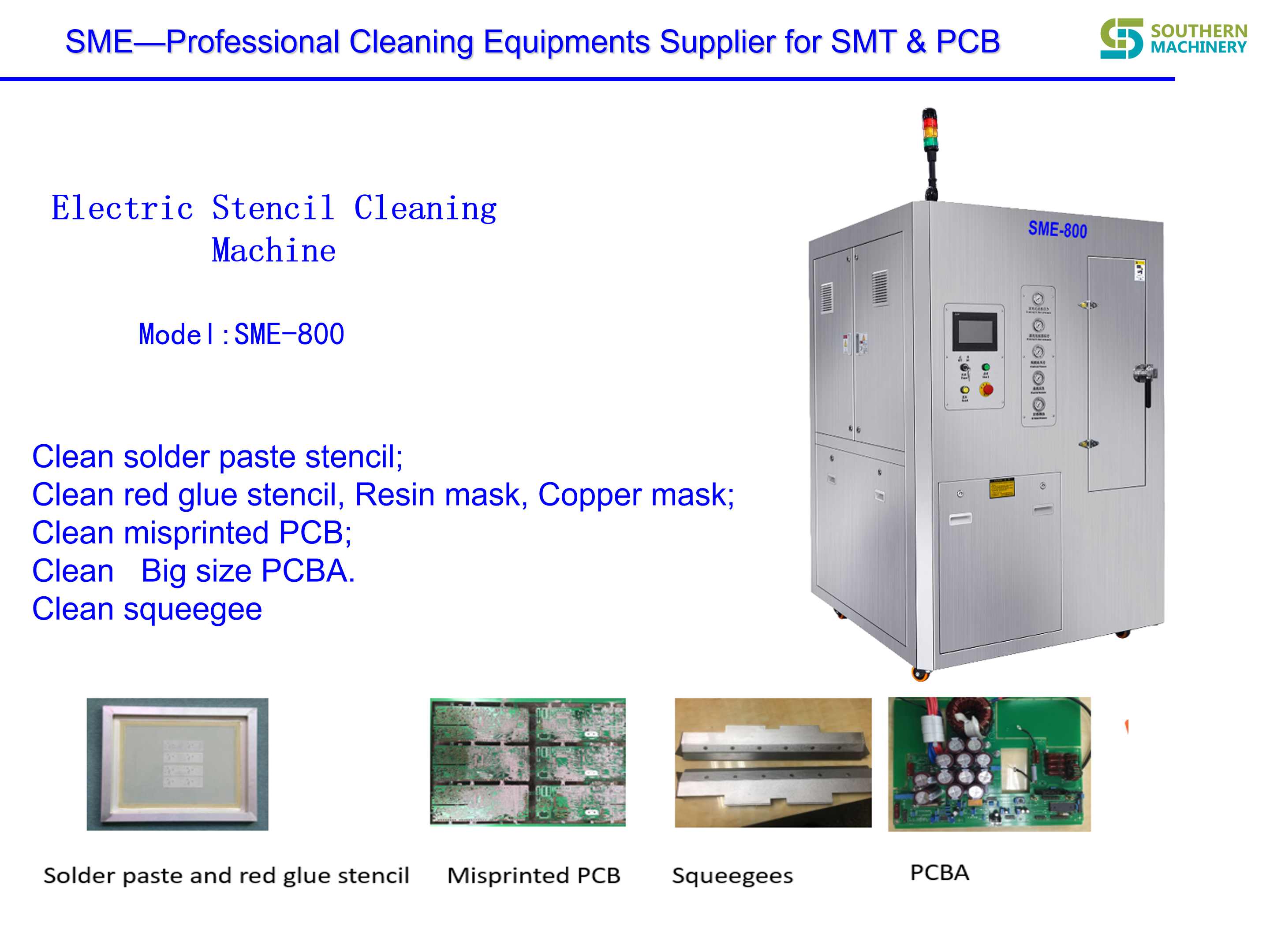
SME800 Auto Stencil Cleaning Machine: Southern Machinery's Solution for SMT Yield Control
In SMT production, yield is largely decided before reflow — at the solder paste printing stage. Bridging, smearing, insufficient deposit, and misprints all trace back to one controllable variable: the condition of the stencil apertures. The SME800 electric stencil cleaning machine from Southern Machinery (Shenzhen, China; serving 237+ global customers since 2011) exists to remove that variable. It automates stencil, squeegee, and misprinted-board cleaning so paste deposition stays repeatable run after run — which is what process control actually means on the factory floor.
<iframe width="560" height="315" src="https://www.youtube-nocookie.com/embed/VhAXCnr6Pvo?rel=0" title="SME800 Auto Stencil Cleaning Machine – SMT Yield Through Process Control" frameborder="0" allow="accelerometer; autoplay; clipboard-write; encrypted-media; gyroscope; picture-in-picture; web-share" referrerpolicy="strict-origin-when-cross-origin" allowfullscreen></iframe>
What is the SME800 used for?
The SME800 is an automatic, electrically driven stencil cleaning machine designed for the print stage of a PCB assembly line. Its core job is to remove residues from stencil apertures so that every print deposits the same volume of solder paste — the foundation of a stable SMT process.
According to the official Southern Machinery product listing, the SME800 is used to:
- Clean solder paste stencils between print runs and changeovers
- Clean red glue (SMT adhesive) stencils, resin masks, and copper masks
- Clean misprinted PCBs, recovering boards that would otherwise be reworked or scrapped
- Clean large-size PCBA
- Clean squeegees used in the printing process
Because the SME800 is electric rather than pneumatic, it is a self-contained unit that does not depend on a heavy compressed-air supply at the print station. That makes it practical for high-mix EMS lines, LED lighting lines, power electronics, and any factory where stencil changes happen frequently and print quality is non-negotiable.
Typical applications
1. High-mix EMS production. When a line changes product several times per shift, stencils are swapped and cleaned constantly. An automated stencil cleaner turns changeover cleaning from an operator-dependent task into a repeatable recipe-based step, so the line returns to production with a known-good stencil every time.
2. Fine-pitch and micro-BGA assemblies. Apertures for 0.4 mm pitch and below clog quickly. Residual paste or dried flux in a fine aperture shows up immediately as insufficient solder or bridging after reflow. Regular automated cleaning keeps aperture walls clean where manual wiping cannot reach reliably.
3. LED and power electronics lines. Red glue (SMT adhesive) and mask applications leave sticky, stubborn residues that manual cleaning handles inconsistently. The SME800 is specified for red glue stencils, resin masks, and copper masks — the chemistries common in LED modules, lighting, and power supply assembly.
4. Misprint recovery. A misprinted board is not necessarily scrap. The SME800 cleans misprinted PCBs so the board can be re-printed and re-flowed, recovering material cost and reducing WIP loss — a direct yield improvement.
5. Stencil life-extension programs. Regular, controlled cleaning preserves stencil tension and aperture geometry far longer than aggressive manual scraping. For factories running stainless steel or fine-mesh stencils, this is a measurable consumable-cost saving.
How it fits into a complete PCB assembly line
The SME800 belongs at the front of the SMT process, alongside the stencil printer and SPI:
Stencil printer → stencil cleaning (SME800) → SPI → pick-and-place → reflow → AOI
Cleaning is a process step, not a chore. When it is scheduled and recipe-controlled, SPI and AOI defect rates drop because the print itself is stable. For factories running MES or Smart EMS factory workflows, the SME800 fits as a controlled process node with repeatable programs and records.
It also sits inside Southern Machinery's wider cleaning and board-handling ecosystem:
- S1688 SMT stencil cleaning machine — the pneumatic counterpart for facilities that prefer air-driven cleaning
- S-100A ultrasonic cleaner — general ultrasonic cleaning for components and tooling
- SME6200 PCBA online cleaning machine — inline cleaning of assembled boards after soldering
- SME-5200 aqueous pallet cleaning system and SME220 auto squeegee cleaning machine — cleaning for wave soldering pallets/fixtures and squeegees
- SCM220 online PCBA cleaning machine — an inline alternative for higher-volume cleaning
- S-6200 nozzle cleaning machine — automatic cleaning for pick-and-place nozzles, keeping placement accuracy consistent
Beyond cleaning, Southern Machinery supplies the full line: SMT pick-and-place, THT auto insertion, wave soldering, board handling, and spare parts. An EMS or OEM can standardize stencil, fixture, squeegee, and nozzle cleaning under one supplier while building a complete SMT/THT line.
Key selection parameters
There is no universal "right" stencil cleaner — the right configuration depends on your product mix and floor constraints. Evaluate these parameters against your own requirements:
- Stencil size compatibility — maximum framed and frameless stencil dimensions you need to handle
- Cleaning method — spray-wash, brush, or combined; and whether the chemistry is solvent-based or aqueous/semi-aqueous
- Drying capability — whether the unit dries the stencil in the same cycle so it is ready to mount
- Filtration and recycling — multi-stage filtration reduces solvent consumption and waste disposal cost
- Cycle time per recipe — must keep pace with your changeover cadence and print frequency
- Utility requirements — electrical supply, footprint, and whether compressed air is needed (the SME800's electric drive avoids air-supply dependency)
- Automation level — recipe presets, semi-automatic vs fully automatic cycles, and integration with line control or MES
- Workpiece flexibility — whether the same unit can clean stencils, squeegees, misprinted PCBs, and large-size PCBA
Southern Machinery's engineers can match a cleaning configuration to the stencil sizes, chemistries, and changeover cadence of a specific line — send your board sizes and paste/adhesive types for a recommendation.
ROI and quality perspective
From a buyer's perspective, the SME800 pays back through four channels:
1. Fewer print defects. Clean apertures mean repeatable paste volume, which means less bridging, smearing, and insufficient solder. Every defect avoided at printing never reaches reflow, AOI, or the customer.
2. Less rework and scrap. Misprinted PCBs that can be cleaned and re-printed are recovered instead of scrapped. On high-value boards, one recovered panel can justify a significant share of the equipment cost.
3. Consistency over manual wiping. Operator-dependent cleaning produces operator-dependent yield. A recipe-controlled machine produces the same result at 8:00 AM and 11:00 PM, across shifts and operators.
4. Longer stencil life and lower consumables. Controlled cleaning preserves stencil tension and aperture geometry, extending stencil service life and reducing replacement spend.
For a high-mix EMS running multiple changeovers per shift, the combination of faster, consistent changeover cleaning and lower print-defect rates typically makes stencil cleaning automation one of the fastest-ROI additions to the print stage.
FAQ
What does the SME800 stencil cleaning machine clean?
It cleans solder paste stencils, red glue (SMT adhesive) stencils, resin masks, copper masks, misprinted PCBs, large-size PCBA, and squeegees, per the official Southern Machinery product listing.
Is the SME800 electric or pneumatic?
The SME800 is an electric stencil cleaning machine, so it does not depend on a compressed-air supply. Southern Machinery also offers the S1688 pneumatic stencil cleaning machine for air-driven installations.
How often should an SMT stencil be cleaned?
Cleaning frequency depends on paste type, aperture size, print count, and observed print quality — typically between production runs and at changeovers. SPI results and defect trends should drive the actual schedule.
Can a misprinted PCB be cleaned and reused?
Yes. The SME800 is used for misprinted PCB cleaning, allowing boards to be re-printed instead of scrapped — a direct yield and cost recovery measure.
What cleaning chemistry should I use?
Compatible solvent or aqueous/semi-aqueous chemistries depend on the paste and adhesive types in use. Southern Machinery can recommend chemistries matched to your materials during the selection process.
Where does stencil cleaning fit in a PCB assembly line?
At the print stage: between the stencil printer and SPI (or placement). Cleaning is scheduled as part of changeover and print-quality control, and the SME800 complements Southern Machinery's board handling, THT insertion, and wave soldering equipment in a full SMT/THT line.
Contact Southern Machinery
Southern Machinery (Shenzhen, China) has been supplying SMT, THT, and PCB assembly automation to 237+ global customers since 2011. For a catalog, machine images, or a stencil cleaning configuration matched to your line:
- Email: Jason Wu — jasonwu@smthelp.com
- Website: https://www.smthelp.com
- Product catalog: https://file.autoinsertion.com
- Product images: https://ph.smthelp.com
Tell us your stencil sizes, paste and adhesive chemistries, and changeover cadence — we will recommend the cleaning configuration that protects your print quality and your yield.
Comments