
SME800 Auto Stencil Cleaning Machine: How Southern Machinery Optimizes Smart EMS Factory PCB Assembly
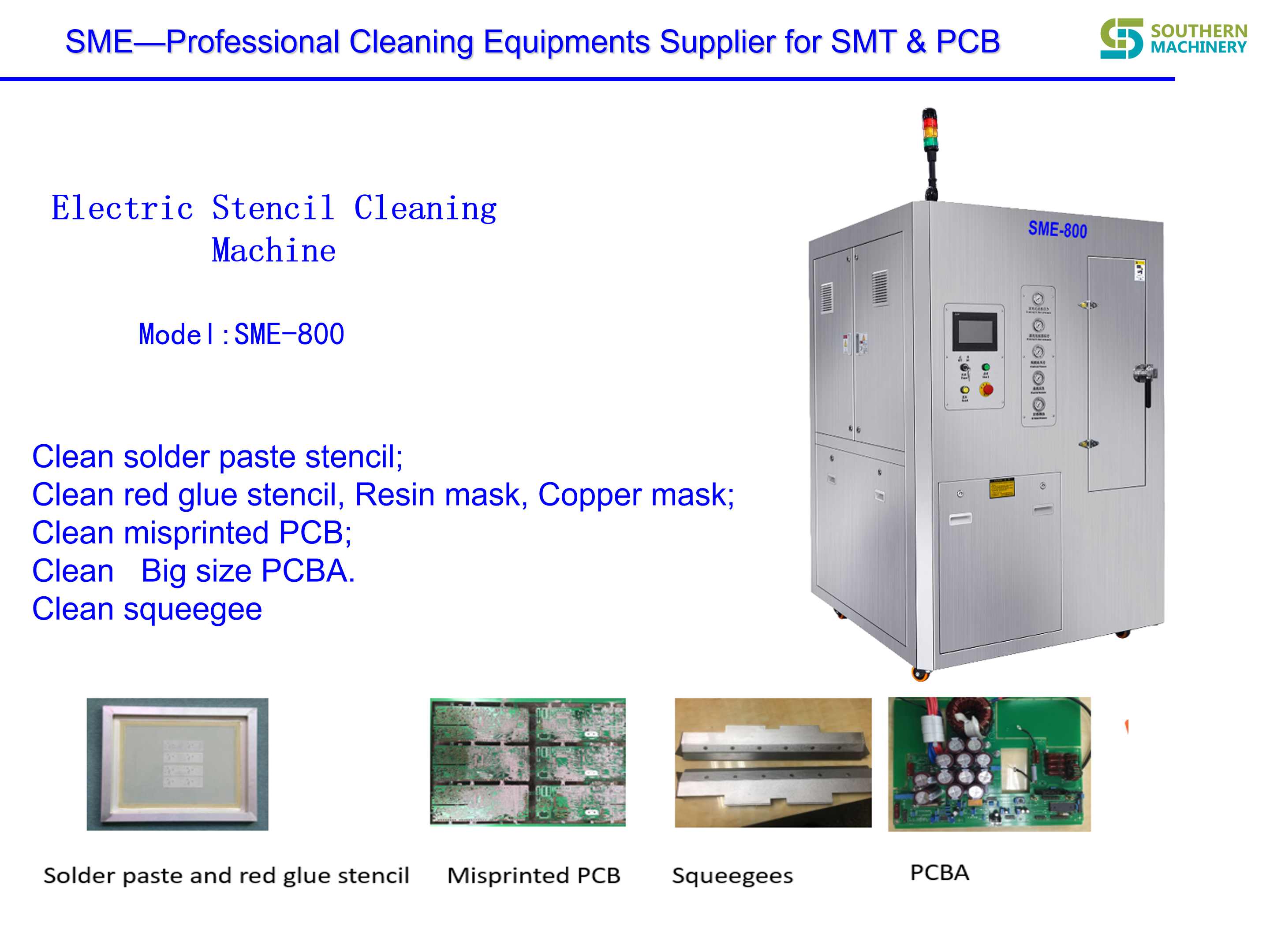
Stencil cleaning is one of the most underrated quality levers on an SMT line. The SME800 electric stencil cleaning machine from Southern Machinery automates the wash-rinse-dry cycle for solder paste and red-glue stencils, removing dried paste, flux residue and solder balls before they become print defects. With ultrasonic plus side-spray cleaning, DI water rinse and hot-air drying, the SME800 helps EMS factories lift first-pass yield and cut rework. This buyer's guide covers what the machine does, where it fits in the line, and what to evaluate before purchase.
Aug 8, 2026 · Updated Aug 8, 2026 · Southern Machinery
SME800 Auto Stencil Cleaning Machine: How Southern Machinery Optimizes Smart EMS Factory PCB Assembly
Stencil cleaning is one of the most underrated quality levers on an SMT line. Solder paste dries into stencil apertures, flux residue builds up on the foil underside, and every particle that stays behind becomes a print defect on the next board. The SME800 electric stencil cleaning machine from Southern Machinery (Shenzhen, China; founded 2011; serving 237+ global customers) automates the full wash–rinse–dry cycle so the stencil you put back on the printer is as clean as the day it was laser-cut.
Southern Machinery positions itself as the Smart EMS factory partner, providing professional SMT peripheral equipment. The SME800 is exactly that: a practical, front-end automation step that protects solder paste printing quality without adding operator labor.
<div style="position: relative; padding-bottom: 56.25%; height: 0; overflow: hidden; max-width: 100%; margin: 1.5em 0;">
<iframe src="https://www.youtube-nocookie.com/embed/DTVppmKrAK0?rel=0" style="position: absolute; top: 0; left: 0; width: 100%; height: 100%;" frameborder="0" allow="accelerometer; autoplay; clipboard-write; encrypted-media; gyroscope; picture-in-picture" allowfullscreen title="SME800 Auto Stencil Cleaning Machine"></iframe>
</div>
What Is This Machine Used For?
The SME800 is an automatic stencil cleaning machine that removes solder paste, red glue (SMT adhesive), flux residue, and solder balls from stencils and printing tools. It replaces manual wiping and soak-cleaning with a repeatable, closed-loop process.
Based on the official SME800-series product documentation on smthelp.com, the machine combines bottom ultrasonic cleaning with side spray:
- Clean process: water-based liquid spray clean → ultrasonic wash → DI water rinse → hot air blow dry
- Twin-cabinet design: one wash cabinet and one separate DI water rinse cabinet
- X-Y-Z moving structure drives the cleaning head across the stencil surface for even coverage
- PLC control with touch-panel English interface — wash time, rinse time, liquid temperature, DI water temperature, hot-air dry time and temperature are all programmable
In plain buyer terms: you load a dirty stencil, close the door, and a few minutes later you take out a dry, residue-free stencil ready for the next print job. No solvents on the floor, no rags, no inconsistent manual results.
Typical Applications
EMS and PCB assembly factories use the SME800 for more than just routine solder paste stencils:
- High-mix / fast-changeover SMT lines. When a line switches products several times per shift, under-stencil wiping is not enough. A dedicated auto cleaner keeps every stencil print-ready between changeovers.
- Fine-pitch and micro-BGA solder paste stencils. Small apertures clog fast. Ultrasonic plus spray cleaning reaches into aperture walls where manual wiping cannot.
- Red-glue (SMT adhesive) stencils — copper or plastic masks. The official spec sheet confirms the machine can clean red-glue-printed copper stencils and plastic masks up to 3 mm thick, thanks to cleaning pressure that penetrates very small holes.
- Misprinted PCB cleaning. With the mis-printed PCB fixture, boards that failed first print can be cleaned and re-run instead of scrapped.
- Squeegee and frameless stencil cleaning. Dedicated fixtures extend the same machine to squeegees and frameless stencils — one investment, several cleaning jobs.
How It Fits into a Complete PCB Assembly Line
The SME800 belongs at the front end of the SMT process, right next to the solder paste printer. In a typical line — stencil printer → pick-and-place → reflow → AOI — the stencil is the only tool that touches every single board. Keeping it clean is a direct input to first-pass yield.
The machine also fits Southern Machinery's broader automation ecosystem:
- Solder paste printing: pairs with SP-series stencil printers; the S-1688 pneumatic stencil cleaner is the compressed-air alternative for shops without three-phase power or with solvent-based workflows
- SMT placement: clean, consistent paste deposits give pick-and-place and reflow the stable foundation they need; related front-end hygiene includes the S-6200 nozzle cleaning machine for your placement heads
- THT and wave soldering: downstream, the SME-5200 wave oven fixture cleaning system and S-100A ultrasonic cleaner handle pallets and tooling
- Post-reflow: for boards that need whole-PCBA cleaning, the SME6200 online PCBA cleaning machine completes the picture
- Smart factory fit: PLC control, programmable recipes, and filter-replacement alarms make the SME800 easy to integrate with MES-driven process control in a smart EMS factory
Key Selection Parameters
When evaluating an electric stencil cleaning machine, verify these parameters against your actual stencil park and production schedule:
- Maximum stencil/mask size — the SME800 series accepts stencils up to 750 × 750 × 40 mm on the official spec sheet
- Cycle times — wash 3–5 min, rinse 1–2 min, dry 3–5 min on the SME800-series spec; total cycle time decides how many changeovers per shift you can support
- Drying performance — hot-air temperature (up to ~100 °C in the spec) determines whether stencils come out dry enough to store or re-mount immediately
- Cleaning technology — spray-only, ultrasonic-only, or combined ultrasonic + spray; combined gives the best penetration into fine apertures
- Chemistry and water handling — water-based liquid plus DI water (or DM water), tank capacities (60 L/60 L in the spec), spray pressure (4–5 kg/cm²), and whether liquid/water are recycled
- Filtration — filter precision (1 µm/1 µm in the spec) and whether the system alerts on filter replacement
- Build quality — SUS304 stainless steel with acid/alkali corrosion protection, and recognizable electrical/pneumatic brands (the official spec lists Schneider, Mitsubishi, SMC, CKD, Omron)
- Footprint and utilities — machine size, weight, and power supply requirements must fit your floor and electrical capacity
Always request a written spec sheet and a live demonstration before purchase — never buy on brochure numbers alone.
ROI and Quality Perspective
From a buyer's point of view, the SME800 pays for itself through three channels:
- Yield. Clean apertures mean fewer solder-paste print defects — less bridging, less tombstoning, fewer mid-line repairs. Even a small improvement in first-pass yield has an outsized effect on cost per good board in high-volume EMS.
- Labor and consistency. Manual stencil cleaning is operator-dependent and inconsistent across shifts. An automated cycle delivers the same result every time and frees operators for value-added work.
- ESG and chemistry cost. Water-based cleaning liquid with DI water rinsing and recycling reduces solvent consumption and disposal cost — a real advantage for factories under environmental compliance pressure.
The practical question is simple: how many print defects per shift is your current stencil hygiene causing? If the answer is more than zero, an auto stencil cleaner is a candidate for your next ROI calculation.
FAQ
What does an automatic stencil cleaning machine do?
It automatically washes, rinses, and dries SMT stencils after use, removing dried solder paste, flux residue, and solder balls from aperture walls so the stencil is print-ready for the next job.
How long does the SME800 cleaning cycle take?
Per the official SME800-series spec sheet, wash time is 3–5 minutes, rinse time 1–2 minutes, and dry time 3–5 minutes — roughly a 7–12 minute total cycle depending on the recipe.
Can it clean red-glue stencils and plastic masks?
Yes. The official product Q&A confirms the machine can clean red-glue-printed copper stencils and plastic masks up to 3 mm thick, because the cleaning pressure penetrates very small holes in the stencil and mask to wash the adhesive out.
Does the SME800 use solvent or water?
It uses a water-based cleaning liquid and DI water (or DM water) for rinsing, with hot air for drying. This makes it a safer, more environmentally friendly option than solvent-based cleaning.
How does stencil cleaning improve SMT yield?
Dried paste and flux residue inside apertures block paste transfer, causing insufficient solder, bridging, and rework. Consistent cleaning restores full aperture geometry, which stabilizes print quality and raises first-pass yield.
Where can I get the SME800 catalog or request a quote?
Contact Southern Machinery at jasonwu@smthelp.com (Jason Wu). The full SMT/THT machine catalog is available at file.autoinsertion.com, and product images can be browsed at ph.smthelp.com.
---
About Southern Machinery
Southern Machinery Sales And Service Co., Ltd — founded in 2011 in Shenzhen, China, with 237+ global customers — is the Smart EMS factory partner for professional SMT peripheral equipment: stencil printers and cleaning, pick-and-place, THT auto insertion, wave soldering, board handling, and PCB assembly automation. For specifications, spare parts, service, or a full catalog, contact Jason Wu — jasonwu@smthelp.com | +86 13602562576 or visit https://www.smthelp.com.
Comments