
Southern Machinery Auto Insertion Machines: Built and Export-Packed for Overseas EMS Factories
Auto insertion machines replace manual DIP assembly for radial and odd-form THT components — and buying from China means the machine must also survive overseas freight. This guide explains what a THT auto insertion machine does, where it delivers the fastest payback, and how Southern Machinery (Shenzhen, founded 2011, 237+ global customers) prepares, protects, and export-packs machines for EMS factories worldwide. We cover typical applications, how an inserter fits into a complete SMT/THT line, the selection parameters buyers should compare, and the ROI case for replacing manual insertion. Request specifications from jasonwu@smthelp.com or download the full catalog at file.autoinsertion.com.
Aug 9, 2026 · Updated Aug 9, 2026 · Southern Machinery
Southern Machinery Auto Insertion Machines: Built and Export-Packed for Overseas EMS Factories
An auto insertion machine is one of the highest-leverage investments a THT (through-hole) line can make — but when you buy it from China, the machine has to survive more than production. It has to survive the freight. Southern Machinery (Shenzhen, China; founded 2011; serving 237+ global customers) designs and manufactures THT auto insertion machines and ships them to EMS factories worldwide, and the packing stage is as deliberate as the build stage. This guide explains what an auto insertion machine does, where it delivers the fastest payback, and what buyers should evaluate — from rated CPH to export crating — before committing to a purchase.
Southern Machinery positions itself as the Smart EMS factory partner, providing professional SMT peripheral equipment. For EMS companies automating DIP assembly, that means one supplier who handles the machine, the feeders, the spare parts, and the overseas delivery.
<div style="position: relative; padding-bottom: 56.25%; height: 0; overflow: hidden; max-width: 100%; margin: 1.5em 0;">
<iframe src="https://www.youtube-nocookie.com/embed/WwLFI_abBUo?rel=0" style="position: absolute; top: 0; left: 0; width: 100%; height: 100%;" frameborder="0" allow="accelerometer; autoplay; clipboard-write; encrypted-media; gyroscope; picture-in-picture" allowfullscreen title="How China made Auto Insertion machine packing for overseas shipping support Smart EMS factory"></iframe>
</div>
What Is This Machine Used For?
An auto insertion machine (also called a THT inserter or DIP insertion machine) automatically places through-hole components onto a PCB and then cuts and clinches the leads so each part is mechanically locked in place before soldering. On radial platforms it handles tape-packed radial-lead parts such as capacitors, transistors, LEDs, and key switches; on odd-form platforms it extends to transformers, relays, connectors, and other non-standard shapes.
The practical purpose is simple: replace manual DIP insertion. Manual lines depend on operator skill, attention, and shift discipline, and they fail in predictable ways — floating high, leakage, misinsertion, and reverse insertion. An insertion machine repeats the same placement and clinch cycle thousands of times per hour with machine-vision correction, which is why automation is the standard answer for any DIP volume worth counting.
The deep-dive video above shows the other half of the story for overseas buyers: how a China-made insertion machine is prepared, protected, and packed so it arrives at a Smart EMS factory ready to install — not as a claim, but as a process you can watch end to end.
Typical Applications
THT auto insertion machines earn their keep wherever boards carry radial or odd-form through-hole components:
- Home appliance control boards. Air conditioners, microwaves, induction cookers, and electric kettles are built around high volumes of capacitors, transistors, and key switches — classic radial-insertion workloads.
- Power supplies and ballasts. Vehicle power supplies, energy-saving power supplies, and lighting ballasts combine radial components with odd-form parts such as transformers and relays that need a flexible inserter.
- LED lighting and display boards. LED lighting, display modules, and luminous-character control systems use tape-packed radial LEDs and driver components at volumes that make manual insertion a bottleneck.
- Automotive electronics. Car audio and vehicle power boards demand consistent, repeatable insertion quality — exactly what vision-corrected machines provide shift after shift.
- General electronics and instrumentation. Watches, meters, and control instruments often mix small radial parts with odd-form connectors, favoring a line that can handle both.
How It Fits into a Complete PCB Assembly Line
An insertion machine is rarely a standalone purchase — it slots into the middle of a mixed SMT/THT process:
- Front end (SMT): solder paste printing → pick-and-place → reflow → AOI handles the surface-mount population.
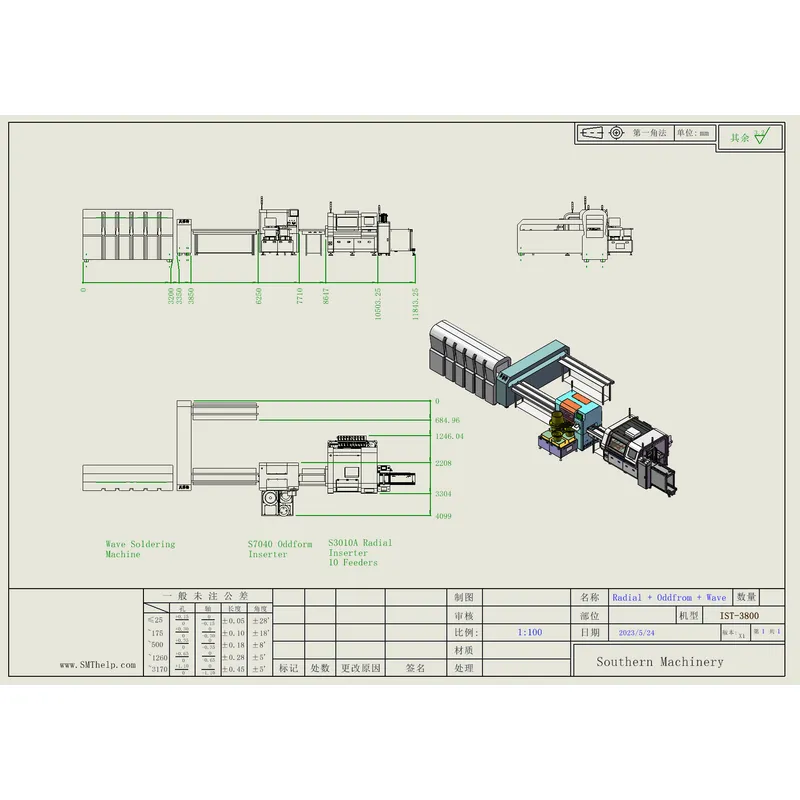
- THT stage: the auto insertion machine places radial and odd-form components, then boards move to wave soldering (for example, Southern Machinery's S-WS450 or S-WS350B lead-free dual-wave machines), where the clinched leads are soldered reliably.
- Around the line: board handling systems convey boards between stations, and post-solder cleaning and inspection close the loop.
A concrete reference point: the S3000 Automatic Radial Component Insertion Machine from Southern Machinery (official spec sheet on smthelp.com) is a dual-span radial inserter rated up to 18,000 CPH mechanical speed with roughly 10,000 CPH typical production throughput, supporting 2.5 mm and 5.0 mm lead spans, 0–360° insertion direction in 1° increments, machine-vision position correction, and automatic lead cutting and clinching (clinch length 1.5–2.2 mm, clinch degree 10–35°). It handles PCBs from 50 × 50 mm up to 400 × 380 mm, runs on 220 V AC single phase with 0.6 MPa air, and programs offline with an English/Chinese interface. The S-3010B series extends span options to 7.5 mm and 10.0 mm for quad-span radial work.
For EMS buyers, the ecosystem matters as much as the machine: feeders, custom nozzles, spare parts, and service support keep the line running after installation — all part of Southern Machinery's SMT/THT automation offering.
Key Selection Parameters
When comparing auto insertion machines from any supplier, verify these parameters against your board portfolio — and never buy on brochure numbers alone:
- Rated vs. actual throughput. Suppliers quote mechanical max CPH; real throughput depends on PCB layout, component mix, and feeder configuration. Ask for both numbers, as with the S3000's 18,000 rated / ~10,000 typical figures.
- Supported component types and lead spans. Radial tape-packed parts (capacitors, transistors, LEDs, key switches) need matched lead spans — 2.5/5.0 mm dual span or wider 7.5/10.0 mm options — while odd-form components require a different platform entirely.
- PCB size range and thickness. Confirm your largest and smallest boards fit the machine's work area and that board thickness is within spec (the S3000, for example, accepts 0.79–2.36 mm).
- Insertion direction flexibility. 0–360° insertion in 1° increments matters when components must be oriented differently across your product mix.
- Vision correction and calibration. Machine-vision position correction is what turns a fast machine into a consistent one; confirm it is standard, not an option.
- Clinching method. Lead clinch length and degree determine pull strength and solderability — verify the settings match your quality requirements.
- Control and programming. Offline programming, recipe storage, and an English (or Chinese) interface affect how fast your team can set up new products.
- Utilities and footprint. Power supply, air pressure/flow, machine footprint, and weight (the S3000: 1800 × 1600 × 1800 mm, 1000 kg) must fit your floor and electrical capacity.
- Export packing and documentation. For overseas purchases, confirm the machine is export-crated with moisture protection, shock protection, and anchoring suitable for ocean freight, plus a packing list, operation manual, and clear delivery terms.
ROI and Quality Perspective
From a buyer's point of view, the ROI case for an auto insertion machine is built on three channels:
- Labor. One machine with a single operator replaces multiple manual insertion stations and removes the training burden of a young, mobile, high-turnover DIP workforce — the exact pain point Southern Machinery documents on its odd-form insertion pages.
- Quality and rework. Manual DIP lines produce floating high, leakage, misinsertion, and reverse insertion defects. Vision-corrected automatic insertion with consistent clinching eliminates most of them, cutting rework and field-failure cost directly.
- Throughput and scalability. Output no longer depends on operator proficiency or overtime; capacity scales with machines, not headcount, which is what makes a Smart EMS factory plan credible.
Add the overseas-shipping angle and the ROI question becomes logistical too: a machine that arrives damaged, undocumented, or without commissioning support costs you weeks. That is why the packing and preparation process shown in the video matters — it is part of the total cost of ownership, not an afterthought.
FAQ
What is an auto insertion machine?
An auto insertion machine automatically places through-hole (THT) components such as capacitors, transistors, LEDs, and key switches onto a PCB, then cuts and clinches the leads to lock the components in place before wave soldering. Odd-form platforms extend the same automation to transformers, relays, and connectors.
How is an auto insertion machine packed for overseas shipping?
Export packing typically means heavy-duty crating with moisture protection, shock absorption, and secure machine anchoring inside the crate, plus a packing list, operation manual, and shipping documentation. Before buying from China, confirm the supplier's export packing standard and pre-shipment inspection process — and watch the factory video to see it in practice.
Which components can a THT auto insertion machine place?
Radial platforms handle standard tape-packed radial-lead components — capacitors, transistors, LEDs, and key switches — across lead spans such as 2.5/5.0 mm (with 7.5/10.0 mm span options on some models). Odd-form insertion machines handle non-standard shapes like transformers, relays, and connectors.
What is the difference between rated CPH and actual throughput?
Rated CPH is the maximum mechanical cycle speed of the machine; actual throughput is what you achieve in production and depends on PCB layout, component mix, feeder setup, and board changeover. For example, the S3000 is rated up to 18,000 CPH with roughly 10,000 CPH typical throughput. Always ask suppliers for both figures.
How does auto insertion compare with manual DIP insertion?
Manual insertion suffers from high labor and training costs and typical defects such as floating high, leakage, misinsertion, and reverse insertion, and output depends on operator skill and overtime. Auto insertion delivers consistent placement with vision correction, controlled clinching, and throughput that scales with machines rather than headcount.
Where can I get the Southern Machinery auto insertion machine catalog or request a quote?
Contact Southern Machinery at jasonwu@smthelp.com (Jason Wu). The full SMT/THT machine catalog is available at file.autoinsertion.com, and product images can be browsed at ph.smthelp.com.
---
About Southern Machinery
Southern Machinery Sales And Service Co., Ltd — founded in 2011 in Shenzhen, China, with 237+ global customers — is the Smart EMS factory partner for professional SMT peripheral equipment: THT auto insertion, stencil printing and cleaning, pick-and-place, wave soldering, board handling, and PCB assembly automation. For specifications, spare parts, service, or a full catalog, contact Jason Wu — jasonwu@smthelp.com | +86 13602562576 or visit https://www.smthelp.com.
Comments