
How China Made Auto Insertion Machines for Smart EMS Factory PCB Assembly | Southern Machinery
Southern Machinery's THT auto insertion machines automate radial-lead PCB assembly for smart EMS factories. Represented by the S-3010B radial insertion machine — rated 22,000 CPH with roughly 13,000 CPH actual production speed — the platform feeds, inserts and clinches capacitors, transistors, LEDs and key switches with lead spans from 2.5 to 10.0 mm on PCBs up to 400 x 400 mm. This buyer guide covers what the machine is used for, typical applications in power supplies, LED lighting, home appliances and vehicle electronics, how it fits into a complete SMT/THT line with wave soldering and board handling, the published selection parameters to evaluate, and the labor and quality ROI case. Published specs from Southern Machinery, Shenzhen, China, founded 2011, 237+ global customers.
Aug 5, 2026 · Updated Aug 5, 2026 · Southern Machinery
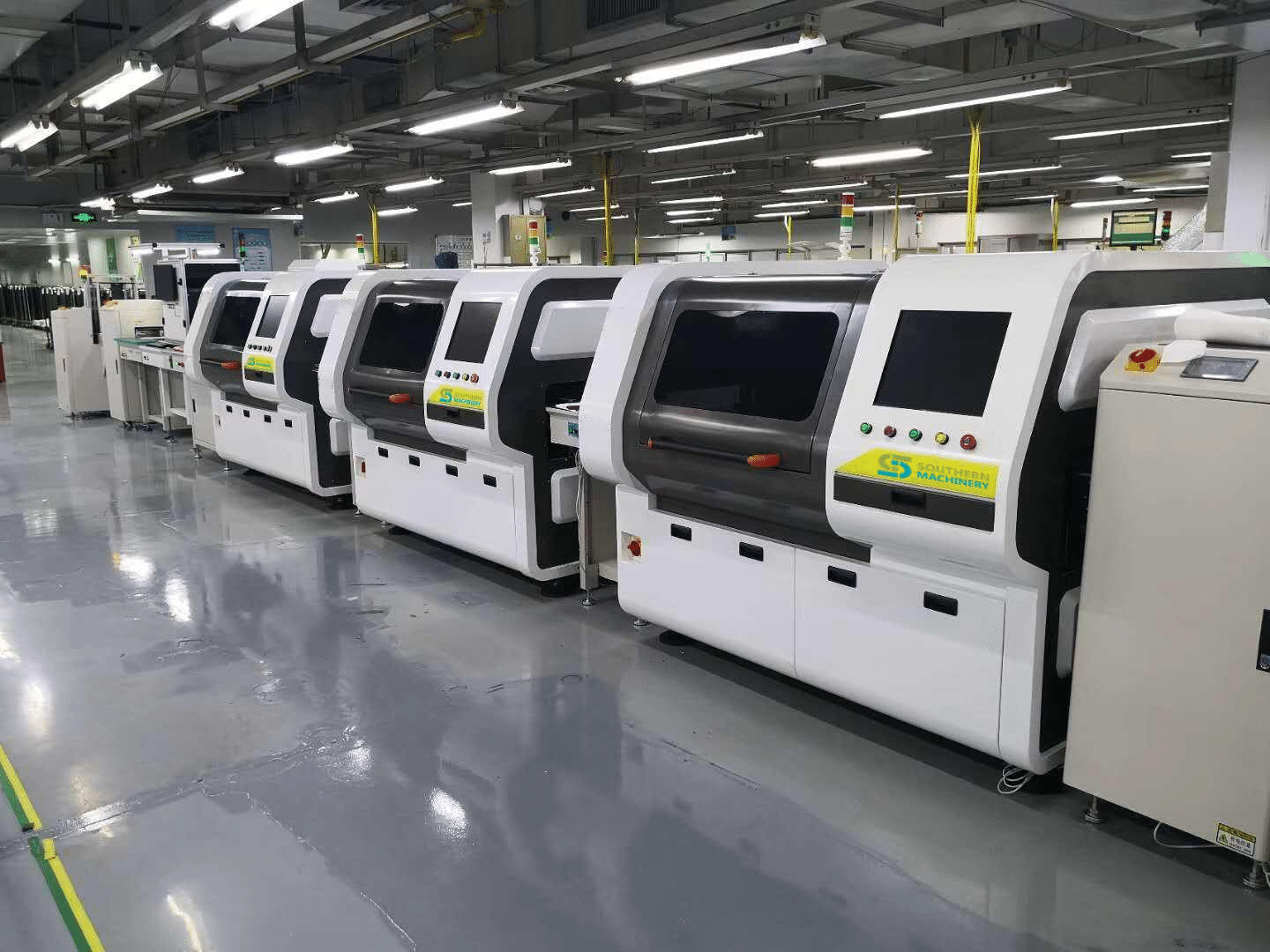
How China Made Auto Insertion Machines for Smart EMS Factory PCB Assembly | Southern Machinery
Product demo: Southern Machinery's THT auto insertion machine bringing radial through-hole component assembly to smart EMS factory lines.
<iframe width="560" height="315" src="https://www.youtube-nocookie.com/embed/gL2gQwdvEmc?rel=0" title="How China made Auto Insertion machine for Smart EMS factory PCB assembly" frameborder="0" allow="accelerometer; autoplay; clipboard-write; encrypted-media; gyroscope; picture-in-picture; web-share" allowfullscreen></iframe>
China's electronics manufacturing industry was built on manual through-hole assembly — and for many EMS factories, hand insertion is still the bottleneck. The smart EMS factory changes that: instead of a row of operators feeding radial-lead components by hand, an auto insertion machine feeds, orients, inserts and clinches them automatically, at a rate no manual station can match consistently.
This guide covers the Southern Machinery THT auto insertion platform, represented by the S-3010B Radial Insertion Machine (off-line) — a machine built in Shenzhen specifically for smart EMS PCB assembly. You will find what the machine is used for, real application scenarios, how it slots into a complete SMT/THT line, the published specifications to evaluate, and the ROI and quality case from the buyer's perspective.
What is this machine used for?
A THT auto insertion machine automates the placement of radial-lead through-hole components — parts with two parallel leads that must be inserted into plated holes and then soldered. The S-3010B performs the full sequence automatically: component feeding from tape, lead forming and spacing, positioning over the board, insertion, and clinching (bending the leads underneath so the component is mechanically locked before wave soldering).
The published S-3010B specification covers:
- Components: capacitors, transistors, LED lights, key switches and standard tape-packed radial-lead components
- Lead spans: 2.5 / 5.0 / 7.5 / 10.0 mm (single-, dual-, triple- and quad-span variants)
- Insertion direction: 0° to 360°, in 1° increments
- Insertion head: servo-motor driven (13.0 mm) with an "N" type clinch base; clinch length 1.5–2.2 mm, clinch degree 10–35°
- Board envelope: PCB from 50 × 50 mm up to 400 × 400 mm; PCB thickness 0.79–2.36 mm
- Throughput: rated 22,000 CPH; actual production speed approximately 13,000 CPH
- Correction: machine vision coordinate correction and calibration on a non-rotary table
- Control: English or Chinese interface on Southern Machinery platform software, industrial PC and LCD monitor; feeders included
The "off-line" configuration means it runs as a standalone station — one operator can manage the line — which is exactly the deployment model most EMS factories use when they first automate THT insertion.
Buyers typically evaluate this machine when one of these conditions is true:
- Hand insertion of radial components is capping line throughput.
- Labor costs are rising while the general labor pool is declining and skilled workers are hard to find.
- Manual insertion quality is unstable — bent leads, missed holes, inconsistent clinching — driving rework and wave-solder touch-up.
- Manual stations take up too much production floor space for the output they deliver.
Typical applications
- Power supply and ballast assembly — vehicle power supplies, energy-saving power supplies and ballast boards are dense with electrolytic capacitors and transistors, the classic radial-lead workload for an auto insertion machine.
- LED lighting and display boards — LED lights, luminous characters, display control systems and LED driver PCBs where high volumes of identical radial components make manual insertion both slow and error-prone.
- Home appliance control boards — air conditioner, TV, microwave, electric kettle and induction cooker PCBs, where key switches and capacitors are inserted before wave soldering.
- Vehicle electronics — car audio and vehicle power supply boards that mix SMT logic with THT power-stage components.
- High-mix EMS lines — any factory running standard tape-packed radial components across multiple board types; programming is done with vision-aided setup, so changeover between boards is a program swap rather than a station rebuild.
If your board mix also includes odd-form parts — connectors, relays, transformers, pin terminals — those belong on a complementary machine (Southern Machinery's S-70LD odd form inserter or the S7020 pin/eyelet terminal series), while the radial inserter handles the standard tape-packed workload.
How it fits into a complete PCB assembly line
The S-3010B is one station in the Southern Machinery SMT/THT ecosystem, not a standalone gadget:
- SMT side: solder paste printing, SPI and pick-and-place machines populate the surface-mount portion of the board. Through-hole parts that placement heads cannot feed are routed to the THT side.
- THT side: the radial auto insertion machine (S-3010B) handles tape-packed radial components; the S-70LD odd form inserter takes non-standard components; the S7020 series covers pin, eyelet and terminal insertion. Together they automate the entire THT workload.
- Downstream: inserted boards move to wave soldering — the S-WS450 standard wave or the S-WS350B lead-free dual wave machine for RoHS-compliant lines — where clinched leads guarantee mechanical retention before the solder wets. From there the line continues through AOI/SPI inspection, PCBA cleaning and board handling systems that move boards between stations without manual lifting.
- Support layer: feeders, custom nozzles, spare parts and retrofit services keep the line running; Southern Machinery's platform software provides the English/Chinese control interface that operators and MES integration both rely on.
The practical benefit for a line designer: an auto inserter feeds the wave line at a steady, predictable rate, while hand insertion creates batch-to-batch variation that appears later as touch-up and rework. For a smart EMS factory, that predictability is what makes the line schedulable.
Key selection parameters
These are the published S-3010B specifications from the Southern Machinery product page — use them as a checklist when comparing any radial auto insertion machine:
- Throughput: rated 22,000 CPH; actual production speed approximately 13,000 CPH
- Lead spans: 2.5 / 5.0 / 7.5 / 10.0 mm
- Insertion direction: 0°–360° in 1° increments
- Insertion head: servo-motor driven (13.0 mm), "N" type clinch base
- Clinch: length 1.5–2.2 mm; degree 10–35°
- Component range: capacitor, transistor, LED, key switch, standard tape-packed radial-lead components
- PCB size: 50 × 50 mm minimum, 400 × 400 mm maximum
- PCB thickness: 0.79–2.36 mm
- Machine size (L×W×H): 1800 × 1600 × 1800 mm; weight 1000 kg
- Power and air: 220 V AC single phase 50/60 Hz; air pressure 0.6 MPa, 0.3 m³/min
- Environment: 10 °C to 35 °C
- Vision and control: machine vision coordinate correction and calibration; non-rotary table; English/Chinese interface; industrial PC + LCD monitor; feeders included
Before committing to any machine, validate throughput, lead span, board envelope, clinch options and changeover workflow against your own boards and volumes. Those parameters — not the demo video — determine whether the machine fits your product mix.
ROI and quality perspective
From the buyer's perspective, the ROI case rests on three measurable items:
- Labor reallocation. One off-line auto insertion machine replaces a manual insertion station that typically needs multiple operators per shift. Those operators move to inspection, programming and line supervision. Southern Machinery positions the S-3010B around rising labor costs, the shrinking general labor pool and rising training costs for skilled workers — with an official marketing claim of reducing costs by up to 40%.
- Quality consistency. Vision-based coordinate correction and controlled servo insertion reduce bent leads, missed holes and component damage. Consistent clinching (1.5–2.2 mm length, 10–35° degree) keeps components locked through handling and wave soldering, which matters for power-stage parts that carry current and heat. Fewer defects downstream mean less touch-up, less AOI fallout and less scrap.
- Throughput predictability. At an actual production speed of approximately 13,000 CPH, output is a number you can schedule around. When radial insertion stops being the pacing operation, the whole appliance, LED or power board line runs faster — and the machine's 1800 × 1600 × 1800 mm footprint replaces floor space previously occupied by rows of manual stations.
For EMS factories serving appliance, LED and power supply customers, the combination of labor savings, reduced rework and predictable throughput is the same cost driver that makes THT automation attractive across the industry.
FAQ
What is a THT auto insertion machine used for?
A THT (through-hole technology) auto insertion machine automatically feeds, orients, inserts and clinches radial-lead components such as capacitors, transistors, LEDs and key switches into plated through-holes on a PCB. It replaces manual insertion before wave soldering, improving throughput, consistency and quality in PCB assembly.
What is the speed of the Southern Machinery S-3010B radial insertion machine?
Southern Machinery publishes the S-3010B at a rated speed of 22,000 CPH, with an actual production speed of approximately 13,000 CPH. Actual output depends on board layout, component mix and feeder setup, so validate against your own products before finalizing a line design.
What components can a radial auto insertion machine handle?
The S-3010B handles standard tape-packed radial-lead components: capacitors, transistors, LED lights and key switches, with lead spans of 2.5 / 5.0 / 7.5 / 10.0 mm. Odd-form components such as connectors, relays and pin terminals require a complementary odd form insertion machine.
What PCB sizes does the S-3010B support?
The published board envelope is 50 × 50 mm minimum to 400 × 400 mm maximum, with PCB thickness from 0.79 mm to 2.36 mm.
What is the difference between radial and odd-form insertion machines?
A radial insertion machine handles standard tape-packed radial-lead components (capacitors, transistors, LEDs) with regular lead spacing. An odd-form insertion machine handles non-standard components — connectors, relays, transformers, pin terminals — that do not fit tape-fed radial formats. Most THT lines need both.
How does an auto insertion machine reduce costs in PCB assembly?
Automating radial insertion removes a repetitive manual operation, cutting operator headcount and reducing defect-driven rework such as bent leads, missed holes and inconsistent clinching. Southern Machinery positions THT insertion automation around labor reduction, throughput stability and yield improvement, with an official marketing claim of reducing costs by up to 40%.
Get the catalog and talk to an engineer
If manual radial insertion is throttling your power supply, LED, appliance or vehicle electronics line, put the Southern Machinery THT auto insertion platform on your shortlist. Southern Machinery — founded in 2011 in Shenzhen, China, serving 237+ global customers in SMT, THT and PCB assembly automation — can help you evaluate the machine against your actual boards.
- Email: jasonwu@smthelp.com (Jason Wu, international sales)
- Product catalog and documentation: https://file.autoinsertion.com
- Product images and albums: https://ph.smthelp.com
- Website: https://www.smthelp.com
Comments