
How to Build a Lights-Out THT Line: Southern Machinery's Automated Through-Hole Assembly Blueprint
A lights-out THT line runs through-hole PCB assembly with minimal operators: automatic radial, axial and odd-form insertion, lead-free wave soldering and board handling linked in one continuous flow. This guide explains what a lights-out THT line is, what it is used for, the Southern Machinery machines that build it, typical applications across power supplies, LED lighting and home appliances, key selection parameters, and the ROI case for replacing manual DIP insertion. Southern Machinery (Shenzhen, China, founded 2011) has served 237+ global customers with SMT/THT/PCB assembly automation.
Aug 4, 2026 · Updated Aug 4, 2026 · Southern Machinery
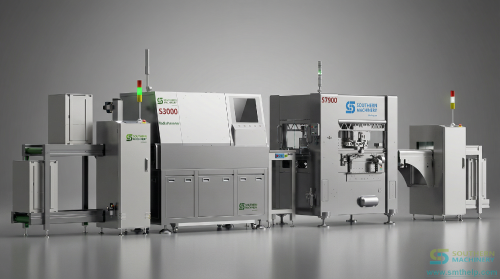
How to Build a Lights-Out THT Line: Southern Machinery's Automated Through-Hole Assembly Blueprint
A "lights-out" THT (through-hole technology) line is exactly what the name suggests: a PCB assembly line that can keep producing with the lights off — minimal operators, maximum automation. For most EMS factories, the through-hole segment is still the most labor-intensive part of the shop floor: operators standing at benches, hand-inserting capacitors, relays, transformers, terminals and odd-form parts, then pushing boards through dip or wave soldering.
It does not have to be that way. Southern Machinery (Shenzhen, China, founded 2011, 237+ global customers) designs and builds the machines that make automated, near-unattended THT assembly practical: radial and axial insertion machines, odd-form and pin/eyelet/terminal inserters, lead-free wave soldering, and the board handling equipment that links them into one continuous flow. This guide explains what a lights-out THT line is, what it is used for, how to configure one, and what to evaluate before you buy.
<iframe width="560" height="315" src="https://www.youtube-nocookie.com/embed/omxIkpIkxS4?rel=0" title="How Build Your Lights-Out THT Line" frameborder="0" allow="accelerometer; autoplay; clipboard-write; encrypted-media; gyroscope; picture-in-picture; web-share" allowfullscreen></iframe>
What is a lights-out THT line used for?
A lights-out THT line is used to automate the through-hole portion of PCB assembly so that boards move from bare PCB to soldered PCBA with little or no manual intervention. Instead of hand insertion, the line uses automatic insertion machines for standard leaded components, dedicated machines for odd-form and non-standard parts, and a wave soldering machine to solder everything in one pass. Board handling conveyors, loaders and unloaders move boards between stations automatically.
From a buyer's perspective, the line exists to solve four problems that manual DIP assembly creates:
- Labor cost and turnover. Manual insertion depends on skilled, stable operators. As Southern Machinery's own S-70LD odd-form machine documentation points out, DIP lines staffed by young, mobile operators carry high training costs and unpredictable output.
- Quality consistency. Manual insertion produces defects that automatic insertion eliminates or dramatically reduces: floating components, missed insertions, misinsertion and reverse-polarity insertion.
- Throughput ceilings. Manual output is capped by operator speed and shift hours. An automatic inserter runs at rated CPH continuously, including night shifts.
- Scalability. A manual line is hard to scale because output scales linearly with headcount. An automated line scales with machine configuration.
A lights-out THT line is the through-hole answer to what Industry 4.0 and smart-factory programs have already done to the SMT side: replace repetitive manual work with repeatable automation, and let MES track every board.
Typical applications
Southern Machinery's THT automation equipment is installed across the industries the company has served for two decades. Typical application scenarios include:
- Power supply and ballast PCBA. Electrolytic capacitors, transformers, fuses and bridge rectifiers are classic radial and axial parts. Radial insertion machines handle capacitors (electrolytic, ceramic, box and film types), transistors, diodes, LEDs, connectors, tact switches, coils, potentiometers, lamps and fuses — the component list that dominates power supplies, vehicle power supplies and energy-saving ballasts.
- LED lighting and display assembly. LED lighting PCBs combine high-volume radial LEDs, bulk LEDs and odd-form housings. Lines combine radial insertion with custom feeders (radial tape, tube, vibration bowl and reel feeders) to run LED tube, panel and street-lamp boards with minimal handling.
- Home appliance control boards. Air conditioner, TV, microwave, electric kettle and induction cooker control boards mix radial parts, relays and connectors. Odd-form insertion machines (S-70LD, S-7000/S-7900 series) are built precisely for relays, transformers and other non-standard components that radial and axial machines cannot feed.
- Automotive electronics. Car audio and vehicle power modules use pin, eyelet and terminal connections that need precise placement. The S-7020 series pin/eyelet/terminal insertion machine inserts terminals from bulk or reel packaging with 360° orientation control and inward or outward clinching.
- Industrial and outdoor lighting. Street lamps and floodlights use larger boards and mixed component sets where a combination of radial, odd-form and terminal insertion plus lead-free wave soldering keeps a two-shift production plan on schedule.
How it fits into a complete PCB assembly line
A lights-out THT line is rarely a standalone island — it is the through-hole section of a full PCB assembly flow:
- SMT section: solder paste printing → pick-and-place → reflow soldering → AOI/SPI inspection.
- THT section: automatic insertion of radial components (S-3000 series), axial components (S-4000 series), odd-form components (S-70LD, S-7000/S-7900 series), and pins/eyelets/terminals (S-7020 series) → wave soldering (S-WS350B lead-free dual wave or S-WS450) → auto lead cutting → cleaning.
- Board handling: PCB loaders, unloaders, conveyors and turn conveyors transport boards between stations, which is what makes "lights-out" operation possible in the first place — no one carries boards.
- Quality and material flow: 3D SPI/AOI machines verify solder paste and solder joints, smart reel storage and feeders manage component material, and the whole line can feed data to MES for traceability.
Southern Machinery supplies the full ecosystem — insertion machines, wave soldering, board handling systems, feeders, nozzles, spare parts and after-sales service — so the THT line can be specified, installed and supported by one partner rather than stitched together from multiple vendors.
Key selection parameters
Every THT line is different, so evaluate these parameters against your board portfolio before buying. (Specific values below are from Southern Machinery's published product documentation; confirm current specifications with the factory for your configuration.)
- Component mix. Define the share of radial, axial, odd-form and pin/eyelet/terminal parts. Radial inserters handle capacitors, transistors, diodes, LEDs, tact switches, coils and fuses; odd-form machines are required for relays, transformers, connectors and other non-standard shapes; pin/eyelet/terminal machines cover metallic terminations.
- Speed and actual throughput. Published speeds give a starting point — for example, Southern's S-3000 series radial insertion machine is documented at 18,000 CPH spec speed, and the S-7020 series pin/eyelet/terminal machine at 12,000 CPH. Validate what throughput you actually need after changeover and setup losses.
- PCB size and hole tolerance. Confirm the maximum board size (e.g. S-7020 documents 380×280 mm, with enlarged sizes customizable) and the hole-to-lead relationship (e.g. an insertion hole about 0.5 mm larger than the component lead). Boards must be designed for auto insertion.
- Insertion angle and clinching. 360° insertion in 1° increments and inward or outward clinching (documented on both S-3000 and S-7020 series) determine bottom-side density and pull-out strength.
- Feeding system. Radial tape feeders, reel feeders, tube feeders and vibration bowl feeders each suit different packaging. Bulk or reel packaging options for terminals are a documented S-7020 feature.
- Programming and changeover. Look for offline programming, Excel-based programs, USB data import and online visual teaching — documented on Southern's S-3000 and S-7020 machines — because programming time is what decides whether a line is truly flexible.
- Wave soldering capability. For lead-free operation, evaluate conveyor speed range, PCB width range, preheating zones, solder pot capacity and temperature control (Southern's S-WS350B documents 300–1800 mm/min conveyor speed, 50–350 mm PCB size, three PID preheating zones and ±1–2 °C temperature control accuracy).
- Power, footprint and utilities. Machines are typically single-phase 220V (S-7020: 2 KVA) or three-phase 380V (S-WS350B, 415V compatible). Check floor space and power availability before layout.
- Service and spare parts. For a line that runs unattended, spare parts availability and local support matter as much as the machine itself. Southern Machinery stocks spare parts for major SMT/THT brands and provides training, upgrading, retrofit and repair services.
ROI and quality perspective
Buyers typically justify a lights-out THT line on three grounds:
- Labor replacement. One automated insertion machine replaces several manual insertion stations, and the saving compounds every shift, every year. Southern Machinery's published THT marketing materials include case studies referencing ROI windows as short as one year for wave-soldered THT PCB assembly.
- Quality cost avoidance. Manual DIP lines generate rework from floating, misinserted and reverse-inserted components. Automatic insertion with clinching and 360° orientation control removes the most common human error classes at the source, cutting rework, scrap and field-failure exposure.
- Capacity without headcount. A lights-out line runs second and third shifts without recruiting or training new operators. For EMS companies facing tight labor markets, that is often the deciding factor.
Quality-wise, the key is repeatability: the same program, the same feeder setup and the same insertion parameters produce the same result on every board, which is what makes AOI downstream and MES traceability meaningful.
FAQ
What does "lights-out" mean in a THT line?
Lights-out manufacturing means a production line that can run unattended — typically overnight or on extra shifts — because board handling, insertion and soldering are fully automated and only supervised by a small team. In a THT context it means automatic insertion machines and wave soldering linked by board handling conveyors, with no manual insertion stations.
Which components can a lights-out THT line insert?
Standard radial components such as capacitors, transistors, diodes, LEDs, connectors, tact switches, coils, potentiometers, lamps and fuses (S-3000 series); axial components (S-4000 series); odd-form parts such as relays and transformers (S-70LD and S-7000/S-7900 series); and pins, eyelets and terminals from bulk or reel packaging (S-7020 series).
How many operators does an automated THT line need?
Far fewer than a manual DIP line. A typical configuration is supervised by one or two operators per shift who handle loading, program changeover and monitoring, while insertion and soldering run automatically. The exact number depends on line length, board mix and changeover frequency.
Can a lights-out THT line handle odd-form components?
Yes. Odd-form components are exactly what machines like the S-70LD and the S-7000/S-7900 series are designed for — components that do not fit radial or axial tape formats, such as relays, transformers, connectors and electrolytic capacitors with unusual lead configurations.
What is the difference between radial and axial insertion?
Radial components have both leads exiting from the same side of the body (capacitors, LEDs, transistors), while axial components have one lead at each end (diodes, resistors, fuses). Different machines are optimized for each body style, which is why a mixed line typically includes both machine types plus an odd-form machine.
How do I start building a lights-out THT line?
Start with your board portfolio: list component types, board sizes, volumes and changeover requirements. Then work with Southern Machinery to select insertion machines, wave soldering and board handling, and verify that your PCB designs meet auto-insertion rules (hole size, lead spacing, keep-out areas). Southern Machinery can provide a line layout, catalog and configuration support.
Contact Southern Machinery
If you are planning a lights-out THT line, Southern Machinery (Shenzhen, China, founded 2011, serving 237+ global customers) can help you select, integrate and support the equipment — from S-3000 radial insertion and S-70LD odd-form machines to S-WS350B lead-free wave soldering and board handling systems.
- Email: jasonwu@smthelp.com
- Website: https://www.smthelp.com
- Product catalog and documentation: https://file.autoinsertion.com
- Machine photos and albums: https://ph.smthelp.com
- YouTube: https://www.youtube.com/c/Smthelping
Comments