
Inside a Horizontal Insertion Machine: What a Dry Run Test Proves Before THT Production
A horizontal insertion machine places axial components flat on the board. Here is how a dry run test verifies THT production readiness before ramp-up.
Sep 18, 2026 · Updated Sep 18, 2026 · Southern Machinery
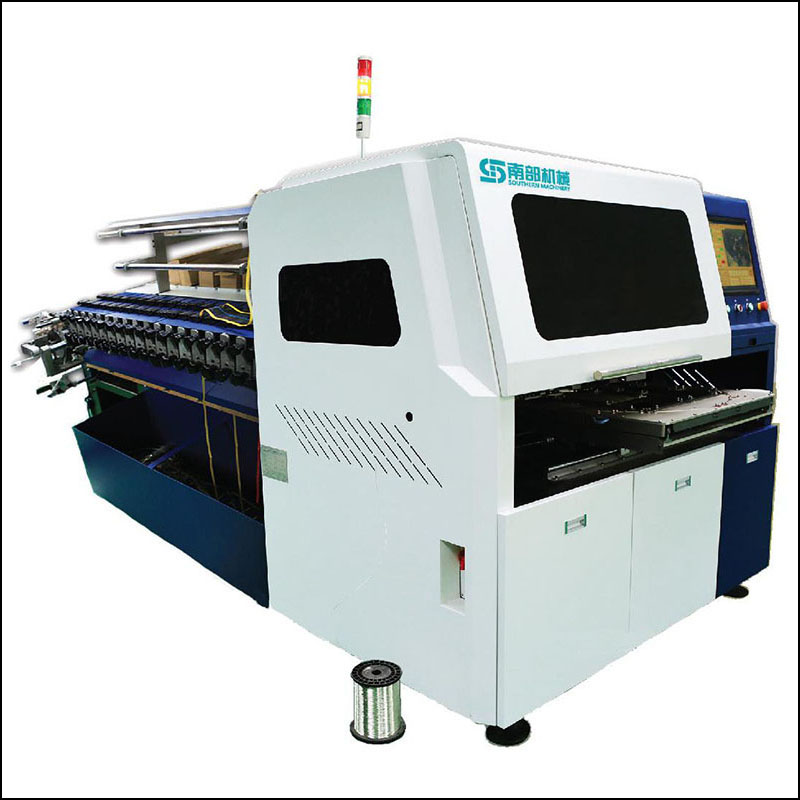
Inside a Horizontal Insertion Machine: What a Dry Run Test Proves Before THT Production
A horizontal insertion machine — also called an axial component inserter — is the THT workhorse that places leaded components flat against the PCB surface instead of standing them upright. If your product mixes axial resistors, diodes and jumper wires into a through-hole assembly, this is the machine that decides whether your line can hit takt time without a wall of manual operators.
This article walks through what a horizontal insertion machine does, why a dry run test is the single most useful acceptance milestone when you commission one, and what to confirm before you sign off on a THT line.
What Is a Horizontal Insertion Machine Used For?
A horizontal insertion machine inserts axial-lead components into a PCB. The component body lies horizontally on the board, and the machine bends and drives the two leads down through the plated holes before a clinch unit secures them for wave soldering.
That is the key difference from a radial insertion machine. Radial (vertical) insertion stands components upright — electrolytic capacitors, LEDs, transistors. Horizontal (axial) insertion handles the flat-lying family:
- Axial resistors
- Axial diodes and rectifiers
- Jumper wires and zero-ohm links
- Other components supplied on axially taped reels with a defined lead span
If you are still hand-inserting these parts, the labour cost per board is easy to underestimate until you measure it. A horizontal inserter converts a repetitive manual station into a programmed, repeatable machine station.
Why a Dry Run Test Matters Before THT Production Ramp-Up
A dry run test is exactly what it sounds like: the machine cycles through its full insertion program — gantry motion, feeder advance, lead forming, insertion stroke, clinch — while you watch for mechanical and sequencing faults, usually with no or reduced component feed and no production pressure.
It matters because a horizontal insertion machine is a mechanical system with many synchronised motions. The dry run is where you catch:
- Gantry and head motion that is not smooth or continuous
- Feeder indexing errors or tape-pitch mismatches
- Lead-span or lead-diameter settings that do not match the actual component
- Board clamping and support problems that would cause mis-insertion
- Program sequence errors before they consume real components
Skipping it and going straight to volume production turns a five-minute adjustment into a scrap pile and a line stoppage. Commissioning discipline is one of the cheapest forms of quality control available to a THT operation.
What to Watch During the Dry Run
- Motion quality. The head should travel through its full X/Y envelope without hesitation, vibration or audible strain.
- Repeat positioning. After a full program cycle, the insertion positions should return to the same coordinates.
- Feeder synchronisation. Every lane should index on cue, with no double-feeds or missed steps.
- Insertion and clinch action. The stroke should be consistent board to board, with no deformation of the PCB or the lead.
- Board handling interface. If the machine loads boards automatically, confirm the transfer and clamping sequence is repeatable.
Verified Specifications: Southern Machinery S4000 Horizontal / Axial Insertion Platform
Southern Machinery's S4000 is an automatic axial component insertion machine built for exactly the horizontal insertion job described above. The published specification:
- Rated insertion speed: up to 20,000 CPH
- Typical actual production speed: approximately 10,000 CPH
- Supported axial lead diameter: 0.3 mm to 0.8 mm
- Supported component lead span: 5 mm to 20 mm
- Component compatibility: resistors, diodes and jumper wires
- Feeder configuration: modular, 5 to 60 feeder stations
- Motion control: full servo-driven system
- Control system: Windows-based software on an industrial computer with EtherCAT bus motion control
- Factory integration: compatible with MES production management systems
- Board handling: automatic PCB loading for production-line integration
- Maintenance access: drawer-style control box
Note the gap between the 20,000 CPH rating and the ~10,000 CPH realistic production figure. Budget your line planning against the realistic number, not the rated one — that is true of every insertion platform on the market, not just this one.
Typical Application Scenarios
Horizontal/axial insertion is a fit wherever a product carries a meaningful axial component count and the volume justifies programming overhead:
- EMS and contract manufacturing. High-mix, repeat-order THT assemblies where manual insertion labour is the throughput ceiling.
- Power supplies and adapters. Axial rectifiers, diodes and jumper wires in dense through-hole sections.
- Home appliances and white goods. Control boards for air conditioners, televisions, microwaves, kettles and induction cookers.
- Automotive electronics. Car audio, vehicle power supplies and body-control boards with mixed SMT/THT content.
- LED and lighting drivers. Driver boards and ballast assemblies with axial components alongside radial parts.
- Industrial control and instrumentation. Boards with low volumes but strict repeatability requirements.
How a Horizontal Insertion Machine Integrates into a Complete PCB Assembly Line
A horizontal inserter is rarely a standalone island. In a full SMT/THT PCB assembly line it sits on a conveyor spine alongside:
- SMT section — stencil printing, SPI, pick-and-place, reflow oven, AOI.
- THT section — axial/horizontal insertion, radial insertion, odd-form insertion, and manual stations for the components that cannot be automated economically.
- Wave soldering — the inserted leads and their clinched joints pass through wave or selective soldering.
- Cleaning — flux residue removal where the process and product class require it.
- Inspection and rework — AOI, X-ray and rework stations.
- Board handling — loaders, unloaders, buffers, turn conveyors and gate conveyors that keep boards moving without manual lifting.
Two integration details decide whether the horizontal inserter helps or hurts your line balance:
- SMEMA-compatible board transfer. Your inserter, conveyors and downstream equipment need to hand boards off without operator intervention. Confirm the interface standard before purchase.
- Line balance, not peak speed. A machine rated at 20,000 CPH is wasted if the upstream printer or downstream wave solder machine cannot keep pace. Size the inserter to the bottleneck.
Key Selection Parameters to Confirm Before You Buy
Do not select a horizontal insertion machine on headline CPH alone. Work through these before committing:
| Parameter | What to confirm |
|---|---|
| Component range | Lead diameter range, lead span range, and whether your specific parts are supported |
| Feeder count and type | How many lanes you need now, and headroom for future products |
| Board size envelope | Maximum and minimum PCB dimensions the machine accepts |
| Insertion accuracy and repeatability | Positioning tolerance for your finest pitch and hole clearance |
| Board handling | Automatic loading, inline SMEMA transfer, or standalone operation |
| Control and data | Recipe management, program storage, MES/Industry 4.0 connectivity |
| Facilities | Power supply, air supply and floor footprint for your bay |
| Support | Spare parts availability, training and local service response |
Only the parameters you can verify in writing should go into your capital request. Where a vendor cannot confirm a figure, treat it as open.
ROI, Quality and Throughput Perspective
The business case for a horizontal insertion machine rests on three measurable shifts:
- Labour conversion. Manual insertion scales linearly with volume — every extra board costs operator minutes. A programmed inserter decouples output from headcount growth.
- Consistency. Machine insertion applies the same stroke and clinch on board one and board ten thousand. Clinch quality directly affects wave solder joint reliability, and inconsistent clinching is a leading cause of downstream defects.
- Rework reduction. Straight, correctly formed leads and repeatable insertion reduce touch-up and rework hours, which is where manual THT assembly quietly loses its margin.
Run the numbers against your own board mix: axial component count per board, current insertion labour minutes, defect and rework rates, and takt time required by your customer. Most operations find the payback case is in labour and rework, not in the headline speed figure.
FAQ
What is a horizontal insertion machine used for?
It inserts axial-lead components — resistors, diodes, jumper wires — flat onto a PCB, forming and driving the leads through the holes so they can be clinched and wave soldered.
What is the difference between horizontal and radial insertion?
Horizontal (axial) insertion lays the component body flat on the board. Radial (vertical) insertion stands the body upright. Most mixed THT boards need both machine types, plus an odd-form inserter for non-standard parts.
What is a dry run test on an insertion machine?
It is a full program cycle run before production — checking gantry motion, feeder indexing, lead forming, insertion and clinch action — to validate the machine and program without consuming production components.
Does a horizontal insertion machine integrate with an existing SMT line?
Yes. Machines with automatic PCB loading and SMEMA-compatible transfer can be placed in line with SMT, wave soldering, cleaning and board handling equipment. Confirm the interface and line balance during selection.
How do I choose between rated and real production speed?
Plan against realistic production speed, not the rated peak. Southern Machinery publishes both figures for its S4000 axial insertion platform — up to 20,000 CPH rated and approximately 10,000 CPH in typical production.
What support does Southern Machinery provide?
Southern Machinery supplies SMT/THT PCB assembly automation equipment with global support, spare parts, sub-assembly and retrofit kits, repair services, operator training and machine overhaul.
Contact Southern Machinery for Configuration Advice
Southern Machinery (Shenzhen Southern Machinery Sales And Service Co., Ltd) has been building and supporting SMT and THT PCB assembly automation equipment since 2011, serving 237+ customers worldwide. Beyond the horizontal/axial insertion platform, the range covers radial and odd-form insertion, wave soldering, board handling, inspection, cleaning and material management — so line balance can be planned end to end.
- Talk to Jason Wu — jasonwu@smthelp.com | +86 13602562576
- Browse catalogues: file.autoinsertion.com
- See machine photos: ph.smthelp.com
- Product information: www.smthelp.com
Watch the horizontal insertion machine dry run test in the video above, then send us your component list and board dimensions — we will confirm the feeder configuration and line interface that fit your assembly.
Comments